7% Pension Increase in Pakistan: Full Eligibility, Calculation & New Rules

7% Pension Increase in Pakistan: Full Eligibility, Calculation & New Rules

7% Pension Increase in Pakistan

This week, there has been good news for retired government employees of Pakistan. The good news is that the government has officially increased the pension of government employees, including military officers, as well as those in the civil forces, by seven percent. The aim of this is clear: to balance the rising costs of living. This announcement will be implemented in Pakistan from July 1. If you have officially retired or your family is about to retire, then the news is very good for you because it will also be known as your monthly income.

If you are retired or about to retire, or if someone in your family has retired, then go and tell them today that the Ministry of Finance has announced you. Today, in this article, we will learn about all the things that are necessary for a pensioner and what benefits those who are going to receive a pension will get from the signs that are being observed today. Stay connected with us for all the information and get information.

What the Ministry of Finance Actually Announced

The Ministry of Finance issued an Office Official document confirming a 7 percent increase in the baseline pension for federal civil pensioners. This includes civilians whose pensions are paid from the Defence Estimates, as well as retired personnel from the armed forces and civil armed forces. The increase takes effect from July 1, 2026, and applies uniformly across these categories. What makes this announcement distinct from earlier increases is the method used to calculate it.

Instead of applying the raise to the gross or net pension amount, the government is using the baseline pension as the reference point. This baseline pension itself was set through earlier notifications issued on January 1, 2025, July 7, 2025, and August 5, 2025. So the 7 percent hike is layered on top of a figure that already reflects previous adjustments, not a fresh recalculation from scratch.

7% Pension Increase in Pakistan: Full Eligibility, Calculation & New Rules

Who Qualifies for the New 7% Increase?

This isn’t a narrow policy limited to one group of retirees. The Office Memorandum is fairly broad in scope, and it’s worth understanding exactly who falls under it before assuming you do or don’t qualify.

  • Federal civil pensioners are retired government employees whose pensions come from the federal budget
  • Civilians paid from Defence Estimates, non-military staff whose salaries and pensions are drawn from defence-related budgets
  • Retired armed forces personnel, soldiers, sailors, and airmen who have completed their service
  • Civil armed forces personnel retire from forces like the Frontier Constabulary, Rangers, and similar organizations
  • Employees retiring on or after July 1, 2026 new retirees are automatically covered under the revised structure, not just existing pensioners

One important detail here: pensioners who retire on or after July 1, 2026, won’t miss out on earlier increases either. The Ministry of Finance has clarified that the 15 percent pension increase granted back in July 2022, along with the 7 percent increase approved in July 2025, will continue to apply to these new retirees as well. So the benefits stack rather than reset.

Karachi Board 12th Class Pre-Medical Result 2026: How to Check by Roll Number, SMS & App

How Family Pensions and Special Schemes Are Affected

Pension increases don’t just apply to the person who served — they often extend to family members who depend on that pension after the pensioner’s death. This latest notification makes sure that coverage stays consistent.

The 7 percent increase will be admissible on family pensions granted under the Pension-cum-Gratuity Scheme, 1954, and the Liberalised Pension Rules, 1977, as amended over the years. It will also apply to pensions sanctioned under the Central Civil Services (Extraordinary Pension) Rules, which typically cover cases involving death or disability during service. Additionally, the Compassionate Allowance granted under CSR-353 will also see the same 7 percent bump.

This matters a lot for widows, children, and other dependents who rely on family pensions as their primary source of income. Without this kind of clause, increases could easily get limited to the original pensioner only, leaving families to deal with inflation on a fixed amount. By explicitly including these schemes, the government has closed that gap for this cycle at least.

How the Baseline Pension Calculation Works

Understanding the “baseline pension” concept is key to knowing how much extra money pensioners will actually see. It’s not as complicated as it sounds, but it does require a quick look at how earlier notifications set things up.

The table below summarizes the key notifications that together form the baseline pension structure being used for this increase.

Notification DateWhat It Established
January 1, 2025Initial baseline pension framework for federal pensioners
July 7, 20257% increase applied, feeding into the baseline calculation
August 5, 2025Further refinement of baseline pension figures
July 1, 2026New 7% increase applied on top of the established baseline

Essentially, the government has moved toward a system where each new increase builds on a fixed reference point rather than recalculating from the original gross pension every single time. This is meant to simplify administration and reduce discrepancies between different pension offices when processing payments.

What’s Excluded From This Increase

Not every pension-related payment gets the 7 percent bump. The Office Memorandum is specific about a couple of exclusions, and pensioners should know about these so there’s no confusion when payments are processed.

  • Special Additional Pension: The amount given instead of the pre-retirement Orderly Allowance is not covered by this increase
  • Monetised value of a driver or orderly, this compensation, given instead of providing an actual driver or orderly, is also excluded from the 7 percent raise

These exclusions aren’t new or unusual; similar carve-outs have appeared in past pension notifications too. The logic is that these particular allowances are treated as separate compensatory payments rather than part of the core pension, so general pension increases don’t automatically apply to them.

How Shared Pensions Between Governments Are Handled

Some pensioners have a slightly more complex situation where their pension liability is shared between the federal government and another government entity, such as a provincial government. This typically happens due to service transfers or joint appointments during a person’s career.

According to the memorandum, if the gross pension sanctioned by the federal government is shared with another government under the rules in Part IV of Appendix III of the Accounts Code, Volume I, then the increase amount will also be apportioned between the two governments on a proportionate basis. In simple terms, if 60 percent of a pension was originally being paid by the federal government and 40 percent by a provincial government, the new increase amount will likely follow that same 60-40 split.

This apportionment rule exists mainly for accounting accuracy between government departments. For the pensioner themselves, the total amount received shouldn’t change based on how it’s split administratively it simply determines which government budget the money is drawn from.

Vlektra Velocity 180 SE Installment Plans in Pakistan: Monthly Payments, Down Payment Details

Official Notification

7% Pension Increase — Effective July 1, 2026

Ministry of Finance, Government of Pakistan

7%Baseline Pension Hike
Jul 1Effective Date
2026Applicable Year
  • Federal civil pensioners
  • Civilians paid from Defence Estimates
  • Retired armed forces personnel
  • Civil armed forces personnel
  • Family pensioners (1954 & 1977 schemes)
  • Compassionate Allowance (CSR-353)
  • Employees retiring on/after Jul 1, 2026
  • Special Additional Pension (in lieu of Orderly Allowance)
  • Monetised value of a driver or orderly

Increase applies to baseline pension, not gross/net pension. Shared pensions are apportioned proportionately between concerned governments.

Quick Summary of Who Gets What

Here’s a simple table breaking down how the increase applies across different pensioner categories, based on the details in the Office Memorandum.

Pensioner Category7% Increase Applicable?Notes
Federal civil pensionersYesApplied on baseline pension
Civilians paid from Defence EstimatesYesSame baseline method used
Retired armed forces personnelYesIncludes all service branches
Civil armed forces personnelYesFrontier Constabulary, Rangers, etc.
Family pensioners (1954/1977 schemes)YesWidows and dependents covered
Compassionate Allowance (CSR-353)YesSame rate applies
Special Additional Pension (Orderly Allowance)NoExplicitly excluded
Monetised driver/orderly valueNoExplicitly excluded

Final Thoughts

This 7 percent pension increase is a welcome update for retired federal employees, armed forces personnel, and their families, especially with inflation continuing to affect household budgets. The key things to remember are that the increase is calculated on the baseline pension rather than gross pension, it covers most pension categories, including family pensions, and it excludes a couple of specific allowances tied to orderly and driver compensation. If you’re unsure how this applies to your specific pension, it’s worth checking directly with your pension disbursing office or the Accountant General’s office, since individual calculations can vary based on your service record and retirement date.

Frequently Asked Questions

1. When does the 7% pension increase take effect? The increase is effective from July 1, 2026, as notified by the Ministry of Finance. It applies to both existing pensioners and those retiring on or after this date.

2. Is the increase calculated on gross pension or baseline pension? The 7 percent increase is calculated on the baseline pension, not the gross or net pension amount. This baseline was established through earlier 2025 notifications.

3. Do family pensioners also get the 7% increase? Yes, family pensions granted under the 1954 Pension-cum-Gratuity Scheme and the 1977 Liberalised Pension Rules are included. Widows and dependents receiving these pensions will see the same increase.

4. Will new retirees in 2026 also get earlier pension increases like the 2022 hike? Yes, employees retiring on or after July 1, 2026, remain eligible for the 15 percent increase from 2022 and the 7 percent increase from 2025. These earlier benefits are not lost for new retirees.

5. What payments are excluded from this pension increase? The Special Additional Pension given in place of the pre-retirement Orderly Allowance, and the monetised value of a driver or orderly, are both excluded from the 7 percent raise.

New MG ZS Price in Pakistan 2026: Hybrid+ & Petrol Variants

Karachi Board 12th Class Pre-Medical Result 2026: How to Check by Roll Number, SMS & App

Karachi Board 12th Class Pre-Medical Result 2026: How to Check by Roll Number, SMS & App

Karachi Board 12th Class Pre-Medical Result

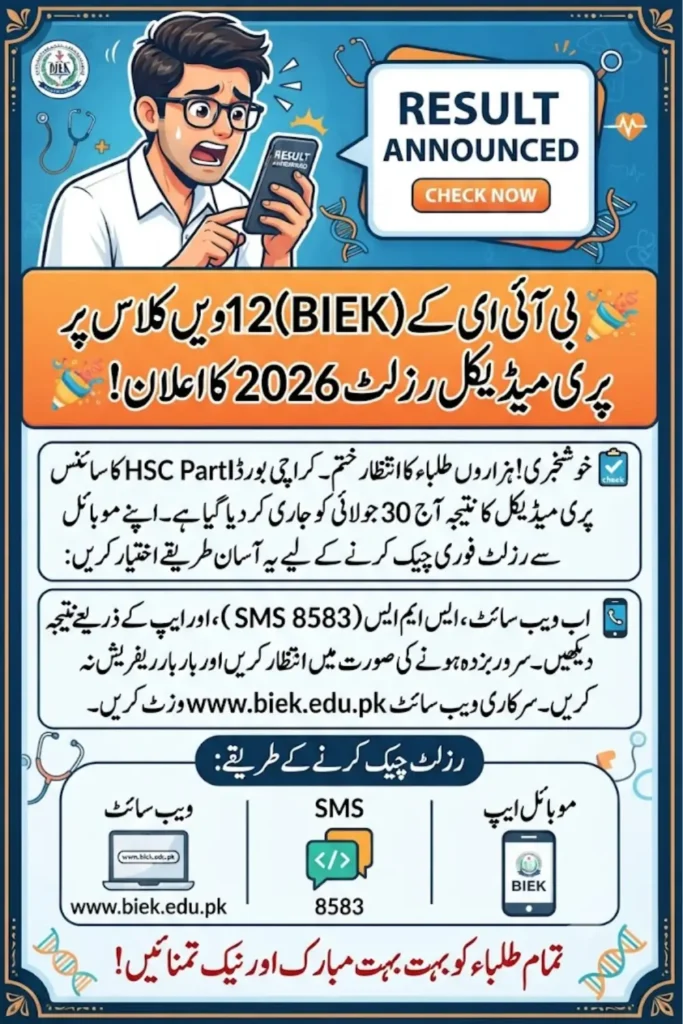
Waiting for your 12th class result can feel like the longest day of the year, and for Pre-Medical students of the Board of Intermediate Education Karachi, that day has finally arrived. The BIEK 12th Class Science Pre-Medical Result 2026 for the HSC Part II Annual Examination is being announced, and thousands of students across Karachi are refreshing their phones and laptops to see how they did.

If you appeared in this year’s Pre-Medical exams under BIEK, this guide will walk you through every single way you can check your result today. From the official website to SMS and the mobile app, we have covered all the options so you don’t have to search around while your nerves are already on edge.

BIEK · Board of Intermediate Education Karachi

12th Class Pre-Medical Result 2026

HSC Part II Annual Examination · Science Pre-Medical Group

Result Day: Thursday, July 30 — exact announcement time not yet confirmed by BIEK

Please enter a valid roll number before continuing.

Your roll number is only used locally in this browser to build the SMS text and result link below. It is never stored or sent anywhere by this widget.

Check on the official website

The most reliable source, straight from BIEK’s own result portal.

  1. 1Open the official BIEK results section
  2. 2Select “HSC Part II Annual Examination 2026”
  3. 3Choose “Science Pre-Medical Group”
  4. 4Enter roll number (shown here once typed above) and submit
Open BIEK Result Portal →

Check by SMS, no internet needed

Send this text to 8583 from your registered mobile number.

BIEK <your roll number>

Reply times can be slower than usual if many students send requests at once. Avoid sending the same message twice.

Check on the BIEK mobile app

A handy backup when the website is busy with heavy traffic.

  1. 1Install the official BIEK Android app
  2. 2Open the “Results” section inside the app
  3. 3Enter your roll number to view the result
Find the App via BIEK Website →

Browse the result gazette

Lists roll numbers of successful candidates, pass percentage, and position holders.

View Official Gazette →

When Is the BIEK Pre-Medical Result 2026 Being Announced?

The Board of Intermediate Education Karachi has confirmed that the 12th Class Science Pre-Medical Group result for the HSC Part II Annual Examinations 2026 will be declared on Thursday, July 30. This announcement brings relief to a huge number of students who sat for their papers earlier in the year and have been waiting anxiously since then.

What the board has not shared yet is the exact time of the announcement. In past years, BIEK has usually released results sometime around midday or early afternoon, but there is no official confirmation on the clock time for this year. Students are advised to keep checking the official BIEK website and social media pages through the day rather than assuming a fixed hour, since boards often adjust timing based on last-minute preparations or gazette approvals.

New MG ZS Price in Pakistan 2026: Hybrid+ & Petrol Variants

Karachi Board 12th Class Pre-Medical Result 2026: How to Check by Roll Number, SMS & App

Why This Result Matters So Much

For Pre-Medical students, this result is not just a report card, it is often the deciding factor for admission into medical and dental colleges. Your HSC Part II marks, combined with your MDCAT score, determine your eligibility for MBBS and BDS programs across Sindh. That is exactly why so many students and parents are anxious about today’s announcement.

It is also worth remembering that this result reflects two years of hard work, not just the final exam. Students who have consistently performed well throughout their intermediate years usually see that effort reflected in their final Part II score. If your result today feels lower than expected, know that the rechecking process exists for a reason, and we will touch on that later in this article.

How to Check Your BIEK Result Online

Checking your result through the official website remains the most reliable and widely used method. Since it comes directly from BIEK’s own system, there is no risk of receiving incorrect or outdated information, unlike some third-party websites that sometimes post unverified figures too early.

Here is exactly how you can check your Pre-Medical result online:

  • Visit the official website at www.biek.edu.pk
  • Click on the Results section on the homepage
  • Select HSC Part II Annual Examination 2026
  • Choose the Science Pre-Medical Group from the list
  • Enter your roll number carefully in the given field
  • Click the search or submit button to view your result

Once your result appears on the screen, take a screenshot or download it right away for your own record. This online copy is provisional and meant for temporary use only. Your actual, original marksheet will be issued later through your respective college, so you will still need to visit your institution to collect the official document.

Common Mistakes Students Make While Checking Online

A lot of students end up frustrated on result day simply because of small, avoidable errors. Double-checking a few basics before you panic can save you a lot of stress.

  • Entering the wrong roll number format, such as adding extra spaces or missing digits
  • Trying to access the website during peak traffic hours when servers are slow
  • Refreshing the page repeatedly instead of waiting a few minutes for it to load
  • Using an outdated browser that may not display the result page properly
  • Confusing the Pre-Medical group link with Pre-Engineering or Commerce group links

If the website seems slow or unresponsive, it is usually because thousands of students are trying to access it at the same time. Waiting ten to fifteen minutes and trying again is often more effective than repeatedly refreshing the page.

Check Your Result Through SMS

Not everyone has stable internet access on result day, and BIEK understands that. The board offers an SMS service that lets you check your result directly from your mobile phone, no internet connection required.

To use this service, open your messaging app and type the word BIEK, leave a single space, and then enter your roll number. Send this message to 8583. Within a short while, you should receive a reply containing a summary of your result, including your marks and overall status.

Keep in mind that this SMS service can slow down significantly when a large number of students send requests around the same time, which is very likely to happen on result day. If your reply doesn’t arrive immediately, wait a bit and avoid sending the same message multiple times, as this can add to the congestion and delay things further for everyone.

Other Ways to Access Your Result

Besides the website and SMS, BIEK also provides a couple of additional channels that make checking your result more convenient depending on your situation.

Using the BIEK Mobile App

For students who prefer using their smartphones over a browser, the result may also be available through the official BIEK Android application. Simply install the app from a trusted source, open the results section within it, and enter your roll number to view your marks. This can be a handy backup option if the website is running slow due to heavy traffic.

Since the app pulls data directly from BIEK’s own servers, the information you see should match exactly what appears on the official website. It’s a good idea to have this app installed ahead of time on future result days so you’re not scrambling to download it at the last minute.

The Result Gazette

Along with the individual result checking options, BIEK is also expected to issue the complete Pre-Medical result gazette. This gazette is a detailed document that lists the roll numbers of all successful candidates, group-wise statistics, the overall pass percentage, and details of position holders.

The gazette is particularly useful for colleges, teachers, and parents who want to see the bigger picture, such as how the entire batch performed this year compared to previous years. Students who want to verify their own status against the official record can also cross-check their roll number within this document once it is released.

Vlektra Velocity 180 SE Installment Plans in Pakistan: Monthly Payments, Down Payment Details

Quick Reference: Result Checking Methods

MethodWhat You NeedBest For
Official Website (biek.edu.pk)Roll number, internet connectionDetailed result with subject-wise marks
SMS to 8583Roll number, mobile signalStudents without reliable internet
BIEK Mobile AppRoll number, app installedSmartphone users, backup option
Result GazetteNone, browse by roll numberVerifying against official records

What to Do After You See Your Result

Once your result is out, there are a few practical steps worth keeping in mind, especially if you plan to pursue medical or dental studies.

StepActionWhy It Matters
1Screenshot or download the online resultTemporary proof until your official marksheet arrives
2Collect original marksheet from your collegeRequired for admissions and future record keeping
3Check eligibility for rechecking, if neededCorrects totaling or marking errors, not re-evaluation
4Prepare MDCAT-related documentsNeeded alongside HSC marks for medical college admission
5Follow only official BIEK channels for updatesAvoids confusion from unverified social media posts

A Word on Unofficial Information

Result day tends to bring out a flood of information on social media, some of it accurate and a lot of it not. Names of position holders and pass percentage figures often circulate on WhatsApp groups and Facebook pages long before the board confirms anything officially.

It is best to treat any such information as unconfirmed until it appears on the official BIEK website, the app, or verified social media pages linked to the board. Relying only on official sources protects you from unnecessary confusion, especially when it comes to something as important as your academic record.

Final Thoughts

Result day is stressful no matter how prepared you feel, but having a clear plan for checking your result makes the process much smoother. Whether you choose the official website, the SMS service, or the mobile app, make sure you keep your roll number handy and stay patient if servers are slow due to heavy traffic.

Remember that this provisional result is just the first step. Your original marksheet will follow through your college, and if anything seems off, the rechecking process is there to help. Good luck with your results, and take the next step in your medical education journey with confidence.

Frequently Asked Questions

1. When will the BIEK 12th Pre-Medical Result 2026 be announced? The result is being declared on Thursday, July 30, though the exact time of announcement has not been officially confirmed by the board yet.

2. How can I check my BIEK result without internet access? You can send an SMS with the word BIEK, a space, and your roll number to 8583 to receive your result summary directly on your phone.

3. Is the online result the final official document? No, the online result is provisional and meant for temporary use only. Your original marksheet will be issued through your college later.

4. What should I do if my result seems incorrect? You can apply for rechecking, which reviews marking and totaling errors only, not a full re-evaluation of your answers.

5. Where can I find the list of position holders? Position holder details are included in the official result gazette released by BIEK, so avoid trusting unverified names shared on social media.

Inter Part-II Practical Exams 2026: Punjab Boards Introduce New Centralized Marking System

Vlektra Velocity 180 SE Installment Plans in Pakistan: Monthly Payments, Down Payment Details

Vlektra Velocity 180 SE Installment Plans in Pakistan: Monthly Payments, Down Payment Details

Vlektra Velocity 180 SE Installment Plans in Pakistan

Electric bikes have been slowly gaining ground in Pakistan, but the upfront cost has always been the biggest hurdle for most buyers. Vlektra is trying to change that with a new financing option for its Velocity 180 SE, one that lets riders spread the cost over time without paying any extra markup.

This move comes at a time when petrol prices remain unpredictable and more commuters are actively looking for cheaper ways to get around. If you’ve been eyeing an electric bike but couldn’t justify the one-time payment, this installment plan might be exactly what tips the decision in your favor. Here’s everything you need to know before applying.

Vlektra Velocity 180 SE — 0% Markup Installment Dashboard

Official financing details · Electric scooter

Updated:2026

Installment Plan Options

12-Month Plan

Rs. 25,300 / month
Down payment: Rs. 115,000
0% markup

18-Month Plan

Rs. 12,200 / month
Down payment: Rs. 200,000
0% markup

Full Installment Breakdown

Plan Duration Down Payment Monthly Installment Markup
12 Months Rs. 115,000 Rs. 25,300 0%
18 Months Rs. 200,000 Rs. 12,200 0%
24 Months Rs. 245,000 Rs. 7,300 0%

Before You Apply

  • Insurance and vehicle registration charges are not included in the monthly installment figures shown above.
  • The higher your down payment, the lower your monthly installment — plan your budget around total cost, not just the monthly figure.
  • Ask Vlektra about early settlement options in case you want to pay off the balance before the plan ends.
  • Keep your CNIC and proof of income ready, as these are commonly required for financing applications in Pakistan.

Quick Installment Calculator

Down payment: Rs. 245,000
Monthly installment: Rs. 7,300
Total of all monthly installments: Rs. 175,200
Estimated total paid (down payment + installments): Rs. 420,200

Estimate excludes insurance and registration charges. Final figures may vary — confirm with Vlektra before applying.

What Is the Vlektra Velocity 180 SE Installment Plan

Vlektra has introduced a 0% mark-up installment plan for its Velocity 180 SE electric scooter, allowing customers to purchase the model through flexible payment options. The key word here is “0% mark-up” meaning you don’t pay any interest or hidden financing fee on top of the bike’s actual price, which is rare in Pakistan’s consumer financing space.

According to Vlektra, buyers can finance the Velocity 180 SE for up to 24 months, with monthly installments starting at Rs. 7,300 under the company’s financing program. That’s a low enough monthly commitment that it opens the door for a much wider range of buyers, including students, delivery riders, and daily office commuters who couldn’t previously afford the full upfront price of an electric bike.

New MG ZS Price in Pakistan 2026: Hybrid+ & Petrol Variants

Vlektra Velocity 180 SE Installment Plans in Pakistan: Monthly Payments, Down Payment Details

Payment Plans and Monthly Installment Breakdown

The installment plan offers multiple payment options. Customers can pay Rs. 25,300 per month with a Rs. 115,000 down payment over 12 months, Rs. 12,200 per month with a Rs. 200,000 down payment over 18 months, or Rs. 7,300 per month with a Rs. 245,000 down payment over 24 months. This structure gives buyers real flexibility based on how much they can afford upfront versus how much they’d rather pay monthly.

Notice the pattern here: the higher your down payment, the lower your monthly installment, and the longer your repayment period. This is standard practice in installment financing, but it’s worth pointing out because it means your choice isn’t just about affordability today it’s also about how much financial breathing room you want each month going forward.

Plan DurationDown PaymentMonthly Installment
12 MonthsRs. 115,000Rs. 25,300
18 MonthsRs. 200,000Rs. 12,200
24 MonthsRs. 245,000Rs. 7,300

Understanding the 0% Markup Structure

A 0% markup plan sounds simple, but it’s worth understanding exactly what it means in practical terms. The company said the financing program carries 0% mark-up. However, insurance and vehicle registration charges are not included in the installment plan. So while you won’t be paying interest on the bike’s price itself, you still need to budget separately for these two additional costs.

This distinction matters because a lot of buyers assume “0% markup” means the total amount they pay will be identical to walking in and paying cash for the bike. That’s true for the bike’s price, but insurance and registration are standard costs that apply regardless of how you’re paying, whether in installments or upfront. It’s a good idea to ask Vlektra directly for an estimate of these charges before signing up, so there are no surprises later.

Why This Matters for Electric Mobility Adoption in Pakistan

Vlektra stated that the financing option aims to make the Velocity 180 SE more accessible for buyers looking to switch to electric mobility. This is part of a broader trend where electric bike makers are trying to compete not just on specs, but on how easy they make the buying process. A bike with great range and performance doesn’t help much if the upfront cost keeps people locked into petrol bikes.

The company also highlighted that the monthly installment can be lower than what many riders spend on petrol each month. That’s a compelling pitch, especially for daily commuters who track their fuel spending closely. If your monthly petrol bill is already close to or higher than Rs. 7,300, then technically you could be paying off an electric bike for roughly the same amount you’re currently spending just to keep a petrol bike running.

Things to Check Before You Apply

Before jumping into any installment plan, it helps to go in with a clear picture of what you’re committing to. A few practical points worth considering:

  • Confirm the exact insurance and registration costs separately, since these aren’t part of the advertised monthly figure and can add a meaningful amount to your total spend.
  • Ask about early settlement some financing plans allow you to pay off the remaining balance early, while others may not, so it’s worth clarifying upfront.
  • Compare the total amount paid across all three plans (down payment plus all monthly installments) to see which option actually costs you the least overall, not just which has the lowest monthly figure.
  • Check the documentation required for the application, such as CNIC copies, proof of income, or address verification, so you’re not caught off guard mid-process.

How to Apply for the Installment Plan

Getting started with the application process is fairly straightforward on paper. Customers interested in the financing plan can apply through Vlektra’s official installment application portal or contact the company for additional details. The portal typically walks you through selecting your preferred plan duration and calculating your down payment and monthly installment based on your choice.

Since this is a newly introduced plan specifically for the Velocity 180 SE, it’s worth reaching out to Vlektra’s customer support directly if you have questions that the online portal doesn’t answer, such as processing time, required documents, or delivery timelines once your application is approved. Getting these details confirmed in writing before you commit will save you from any confusion down the line.

Maryam Nawaz Ration Card Programme Expanded: Eligibility, Benefits & Latest 2026 Update

Vlektra Velocity 180 SE: Quick Snapshot

Here’s a simple summary table to help you compare all three financing options side by side, along with what stays constant across all of them.

FeatureDetails
Markup Rate0% (interest-free)
Financing DurationUp to 24 months
Lowest Monthly InstallmentRs. 7,300 (24-month plan)
Highest Monthly InstallmentRs. 25,300 (12-month plan)
Excluded CostsInsurance, vehicle registration
Application MethodOnline portal or direct contact with Vlektra

Is This Installment Plan Worth It for You

Whether this plan makes sense for you really depends on your current spending habits and financial situation. If you’re currently paying a significant amount on petrol every month and have some savings set aside for a down payment, the 24-month plan at Rs. 7,300 per month is likely the most budget-friendly route, especially since it roughly matches or beats typical fuel costs.

On the other hand, if you’d rather own the bike outright sooner and can manage a higher monthly payment, the 12-month plan gets you there faster with less total commitment time, even though the monthly amount is noticeably higher. There’s no universally “right” choice here it comes down to weighing your available down payment against how much flexibility you want in your monthly budget over the next one to two years.

Conclusion

Vlektra’s 0% markup installment plan for the Velocity 180 SE is a practical step toward making electric bikes genuinely accessible in Pakistan, rather than just an aspirational purchase. With monthly installments starting as low as Rs. 7,300, and no interest tacked on top, it’s a reasonable option for anyone tired of unpredictable petrol costs. Just remember to factor in insurance and registration separately, and pick the plan duration that actually fits your monthly budget, not just the one with the lowest sticker payment.

Frequently Asked Questions

Q1: What is the lowest monthly installment for the Vlektra Velocity 180 SE?
The lowest monthly installment is Rs. 7,300 under the 24-month plan, which requires a down payment of Rs. 245,000.

Q2: Does the installment plan include insurance and registration?
No, insurance and vehicle registration charges are not included in the installment plan and must be paid separately.

Q3: Is there any interest or markup on this financing plan?
No, Vlektra has confirmed the plan carries a 0% mark-up, meaning no extra interest is added to the bike’s price.

Q4: How many installment duration options does Vlektra offer?
Vlektra offers three duration options: 12 months, 18 months, and 24 months, each with a different down payment and monthly installment.

Q5: How can I apply for the Velocity 180 SE installment plan?
You can apply through Vlektra’s official installment application portal or by contacting the company directly for more details.

Inter Part-II Practical Exams 2026: Punjab Boards Introduce New Centralized Marking System

New MG ZS Price in Pakistan 2026: Hybrid+ & Petrol Variants

New MG ZS Price in Pakistan 2026: Hybrid+ & Petrol Variants

New MG ZS Price in Pakistan

MG Motor Pakistan has just rolled out something buyers have been waiting for the all-new second-generation ZS. This isn’t a minor facelift. It’s a full redesign that brings hybrid technology to a segment that was, until now, dominated by regular petrol engines. For a market where fuel prices keep climbing, that’s a big deal.

What makes this launch interesting is choice. MG isn’t forcing anyone into hybrid tech if they’re not ready for it. Instead, buyers get three variants to pick from one petrol and two Hybrid+ options each aimed at a slightly different type of buyer. Let’s break down everything you need to know before you head to a dealership.

MG ZS 2026 — Pakistan Price & Specs Dashboard

Official launch data · Hybrid+ & Petrol variants

Updated: 2026

Variant Lineup & Pricing

ZS Vibe

Rs. 6,599,000
Petrol · 8-speed CVT
80 kW / 142 Nm

ZS Hybrid+ Excite

Rs. 7,099,000
Hybrid+ system
158 kW / 465 Nm

Powertrain Specifications

Powertrain Power Torque Transmission Claimed Range
Hybrid+ (Excite / Essence) 158 kW 465 Nm Hybrid system Up to 940 km
Petrol (Vibe) 80 kW 142 Nm 8-speed CVT Not specified

Exterior Colors & Interior Themes

York White
Cosmic Silver
Clever Grey
Flare Red
Black Pearl

Interior Themes

Dark Theme
Light Theme

Booking & Balance Calculator

Booking amount: Rs. 1,200,000
Balance on delivery: Rs. 5,399,000

What’s New About the 2026 MG ZS

The first-generation ZS arrived in Pakistan back in 2019 as a 1.5-liter combustion-engine crossover, and MG later introduced an electric variant as well. The 2026 model marks a proper second generation, not just a mid-life update. It brings a redesigned exterior, a refreshed cabin, and most importantly a hybrid powertrain option for the first time in this model line.

This matters because the subcompact SUV segment in Pakistan has been heating up fast. Buyers today aren’t just comparing looks and price; they’re comparing running costs, fuel economy, and long-term value. By adding Hybrid+ technology alongside a traditional petrol engine, MG is trying to cover both types of buyers in one showroom visit the ones who want a proven petrol setup and the ones ready to switch to hybrid for better mileage.

Chery Tiggo 7 PHEV Pakistan: 120+ SUVs Delivered, 200 More on the Way

New MG ZS Price in Pakistan 2026: Hybrid+ & Petrol Variants

Engine and Powertrain Options Explained

The lineup gives you a genuine choice between two very different driving experiences. The Hybrid+ models produce 158 kW of power and 465 Nm of torque, numbers that put them well ahead of typical petrol-only crossovers in this price range. MG also claims a driving range of up to 940 kilometers on the hybrid setup, which if it holds up in real-world Pakistani driving conditions would be a strong selling point for anyone doing long intercity trips or heavy daily commutes.

The petrol variant, meanwhile, sticks to a more conventional formula. It delivers 80 kW of power and 142 Nm of torque, paired with an 8-speed CVT transmission. It’s less powerful on paper, but it’s also the cheaper, simpler option for buyers who’d rather avoid hybrid components altogether whether that’s due to servicing concerns, resale value questions, or just personal preference.

PowertrainPower OutputTorqueTransmissionClaimed Range
Hybrid+158 kW465 NmHybrid systemUp to 940 km
Petrol (Vibe)80 kW142 Nm8-speed CVTNot specified

MG ZS Price in Pakistan 2026

Pricing is where most buyers will start their decision-making, and MG has structured it in a fairly straightforward step-up format. MG Motor Pakistan has launched the ZS in three variants: the petrol-powered ZS Vibe, the ZS Hybrid+ Excite, and the range-topping ZS Hybrid+ Essence.

The entry-level MG ZS Vibe, running on the gasoline engine, is priced at Rs. 6,599,000. Moving up, the MG ZS Hybrid+ Excite comes in at Rs. 7,099,000, and the range-topping MG ZS Hybrid+ Essence tops the lineup at Rs. 7,499,000. That’s roughly a Rs. 900,000 gap between the cheapest and most expensive trims, which gives buyers a fairly wide window to pick based on budget rather than just features.

VariantPowertrainPrice (PKR)
MG ZS VibePetrol6,599,000
MG ZS Hybrid+ ExciteHybrid+7,099,000
MG ZS Hybrid+ EssenceHybrid+7,499,000

It’s worth noting that some early reports referred to this as limited-time introductory pricing, so buyers planning to book later in the year should double-check current rates with an MG dealership before finalizing a decision.

Booking Process and What to Expect

Getting your hands on the new ZS starts with a booking, and MG has kept the process simple on paper, even if the amount required is fairly substantial. Bookings for the all-new MG ZS are now open with a booking amount of Rs. 1.2 million, which is a serious commitment compared to some competitors in the segment.

Here’s what buyers should keep in mind before booking:

  • The booking amount is a significant chunk of the total price, so make sure your variant and color choice are finalized before paying.
  • Delivery timelines for new launches in Pakistan often stretch out due to demand, so ask your dealer for a realistic delivery window, not just a rough estimate.
  • Since this is a fresh launch, early units may see longer waiting periods compared to bookings made a few months down the line.
  • Confirm whether the Rs. 1.2 million is fully refundable in case you change your mind before delivery.

FBISE 9th & 10th Class Result 2026 Check by Roll Number, SMS & New Grading System

Colors and Interior Choices

Beyond powertrains and pricing, MG has also focused on giving buyers a decent amount of personalization without overwhelming them with options. The exterior colors are a mix of practical and bold choices, which should appeal to a wide range of tastes across Pakistan’s car-buying audience.

MG will offer the SUV in five exterior colors: York White, Cosmic Silver, Clever Grey, Flare Red, and Black Pearl. On the inside, buyers aren’t stuck with just one look either — buyers can also choose between dark and light interior themes, letting them match the cabin feel to their personal preference or climate concerns (dark interiors tend to show less dust, while light interiors can feel cooler in Pakistan’s hot summers).

How the ZS Stacks Up Against Rivals

No SUV launch happens in a vacuum, and the new ZS is entering a genuinely crowded field. On the hybrid side, it’s going up against some serious names already established in Pakistan’s market. The hybrid variants go up against other subcompact hybrid SUVs in Pakistan, including the Jaecoo J5, Haval Jolion, Honda HR-V e:HEV, Suzuki Fronx Mild Hybrid and Toyota Corolla Cross HEV.

The petrol variant has its own set of competitors too, and here the fight is more about price-to-features ratio than powertrain technology. The non-hybrid trim competes in the regular subcompact SUV space, with the Peugeot 2008, non-hybrid variants of the Honda HR-V, Suzuki Fronx, Toyota Corolla Cross, and Haval Jolion as rivals. One of the closest direct hybrid rivals price-wise is the Jaecoo J5 HEV, which is currently priced at around Rs. 7.7 million putting it just above the top-spec ZS Hybrid+ Essence.

A few things buyers should factor into any comparison shopping:

  • Compare real-world fuel economy claims, not just brochure numbers, since hybrid systems perform differently depending on driving style and traffic conditions.
  • Check after-sales service network coverage in your city, since newer entrants sometimes have fewer service centers than established brands.
  • Look at resale value trends for the brand in your specific city, as this varies significantly across Pakistan.
  • Factor in spare parts availability and cost, especially for hybrid-specific components like batteries and motors.

Should You Book the New MG ZS?

Deciding between the petrol and hybrid versions really comes down to how you use your car day to day. If most of your driving is short city trips, or if you’re wary of newer hybrid technology and its long-term maintenance costs, the ZS Vibe at Rs. 6,599,000 gives you a lower entry price with a simpler mechanical setup.

On the other hand, if you regularly drive long distances or want better fuel efficiency without switching to a full EV, the Hybrid+ variants make a stronger case especially with that claimed 940 km range. The price difference between the Excite and Essence trims (Rs. 400,000) is something buyers should weigh carefully based on which extra features actually matter to them, since MG hasn’t been shy about loading the top trim with more equipment to justify the price jump.

Conclusion

The all-new MG ZS gives Pakistani buyers something they haven’t really had before in this segment: a genuine choice between petrol and hybrid power under one nameplate, at a price point that’s competitive against established rivals. Whether the Hybrid+ technology proves itself with real-world fuel savings, and whether MG can keep up with service and parts demand, will likely shape how this launch is remembered a year from now. For now, though, it’s a strong, well-rounded entry into a segment that badly needed more hybrid options.

Frequently Asked Questions

Q1: What is the starting price of the new MG ZS in Pakistan?
The entry-level MG ZS Vibe (petrol) starts at Rs. 6,599,000. The Hybrid+ variants are priced higher, starting from Rs. 7,099,000.

Q2: How many variants does the new MG ZS come in?
It comes in three variants: ZS Vibe (petrol), ZS Hybrid+ Excite, and ZS Hybrid+ Essence, the range-topping model.

Q3: What is the claimed driving range of the MG ZS Hybrid+?
MG claims the Hybrid+ variants can deliver a driving range of up to 940 kilometers, though real-world figures may vary with driving conditions.

Q4: How much is the booking amount for the MG ZS?
Bookings require a payment of Rs. 1.2 million, which is a fairly high amount compared to some competing SUVs in Pakistan.

Q5: What colors are available for the new MG ZS?
Buyers can choose from five exterior colors: York White, Cosmic Silver, Clever Grey, Flare Red, and Black Pearl, plus dark or light interior themes.

FBISE Inter Results 2026: Tentative Date, HSSC-I and HSSC-II Schedule Explained

Chery Tiggo 7 PHEV Pakistan: 120+ SUVs Delivered, 200 More on the Way

Chery Tiggo 7 PHEV Pakistan: 120+ SUVs Delivered, 200 More on the Way

Chery Tiggo 7 PHEV Pakistan

If you’ve been following Pakistan’s growing plug-in hybrid market, you’ve probably noticed one name popping up again and again this year: Chery. The company’s local partner, Chery Master Pakistan, has just confirmed that deliveries of its newest SUV, the Tiggo 7 PHEV, are picking up speed across the country, with hundreds of vehicles already reaching customers or on their way.

This isn’t a one-off launch story either. It’s part of a bigger pattern where Chery Master Pakistan has been consistently turning bookings into actual doorstep deliveries faster than most buyers are used to seeing from a newly introduced model. Here’s what’s happening, why it matters, and what the Tiggo 7 PHEV actually brings to the table.

Chery Master Pakistan · Super Hybrid Lineup

Tiggo 7 PHEV Delivery Dashboard

Compact C-SUV · Plug-in Hybrid · Nationwide Rollout 2026

Deliveries Accelerating · July 2026

Powertrain & Safety

Built on Chery’s Super Hybrid (CSH) architecture, pairing a 1.5L TGDi engine with an 18.3 kWh battery.

Chery Tiggo 7 PHEV — Key Specifications
Engine1.5L TGDi turbo-petrol + electric motor
Battery18.3 kWh
Power Output342 hp
Torque525 Nm
0–100 km/h8.4 seconds
Pure Electric RangeUp to 90 km
Combined RangeUp to 1,200 km
Fast Charging (30%–80%)~19 minutes (DC 40 kW)
Safety8 airbags · Level 2 ADAS · 5-star rating

Estimated Range Split

~90 km pure EV up to 1,200 km combined
Figures reflect Chery Master Pakistan’s public statements as of July 2026. This widget is an independent informational tool and is not affiliated with Chery or Master Group.

What's Driving the Delivery Surge

Chery Master Pakistan delivered more than 120 units of the Tiggo 7 PHEV in June alone, and the momentum hasn't slowed down. As July rolls on, over 200 additional customer vehicles are already in transit across the country, which tells you production has been scaled up fairly aggressively to keep pace with bookings. For a market where new car launches often come with long, unpredictable waiting periods, this kind of turnaround is worth paying attention to.

The company says this delivery pace reflects a broader commitment to sticking to promised timelines without cutting corners on quality or the technology packed into each unit. It's also a continuation of a pattern Chery Master Pakistan set with its earlier PHEV models, the Tiggo 8 and Tiggo 9, both of which reportedly reached customers ahead of their original schedules. That track record seems to be feeding directly into how confidently the company is now scaling up Tiggo 7 production.

Pakistan National Champions Cup Schedule 2026, Teams, and Match Fixtures Revealed

Chery Tiggo 7 PHEV Pakistan: 120+ SUVs Delivered, 200 More on the Way

Where the Tiggo 7 PHEV Fits in Chery's Lineup

With the Tiggo 7 PHEV now on the road, Chery Master Pakistan's Super Hybrid family is complete across three different SUV sizes. The Tiggo 7 covers the compact C-segment, the Tiggo 8 sits in the larger D-segment as the country's only seven-seater plug-in hybrid SUV, and the Tiggo 9 rounds things out at the premium E-segment end. Having all three built locally gives Chery arguably the widest locally assembled PHEV range currently available in Pakistan.

This matters for buyers because it means there's now a Chery Super Hybrid option at more than one price point and size category, rather than a single model trying to serve everyone. Globally, the Tiggo 7 carries a fair bit of weight behind it too, since it's recognized as one of China's most exported SUV nameplates and has already built a user base of more than a million owners worldwide. Bringing that kind of proven, high-volume model into local assembly gives Pakistani buyers access to a platform that's already been tested at serious scale elsewhere.

Tiggo 7 PHEV: Specs Worth Knowing

Underneath the badge, the Tiggo 7 PHEV runs on Chery's Super Hybrid (CSH) architecture, pairing a 1.5-litre TGDi turbo-petrol engine with an electric motor and an 18.3 kWh battery pack. Combined, the setup produces 342 horsepower and 525 Nm of torque, enough for a 0-100 km/h sprint in around 8.4 seconds, which is quick for a family SUV in this segment.

On the efficiency side, the car offers roughly 90 km of pure electric-only range, useful for most daily city commutes without touching a drop of petrol, and a combined range of up to 1,200 km when you factor in the hybrid system working alongside the battery. DC fast charging support means the battery can top up from 30% to 80% in about 19 minutes at a compatible charger, which is a genuinely useful feature for longer trips. Safety-wise, the SUV comes with eight airbags, Level 2 advanced driver assistance systems, and a 5-star safety rating, positioning it as one of the better-equipped options in its price bracket.

Pricing and the GST Factor

One detail that's been on a lot of buyers' minds this year is how the recent GST increase affected pricing across Pakistan's auto sector. Chery Master Pakistan has said it chose to absorb most of that tax impact across its Super Hybrid lineup rather than pass the full cost onto customers, limiting the price adjustment on the Tiggo 7 PHEV to a noticeably smaller percentage than the tax hike itself.

The Tiggo 7 PHEV originally launched at an introductory ex-factory price of PKR 9,499,000, with a booking amount of PKR 1,500,000. Under the company's ongoing Customer Pricing Support Initiative, buyers who complete full payment can lock in a lower effective price, since Chery Master Pakistan is covering most of the GST increase and passing on only a small portion of it. That offer, however, is tied to limited stock and is only available until the end of July, so it's worth checking current terms directly with a dealership if you're considering a booking.

Chery Tiggo 7 PHEV at a Glance

SpecificationDetail
SegmentCompact C-SUV
Engine1.5L TGDi turbo-petrol + electric motor
Battery18.3 kWh
Power Output342 hp
Torque525 Nm
0-100 km/h8.4 seconds
Pure Electric RangeUp to 90 km
Combined RangeUp to 1,200 km
Fast Charging (30%–80%)Approx. 19 minutes
Safety Rating5-star, 8 airbags, Level 2 ADAS
Introductory Ex-Factory PricePKR 9,499,000

Chery Master Pakistan's Growing Footprint

DetailCurrent Status
Dealerships in operation10 nationwide
Planned expansion20 dealerships within 6 months
Super Hybrid models availableTiggo 7, Tiggo 8, Tiggo 9
June deliveries (Tiggo 7 PHEV)120+ units
July deliveries in transit200+ units
Pricing offer deadlineValid until July 31

Why This Rollout Matters for Buyers

Beyond the numbers, there are a few practical takeaways for anyone shopping in this segment right now.

  • Faster delivery timelines mean less uncertainty for buyers who've already booked or are considering a booking, which has historically been a pain point in Pakistan's auto market.
  • A three-model lineup across C, D, and E-segments gives families more flexibility to pick a size and price point that actually fits their needs, instead of settling for a one-size-fits-all option.
  • The GST absorption offer, while time-limited, effectively softens the tax-driven price hike that's affected most vehicles in this category this year.
  • Local assembly across all three Super Hybrid models suggests a longer-term manufacturing commitment rather than a short-term import-based push.

What to Check Before Booking

If you're seriously considering the Tiggo 7 PHEV, a little homework upfront can save you surprises later.

  • Confirm the current ex-factory price and any active pricing support offer directly with an authorized dealership, since limited-stock promotions can change quickly.
  • Ask about expected delivery timelines for new bookings specifically, since the 120+ and 200+ unit figures reflect existing order fulfillment rather than fresh bookings made today.
  • Check charging infrastructure availability in your city if you plan to rely on DC fast charging regularly.
  • Compare after-sales service coverage across the expanding dealership network, especially if you're located outside major cities where the 20-dealership expansion is still rolling out.

Conclusion

Chery Master Pakistan's push to accelerate Tiggo 7 PHEV deliveries is a solid signal that the company is serious about turning its Super Hybrid lineup into a real, everyday option for Pakistani families rather than just a headline-grabbing launch. With strong specs, a competitive electric range, and a pricing strategy that absorbs most of the recent GST hit, the Tiggo 7 PHEV lands as one of the more practical plug-in hybrid choices in the C-SUV space right now. If you're in the market for a hybrid SUV, it's worth a closer look while the current pricing support offer is still active.

FBISE 9th & 10th Class Result 2026 Check by Roll Number, SMS & New Grading System

Frequently Asked Questions

1. How many Tiggo 7 PHEV units has Chery Master Pakistan delivered so far? Over 120 units were delivered in June 2026, with more than 200 additional vehicles currently in transit as July deliveries continue.

2. What is the price of the Chery Tiggo 7 PHEV in Pakistan? The introductory ex-factory price is PKR 9,499,000, with a booking amount of PKR 1,500,000, though a limited-time pricing support offer can lower the effective cost.

3. What is the electric-only range of the Tiggo 7 PHEV? It offers up to 90 km of pure electric driving range and up to 1,200 km of combined range using both the battery and petrol engine.

4. How does the Tiggo 7 PHEV compare to the Tiggo 8 and Tiggo 9? The Tiggo 7 covers the compact C-segment, while the Tiggo 8 is a seven-seater D-segment SUV and the Tiggo 9 is the premium E-segment model, together forming Chery's full local Super Hybrid range.

5. Until when is the GST pricing support offer valid? The Customer Pricing Support Initiative is available until July 31, 2026, and applies only while stock lasts.

FBISE 9th & 10th Class Result 2026 Check by Roll Number, SMS & New Grading System

FBISE 9th & 10th Class Result 2026 Check by Roll Number, SMS & New Grading System

FBISE 9th & 10th Class Result

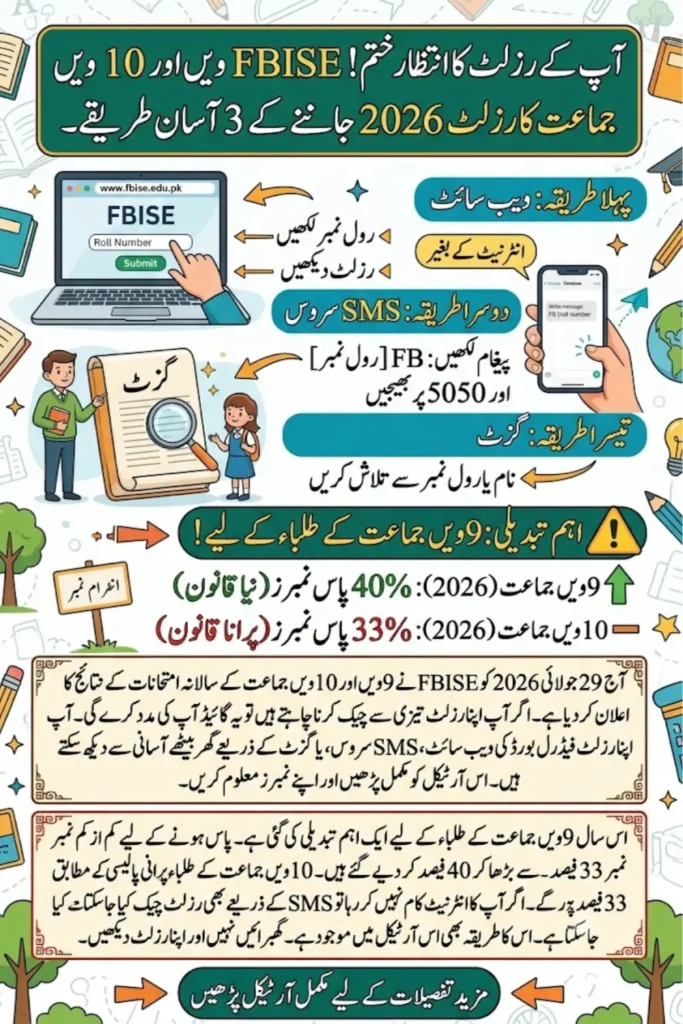
Wednesday, July 29, 2026, was a big day for hundreds of thousands of students across Pakistan. The Federal Board of Intermediate and Secondary Education (FBISE) released both the 9th Class Result 2026 and the 10th Class Result 2026 at 11:15 AM, closing out months of anxious waiting for SSC Part I and SSC Part II candidates.

If you’re one of the students who sat these papers, you’re probably refreshing your browser right now trying to figure out the fastest way to see your marks. This guide walks you through every method available website, SMS, and gazette and also explains an important change to the grading system that Class 9 students in particular need to understand.

Federal Board of Intermediate & Secondary Education

SSC Result 2026 Dashboard

Class 9 (Part I) & Class 10 (Part II) — First Annual Examinations

Result Announced · 11:15 AM, Jul 29

Check Your Result

Enter your SSC Part I roll number as printed on your admit card.

Official Website

www.fbise.edu.pk

Open Site

SMS Service

Send FB <Roll No> to 5050

Helpline

111-032-473

Passing Marks & Grading

Class 9 Grading Scale (New System, 2026)
PercentageGradeDescription
96%–100%A++Extraordinary
91%–95%A+Exceptional
86%–90%AOutstanding
81%–85%B++Excellent
76%–80%B+Very Good
71%–75%BGood
61%–70%C+Fairly Good
51%–60%CAbove Average
40%–50%DEmerging
Below 40%UUngraded

Minimum passing marks: 40% per paper (raised from 33%).

After You Check Your Result

  • Verify your name, roll number, and date of birth on the result card.
  • Apply for rechecking if you believe a paper’s marks were miscalculated.
  • Save a downloaded or printed copy for future admission requirements.
  • Watch for the official result gazette for final pass-percentage statistics.
Result data source: FBISE official announcements, July 29, 2026. This widget is an independent informational tool and is not affiliated with FBISE.

How to Check Your FBISE Result Online

The most direct way to see your result is through the official FBISE website at www.fbise.edu.pk. Head to the results section, pick either “SSC Part I First Annual Examination 2026” for Class 9 or “SSC Part II First Annual Examination 2026” for Class 10, then punch in your roll number and hit submit. Your subject-wise marks, grades, and overall status should appear within seconds.

One thing worth keeping in mind: right after a result announcement, thousands of students hit the site at the same time, so it may load slowly or time out. If that happens, don’t panic and don’t keep smashing refresh just wait a couple of minutes and try again. It usually clears up once the initial rush settles down.

FBISE Inter Results 2026: Tentative Date, HSSC-I and HSSC-II Schedule Explained

FBISE 9th & 10th Class Result 2026 Check by Roll Number, SMS & New Grading System

Checking Your Result Without Internet Access

Not everyone has reliable internet on result day, and FBISE has planned for that. You can check your result through a simple SMS by typing FB, leaving a space, then entering your roll number, and sending it to 5050. For example, if your roll number is 123456, you’d send “FB 123456”. Within moments, your result comes back as a text message.

This method works well as a backup if the website is too slow, or if you simply don’t have data available at the moment. It’s also handy for parents or guardians who want to check a result on the student’s behalf without needing to navigate a website.

Using the Result Gazette

FBISE also publishes an official result gazette for both SSC Part I and SSC Part II. This is a large document listing results for every candidate from affiliated schools. It’s particularly useful if you’ve misplaced your roll number slip, since you can search the gazette by name instead.

To use it, download the gazette PDF once it’s released, then press Ctrl + F on a computer and type in the roll number or student name. This trick is also a favorite among schools and teachers who need to check results for many students at once rather than looking each one up individually on the website.

What’s New: The Revised Grading System

This year brings a genuinely important change, especially for Class 9 students. FBISE has rolled out a new grading system for SSC Part I starting with the First Annual Examinations 2026, and the minimum passing percentage has gone up from 33% to 40%. Students scoring below 40% in any paper now fall into the “U” or Ungraded category.

Class 10 students, however, are not affected by this change just yet. SSC Part II candidates in 2026 still follow the older rules, meaning the passing requirement remains at 33%. The new system and the 40% threshold will only apply to Class 10 starting from the First Annual Examinations 2027. This staggered rollout means Class 9 and Class 10 students are technically being graded under two different systems this year, so it’s worth double-checking which rules apply to you before comparing your result with a friend in the other class.

FBISE Result 2026 Overview

DetailClass 9 (SSC Part I)Class 10 (SSC Part II)
ExaminationFirst Annual Examination 2026First Annual Examination 2026
Result DateWednesday, July 29, 2026Wednesday, July 29, 2026
Result Time11:15 AM11:15 AM
Passing Marks40% (new rule)33% (existing rule)
Grading SystemNew system (A++ to U)Existing system, new rules apply from 2027
Official Websitewww.fbise.edu.pkwww.fbise.edu.pk
SMS Code50505050

New Grading Scale for Class 9

Since Class 9 students are the first to experience the revised grading structure, here’s a quick reference so you know exactly where your percentage lands.

PercentageGradeDescription
96%–100%A++Extraordinary
91%–95%A+Exceptional
86%–90%AOutstanding
81%–85%B++Excellent
76%–80%B+Very Good
71%–75%BGood
61%–70%C+Fairly Good
51%–60%CAbove Average
40%–50%DEmerging
Below 40%UUngraded

Steps to Check Your Result on the FBISE Website

If this is your first time checking a board result online, here’s the process broken down simply:

  • Open your browser and go to www.fbise.edu.pk.
  • Look for the results section on the homepage or navigation menu.
  • Choose the correct examination SSC Part I for Class 9, SSC Part II for Class 10.
  • Type in your roll number exactly as it appears on your admit card or exam slip.
  • Click the search or submit button and wait for the page to load.
  • Download or print the result card once it appears, so you have a copy saved for later.

Inter Part-II Practical Exams 2026: Punjab Boards Introduce New Centralized Marking System

What to Do After Checking Your Result

Once you’ve seen your marks, there are a few practical steps worth taking right away, regardless of how the result turned out.

  • Double-check your name, roll number, father’s name, and date of birth on the result card for any errors, and report mistakes to your school immediately.
  • If you’re unhappy with a specific subject’s marks, you can apply for rechecking, which reviews the calculation of marks and checks for any unmarked portions of your answer though your answers won’t be re-evaluated from scratch.
  • Class 10 students who want to raise their marks in certain subjects can look into FBISE’s improvement exam policy and its application schedule.
  • Keep both a digital and printed copy of your provisional result card, since formal admissions processes will likely ask for the board’s official documentation later.
  • Watch for the official result gazette, which will confirm the total number of candidates and the overall pass percentage for both classes once released.

Position Holders and What Comes Next

FBISE typically releases a list of position holders alongside the main result, highlighting the top scorers from both the Science and Humanities groups along with their roll numbers and institutions. If you’re curious how your school performed overall, or want to see who topped the province, keep an eye on FBISE’s official announcements over the following days, since these lists sometimes come out a little after the main result.

For most students though, the priority now shifts to what’s next whether that’s preparing for Class 10 finals, applying for intermediate admissions, or simply enjoying a well-earned break. Either way, keep your result card safe, because you’ll need it at multiple points in the coming months.

Conclusion

Result day can feel stressful, but checking your FBISE 9th or 10th Class Result 2026 doesn’t have to be complicated. Whether you use the official website, the SMS shortcut, or the result gazette, you now have three reliable ways to get your marks. And if you’re a Class 9 student, take a moment to understand the new grading scale, since it works differently from what your seniors experienced last year. Stay patient if the website is slow, keep your documents organized, and start planning your next academic step with confidence.

Frequently Asked Questions

1. Has the FBISE 9th and 10th Class Result 2026 been announced? Yes, both results were announced on Wednesday, July 29, 2026, and became available at 11:15 AM through the official website and SMS service.

2. What are the passing marks for Class 9 and Class 10 in 2026? Class 9 students need at least 40% under the new grading rules, while Class 10 students still need 33% since the revised system applies to them from 2027.

3. Can I check my result without a roll number? Yes, you can contact your school to recover your roll number, or search for your name in the official result gazette once it’s published.

4. What should I do if the FBISE website isn’t loading? Wait a few minutes instead of repeatedly refreshing, and try the SMS service or the gazette as backup options during peak traffic.

5. Can I apply for rechecking if I’m not satisfied with my marks? Yes, FBISE offers a rechecking service that reviews mark calculation and unmarked answer portions, though your answers themselves are not re-evaluated.

Maryam Nawaz Ration Card Programme Expanded: Eligibility, Benefits & Latest 2026 Update

FBISE Inter Results 2026: Tentative Date, HSSC-I and HSSC-II Schedule Explained

FBISE Inter Results 2026: Tentative Date, HSSC-I and HSSC-II Schedule Explained

FBISE Inter Results 2026

The Federal Board of Intermediate and Secondary Education is expected to announce the FBISE Inter Results 2026 during the last week of August, and this update is important news for thousands of students waiting anxiously for their marks. This tentative schedule applies to both HSSC-I and HSSC-II examinations, which means both first-year and second-year students may get their results around the same time. In this article, we will explain what this announcement means, why the result matters, and how students can check it once it goes live.

FBISE Inter Results 2026 Tentative Announcement Date

According to the latest update, FBISE has given a tentative timeline of the last week of August for announcing Inter Results 2026. This applies to both HSSC-I, which is for first-year students, and HSSC-II, which is for second-year students, so both groups are expected to receive their results within a similar time frame.

However, it is important to understand that this is only a tentative window, not a confirmed date. The board has not yet shared separate dates for Class 11 and Class 12, and it has also not confirmed the exact time of the announcement. Some unofficial websites are already sharing specific dates and times for the result, but since FBISE itself has not confirmed these details, students should treat such information carefully and wait for an official notification instead of relying on guesses shared online.

Inter Part-II Practical Exams 2026: Punjab Boards Introduce New Centralized Marking System

FBISE Inter Results 2026: Tentative Date, HSSC-I and HSSC-II Schedule Explained

Why the HSSC-II Result Matters for University Admissions

The HSSC-II result holds special importance because it directly affects university and professional degree admissions across Pakistan. Most universities require final intermediate marks before they can confirm admission offers or calculate merit lists, which means students cannot move forward with certain admission processes until this result is officially announced.

On the other hand, the HSSC-I result is equally valuable, but for a different reason. It helps first-year students understand how well they performed in their first year of intermediate education, giving them a clear idea of which subjects need more attention before they enter their final and more important second year. Both results, although used differently, play an important role in shaping a student’s next academic steps.

FBISE HSSC Exam Background Leading to This Result

To understand why the result is expected in August, it helps to look at when the actual exams took place. FBISE conducted the HSSC first annual examinations during May and June 2026, covering both first-year and second-year students under its jurisdiction.

After the exams are completed, the board goes through a detailed process of marking answer sheets, verifying scores, and compiling the final results before making any public announcement. This entire process takes time, especially when a large number of students and subjects are involved, which is why there is usually a gap of a few months between the exam dates and the result announcement. The board is currently in this preparation stage ahead of the tentative August announcement.

How Students Can Check FBISE Inter Results 2026

Once the result is officially announced, students will be able to check it through the official FBISE website, which remains the safest and most reliable method. On the results portal, students simply need to select either HSSC-I or HSSC-II based on their class and then enter their roll number to view their marks.

Apart from the website, FBISE has also provided results through other methods in the past, including SMS service and its official mobile application. The board is also expected to publish a result gazette alongside individual results, which contains a complete list of students along with their marks and grades. Having more than one way to check the result is helpful for students who may face internet issues or heavy website traffic on the announcement day.

HSSC-I vs HSSC-II Result Overview

The table below gives a simple comparison of HSSC-I and HSSC-II results to help students understand the difference between the two.

CategoryApplies ToWhy It Matters
HSSC-I ResultFirst-year intermediate studentsHelps evaluate performance before the final year
HSSC-II ResultSecond-year intermediate studentsRequired for university and professional admissions

This table shows that while both results come from the same board and around the same time, they serve two different purposes for students at different stages of their intermediate education. Understanding this difference can help students set the right expectations for what each result means for their academic journey.

Geely Galaxy Enters Pakistan: EX5 and EX2 Electric Cars Launching in Q3 2026 via Bestway Group

Ways to Check FBISE Inter Result 2026

Since students may not be aware of every available method, the table below summarizes the different ways to check the FBISE Inter Result 2026 once it is announced.

MethodHow It Works
Official WebsiteSelect HSSC-I or HSSC-II and enter roll number
SMS ServiceSend roll number or name to the given SMS code
Mobile ApplicationCheck result directly through the FBISE app
Result GazetteSearch name or roll number in the published PDF gazette

Having multiple checking options ensures that students in different areas, including those with limited internet access, can still access their results without much difficulty. It is a good idea for students to keep their roll number slip safe and easily accessible as result day approaches.

Important Things Beginners Should Know Before Result Day

For students checking their intermediate result for the first time, there are a few basic points that can make the experience smoother and stress-free.

  • Unofficial websites and social media pages sometimes share specific result dates and times before the board confirms anything, so such information should not be treated as final or accurate.
  • Passing requirements can vary slightly by subject and exam type, so students should be aware that both theory and practical portions often need to be cleared separately rather than just meeting an overall total.

Beyond these points, students should also avoid panicking if the official website becomes slow or difficult to access on the result day, since heavy traffic from thousands of students checking at the same time is completely normal. Trying alternate methods like SMS or the mobile app, or simply waiting a short while before retrying the website, usually solves this issue without any need for concern.

Final Thoughts on FBISE Inter Results 2026

The tentative announcement of FBISE Inter Results 2026 during the last week of August gives students a general idea of when to expect their marks, even though exact dates and times for HSSC-I and HSSC-II have not been confirmed yet. Since so much depends on this result, from academic self-assessment to university admissions, students should stay alert but avoid stress over unofficial rumors circulating online.

The safest approach for every student is to rely only on FBISE’s official announcements and check the board’s website regularly as the tentative date approaches. Preparing roll numbers in advance and knowing all the available checking methods will make result day much easier to manage once the official date is confirmed.

Frequently Asked Questions

When will FBISE announce Inter Results 2026? FBISE is expected to announce the results during the last week of August 2026. However, the exact date and time have not been officially confirmed yet.

Does the tentative schedule apply to both Part-I and Part-II? Yes, the tentative last week of August schedule applies to both HSSC-I and HSSC-II examinations. Separate exact dates for each have not been announced so far.

How can students check their FBISE Inter Result 2026? Students can check their result on the official FBISE website by selecting HSSC-I or HSSC-II and entering their roll number. Results can also be checked through SMS, the mobile app, or the result gazette.

Why is the HSSC-II result important for admissions? Most universities and professional degree programs require final intermediate marks to confirm admission or calculate merit. Without the HSSC-II result, students cannot complete certain admission requirements.

Should students trust result dates shared on social media? No, students should not rely on unverified dates shared by unofficial websites or social media pages. Only FBISE’s official announcement should be treated as the confirmed schedule.

When were the FBISE HSSC exams conducted this year? The HSSC first annual examinations were conducted during May and June 2026. The board is now completing marking and verification before announcing the result.

Kaiyi E04 Price in Pakistan 2026: 300km vs 400km Variant, Booking & Delivery Details

Inter Part-II Practical Exams 2026: Punjab Boards Introduce New Centralized Marking System

Inter Part-II Practical Exams 2026: Punjab Boards Introduce New Centralized Marking System

Inter Part-II Practical Exams

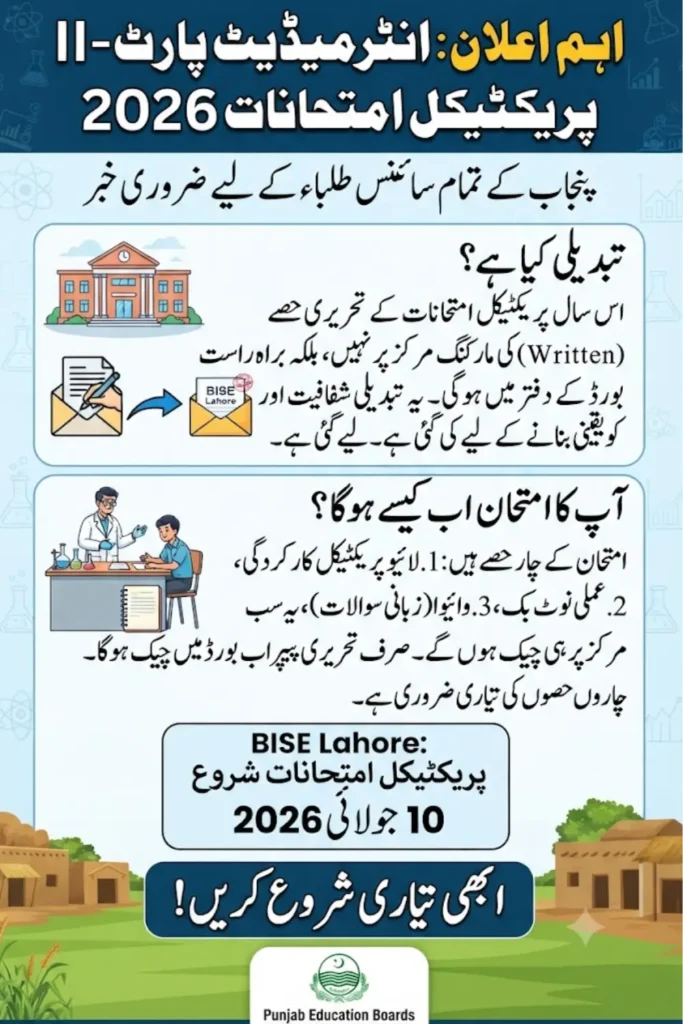
Punjab education boards have changed the marking method for Intermediate Part-II Practical Examinations 2026, and this update is important for every science student appearing in these exams this year. According to the latest announcement, BISE Lahore Inter Part-II Practical Exams 2026 will begin on 10 July 2026, and the new marking system will apply to several major subjects. This article explains what has changed, how marks will now be divided, and what students should keep in mind before appearing in their practical exams.

What Has Changed in Inter Part-II Practical Exams 2026

The biggest change in this year’s practical exams is how the written part of the paper gets checked. Earlier, the examiner sitting at the exam centre used to mark the written answer sheet right there on the spot. Now, this written portion will be sent to the board and checked centrally, exactly like theory papers are checked after the exam is over.

This change is part of a larger effort by Punjab boards to make the checking process more fair and consistent across different exam centres. In the past, practical exams faced criticism because examiners had a lot of personal control over marks, which sometimes led to unfair grading. By moving the written part to centralized checking, the board is trying to reduce this kind of inconsistency and bring practical exams closer to the same standard used for theory papers.

Geely Galaxy Enters Pakistan: EX5 and EX2 Electric Cars Launching in Q3 2026 via Bestway Group

Inter Part-II Practical Exams 2026: Punjab Boards Introduce New Centralized Marking System

BISE Lahore Inter Part-II Practical Exam Date and Subjects

BISE Lahore has confirmed that the Inter Part-II practical exams will start on 10 July 2026. This date applies specifically to second year students, so first year students should not confuse this with their own practical schedule, which usually follows a different timeline.

The new centralized marking policy applies to five major subjects, which are Physics, Chemistry, Biology, Computer Science, and Statistics. These subjects were chosen because they all include a written component along with practical work, unlike some subjects where only lab performance is judged. Students enrolled in any of these five subjects should prepare according to the updated marking pattern explained in this article.

What Students Will Still Be Assessed On at Practical Centres

Even though the written answer sheet checking has moved to the board level, students should not think that practical centres have become less important. Live practical performance, the handwritten practical notebook, and viva voce will still be checked directly at the exam centre by the examiner, just like before.

This means students actually have four things to prepare for instead of just one. They need to perform their experiment correctly in front of the examiner, maintain a properly completed notebook throughout the year, answer viva questions confidently, and also write clear and accurate answers on the written sheet. Ignoring any one of these four parts can affect the final practical score, so balanced preparation is necessary rather than focusing only on the written portion.

Old System vs New System Comparison

To make this change easier to understand, the table below compares how practical exams were checked earlier and how they will be checked from 2026 onward.

Exam ComponentOld Checking MethodNew Checking Method (2026)
Written Answer SheetMarked by examiner at exam centreMarked centrally at the board
Live Practical PerformanceMarked by examiner at exam centreSame, no change
Practical NotebookMarked by examiner at exam centreSame, no change
Viva VoceMarked by examiner at exam centreSame, no change

This comparison makes it clear that only one part of the exam process has actually changed, while the rest of the evaluation stays exactly the same as before. Students who were already preparing seriously for their notebooks and viva do not need to worry, since the update mainly affects how the written sheet travels for checking, not how students should prepare for it.

New Marks Distribution for Inter Part-II Practical Exams

Along with the marking method, the board has also shared the exact marks distribution for each subject under the new system. This breakdown helps students understand how much weight is given to performance and viva compared to the written answer sheet.

SubjectPerformance, Notebook and VivaWritten Answer SheetTotal Marks
Physics16 marks14 marks30 marks
Chemistry14 marks16 marks30 marks
Biology13 marks17 marks30 marks
Computer Science26 marks24 marks50 marks
Statistics20 marks10 marks30 marks

Looking at this table, it becomes clear that different subjects give different importance to written answers compared to hands-on performance. For example, Biology gives more weight to the written sheet, while Physics and Statistics give more importance to performance, notebook, and viva combined, so students should adjust their preparation strategy based on their specific subject.

Kaiyi E04 Price in Pakistan 2026: 300km vs 400km Variant, Booking & Delivery Details

Important Things Beginners Should Know Before the Practical Exams

Since many students appear in practical exams for the first time without fully understanding how marking works, here are a few points worth keeping in mind before the exam day.

  • Notebook marks are usually based on regular lab work completed throughout the year, so a notebook prepared only a few days before the exam is unlikely to score well.
  • Viva voce marks depend on how clearly a student can explain what they did in the practical and why, not just on memorized answers, so understanding concepts is more useful than cramming.

Apart from these points, students should also remember that centralized marking of the written sheet does not mean the written part has become less important. Since the written answer sheet still carries a large portion of the total marks in most subjects, students should continue writing clear, well-organized, and relevant answers just as they would in a theory exam. Neat handwriting and proper labeling of diagrams can also help since the checker at the board level will not have any personal familiarity with the student, unlike examiners at the centre.

How This Reform Reflects a Wider Change in Punjab’s Exam System

This update to Inter Part-II practical exams is not an isolated decision but part of a broader effort by Punjab boards to modernize how practical exams are conducted. Similar reforms have already been introduced for other exam levels, including changes aimed at reducing examiner bias and improving transparency in marking overall.

Such reforms usually take time to fully settle in, and students, teachers, and exam centres may need a short adjustment period as everyone gets used to the new process. However, the long-term goal behind these changes is to make sure that a student’s final result depends purely on their actual knowledge and performance, rather than being influenced by personal factors at the exam centre.

Final Thoughts on Inter Part-II Practical Exams 2026

The new centralized marking system for Inter Part-II Practical Exams 2026 brings an important shift in how written practical answers are checked, while keeping performance, notebook, and viva evaluation unchanged at the exam centres. Students appearing in Physics, Chemistry, Biology, Computer Science, or Statistics should prepare for all four components equally instead of focusing on just one part.

With exams starting from 10 July 2026 at BISE Lahore, students still have time to revise their practical notebooks, practice viva questions, and go through important experiments before the exam day. Staying updated with the official BISE Lahore website for any further instructions related to exam centres and timing is strongly recommended.

Frequently Asked Questions

When do BISE Lahore Inter Part-II practical exams start in 2026? The BISE Lahore Inter Part-II Practical Exams 2026 are scheduled to begin on 10 July 2026. Students should confirm their exact exam date and centre through their roll number slip.

Which subjects are affected by the new practical marking policy? The new centralized marking system applies to Physics, Chemistry, Biology, Computer Science, and Statistics. These subjects all include a written component along with practical work.

Will viva voce and notebook still be checked at the exam centre? Yes, live practical performance, notebook checking, and viva voce will still be conducted at the exam centre. Only the written answer sheet checking has moved to centralized marking.

How are marks distributed under the new system? Marks are divided between performance, notebook, and viva on one side, and the written answer sheet on the other. The exact split varies by subject, as shown in the marks distribution table.

Why did Punjab boards introduce centralized marking for practical exams? The change aims to bring more fairness and consistency to how written practical answers are checked. It removes full marking control from a single examiner at the exam centre.

Does centralized marking mean the written part carries less importance now? No, the written answer sheet still carries a significant share of total marks in most subjects. Students should continue preparing it as seriously as before.

E Learn She Earn Program 2026 Official Website 2026 For Apply Online

Maryam Nawaz Ration Card Programme Expanded: Eligibility, Benefits & Latest 2026 Update

Maryam Nawaz Ration Card Programme Expanded: Eligibility, Benefits & Latest 2026 Update

Maryam Nawaz Ration Card Programme Expanded

If you live in Punjab and work as a labourer, a factory hand, a miner, or in any registered low-income job, there’s fresh news that directly affects your monthly budget. Chief Minister Maryam Nawaz Sharif has approved an additional Rs43.2 billion for the Maryam Nawaz Ration Card programme, on top of the Rs28 billion already handed out to over 1.2 million registered workers. This isn’t a small top-up it’s one of the biggest social protection moves in the province this year.

For families who depend on this monthly support to buy flour, rice, sugar, ghee, and pulses, this announcement matters a lot. In this article, we’ll break down what the new funding means, how the scheme currently works, who’s eligible, and what changes are coming for the 2026-27 financial year.

Punjab Government · Live Update

Maryam Nawaz Ration Card

Programme dashboard — funding, reach & distribution

Already Disbursed New Allocation
Total committed this year: Rs 71.2 billion
0 Registered Workers
0 Cards Issued
0 Cards Printing
0 Partner Shops
Card Issuance Progress 88.7%

1,244,130 of 1,403,063 registered workers have received their card. Remaining cards are in print.

Rs 3,000 Monthly Benefit / Worker
FY 2026–27 Programme Approved

Source: Official Government Statement, July 2026

What Did the Punjab CM Actually Announce?

On Monday, an official government statement confirmed that CM Maryam Nawaz had approved an extra Rs43.2 billion for the ration card scheme during a review meeting on the programme. This comes after the province had already disbursed Rs28 billion to 1.2 million registered workers through the scheme. The new funding is meant to cover the growing number of registrations and keep monthly payments flowing without interruption.

This is not the first expansion the scheme has seen. It started small in 2025 and has been scaled up multiple times as more workers signed up and the government tested how well the disbursement system was working. The latest boost suggests Punjab's government sees this as a long-term commitment rather than a one-time relief package, especially since the CM has now also approved the programme for the next financial year.

Cross Subsidy Program Online Registration 2026: How to Apply, Eligibility & Official Portal

Maryam Nawaz Ration Card Programme Expanded: Eligibility, Benefits & Latest 2026 Update

How Many Workers Are Currently Registered?

According to the official statement, the number of registered workers in Punjab has reached a record 1,403,063. Out of this total, 1,244,130 registered workers have already received their Maryam Nawaz Ration Cards, while printing of another 4,984 cards is under way.

That's a huge jump from where the programme started. Back in April 2025, the scheme launched with a target of covering around 1.25 million working families, and it has since crossed that mark comfortably. The gap between registered workers and those who've physically received their cards is fairly small in percentage terms, which shows the printing and distribution process is moving at a reasonable pace, even as new applications keep coming in.

How Does the Ration Card Scheme Work?

The mechanics of the programme are fairly simple, which is part of why it has managed to reach so many people quickly. Registered workers get a set amount of monthly support that they can use to buy essential kitchen items at approved shops.

Here's a quick breakdown of how the benefit is delivered:

  • Workers get essential commodities worth Rs3,000 per month through the card
  • This support is available at 62,000 shops across the province
  • The card is linked to a bank partnership, so the amount loads digitally each month
  • Items typically covered include flour, rice, sugar, ghee, and pulses
  • No cash is withdrawn directly the card is used like a debit card at approved outlets

This shop-based model was chosen over straight cash transfers because it lets the government track usage and reduces the chances of the money being spent on anything other than food essentials. It also means workers don't need to travel far, since 62,000 outlets is a large network spread across cities and rural areas alike.

Who Is Eligible for the Ration Card?

Eligibility has broadened since the scheme first launched. Initially, it focused on industrial and social security registered workers, but it now covers a wider set of labour categories.

Groups currently benefiting from the programme include:

  • Registered social security workers across various industries
  • Mine workers registered under the Mines & Minerals Department
  • Workers linked with the Suthra Punjab cleanliness programme, with more than 100,000 workers from this group now included
  • Factory and industrial labourers who fall under Punjab's labour welfare umbrella

If you're not sure whether you qualify, the safest step is to check with your employer's labour registration status or visit the nearest Punjab Labour Department office, since registration is usually tied to formal employment records.

Programme Growth: A Quick Comparison

To understand how fast this scheme has expanded, it helps to look at the numbers side by side.

MilestoneApproximate DateKey Figures
Initial launchApril 2025Rs40 billion budget, target of 1.25 million families
Expanded packageApril 2025 (later)Rs84 billion total package including hospitals and welfare projects
Mid-year updateOctober 2025Over 1.37 million workers receiving monthly benefits
Latest updateJuly 2026Rs28 billion already disbursed, Rs43.2 billion newly approved

The pattern here is clear: the government keeps adding funds as registration numbers climb, rather than setting a fixed budget and closing the scheme once it's used up. That approach has helped the programme stay open to new applicants instead of turning people away.

What's New for the 2026-27 Financial Year?

Beyond just adding money to the current budget, the CM also approved the ration card programme to continue into the 2026-27 financial year. This is an important detail because it confirms the scheme isn't ending soon it's being treated as an ongoing welfare commitment rather than a temporary relief effort tied to one budget cycle.

During the same meeting, Maryam Nawaz directed officials to keep increasing the number of registered workers, signaling that the government wants to bring in more eligible families rather than cap the programme at its current size. She also reiterated that protecting the financial well-being of labourers remains her personal responsibility, a message that has been repeated at almost every public event connected to this scheme since it launched.

Pakistan National Champions Cup Schedule 2026, Teams, and Match Fixtures Revealed

Benefits and Concerns Around the Scheme

Like most large welfare programmes, this one has clear strengths but also some practical challenges worth understanding.

AspectDetails
ReachOver 1.4 million workers registered, spread across all districts
Monthly valueRs3,000 per worker for essential groceries
Distribution network62,000 partner shops across Punjab
Main challengeKeeping registration and card printing in sync as numbers grow
Sustainability questionRequires repeated budget top-ups as more workers join

The biggest strength is scale few provincial welfare schemes in Pakistan have reached over a million beneficiaries this quickly. The main concern, which independent observers have pointed out about similar schemes, is long-term funding. Since the programme depends on repeated budget approvals rather than a fixed endowment, its future scale will depend on how much the provincial government can keep allocating each year.

Conclusion

The Rs43.2 billion top-up to the Maryam Nawaz Ration Card programme shows Punjab's government is treating worker welfare as a continuing priority, not a one-off announcement. With over 1.4 million workers now registered and the scheme extended into the next financial year, it's clear the province plans to keep expanding coverage rather than scaling back. For workers and their families, the practical takeaway is simple: if you're eligible and not yet registered, it's worth checking your status soon, since the government has signaled it wants more people added to the list.

Frequently Asked Questions

1. What is the Maryam Nawaz Ration Card programme? It's a Punjab government welfare scheme that gives registered workers Rs3,000 worth of monthly groceries through a bank-linked card, usable at thousands of partner shops.

2. How much has the government added recently? The CM approved an additional Rs43.2 billion on top of the Rs28 billion already disbursed to 1.2 million workers.

3. Who is eligible for the ration card? Registered social security workers, mine workers, Suthra Punjab staff, and other formally registered labourers across Punjab can qualify.

4. Where can cardholders use their ration card? Cardholders can use it at around 62,000 approved shops across the province to buy essential kitchen items.

5. Will the programme continue next year? Yes, the CM has already approved the scheme for the 2026-27 financial year, and officials have been told to register even more workers.

Hyundai Elantra Unveiled 2026 With New Design, Bigger Cabin and Advanced Technology

Pakistan National Champions Cup Schedule 2026, Teams, and Match Fixtures Revealed

Pakistan National Champions Cup Schedule 2026, Teams, and Match Fixtures Revealed

Pakistan National Champions Cup Schedule

Pakistan’s domestic cricket season is about to kick off, and it’s arriving with a brand-new tournament format. The Pakistan Cricket Board has announced the squads and schedule for the National Champions Cup, a fresh 50-over competition designed to open the 2026-27 season and give selectors a close look at the country’s best available players.

This isn’t just another domestic event on the calendar. With the ICC Men’s Cricket World Cup 2027 on the horizon, the PCB is treating this tournament as an early testing ground, evaluating players in a genuinely competitive setup rather than the usual spread-out domestic format. Here’s everything you need to know about the teams, the schedule, and how the competition will work.

NCC

National Champions Cup 2026

PCB Official Schedule & Squads Dashboard

VenueMultan Cricket Stadium
7 Matches
4 Teams
50-Over List A
Aug 11-18 2026

All matches are day-night fixtures starting at 3:00 PM, played at the Multan Cricket Stadium.

Support Staff

Reserve players may only replace an injured or concussed player from the announced playing XI.

What Is the National Champions Cup?

The National Champions Cup is a new List A tournament, meaning it follows the 50-over format used in one-day cricket. It marks the start of Pakistan’s 2026-27 domestic season and will run from August 11 to 18, with all matches hosted at the Multan Cricket Stadium.

What sets this competition apart from Pakistan’s usual domestic events is its scale and structure. Instead of spreading matches across multiple venues over several weeks, the PCB has condensed everything into a tight, seven-match window at a single ground. All the fixtures will be played as day-night matches, with the first ball scheduled for 3:00 PM each day. This setup allows the board to concentrate its scouting efforts, put players under sustained pressure in a short span, and get clear performance data heading into World Cup planning.

Tecno Pova 8 Review Features, Camera, Performance and Full Specifications

Pakistan National Champions Cup Schedule 2026, Teams, and Match Fixtures Revealed

Format and Tournament Structure

Four teams will take part in the National Champions Cup: Pakistan Greens, Pakistan Whites, Pakistan Blues, and Pakistan Gold. They’ll play a single round-robin format, meaning each team faces every other team once during the league stage.

Once the round-robin matches wrap up, the top two teams on the points table will advance directly to the final, which is set for August 18 at the same venue. This straightforward format means there’s no room for hiding, a bad start in the league phase could realistically knock a team out of contention for the final. One of the more interesting structural choices here is that the PCB has locked in a fixed playing XI for each side. Squads must field their named eleven throughout the tournament, and the 13-player reserve pool can only be used if a player gets injured or suffers a concussion. This is a shift from the usual domestic setup where team combinations often change from match to match, and it puts more weight on team chemistry and workload management for the coaching staff.

National Champions Cup Squads and Captains

Each of the four teams is being led by a well-known name from Pakistan’s national setup. Shadab Khan captains Pakistan Greens, Saim Ayub leads Pakistan Whites, Sahibzada Farhan takes charge of Pakistan Blues, and Shaheen Shah Afridi captains Pakistan Gold.

Beyond the captains, all four squads carry a strong blend of experienced internationals and rising domestic talent, giving the tournament genuine competitive depth. Here’s how the four playing XIs line up:

Pakistan GreensPakistan WhitesPakistan BluesPakistan Gold
Shadab Khan (c)Saim Ayub (c)Sahibzada Farhan (c)Shaheen Shah Afridi (c)
Faheem AshrafAkif JavedAhmed DaniyalAbdul Samad
Fakhar ZamanAli RazaArafat MinhasAbdul Subhan
Farhan YousafHaris RaufHasan AliFaisal Akram
Mehran MumtazHasan NawazHussain TalatHaider Ali
Mohammad HasnainKhushdil ShahJahandad KhanKamran Ghulam
Mohammad Salman MirzaMohsin RiazRohail Nazir (wk)Maaz Sadaqat
Naseem ShahMohammad Wasim JnrShamyl HussainMohammad Nawaz
Omair Bin YousufSaad MasoodSufyan MoqimMuhammad Akhlaq (wk)
Saad Baig (wk)Shahzaib KhanTaimur Khan (wk)Muhammad Imran
Sameer MinhasUsman Khan (wk)Tayyab TahirSaad Khan

Looking at the four squads, there’s a noticeable spread of pace-bowling talent, with names like Naseem Shah, Haris Rauf, Hasan Ali, and Shaheen Shah Afridi himself all leading different attacks. This should make for some sharp, high-intensity contests, especially with the tournament’s condensed scheduling putting bowlers under repeated workload in a short window.

Coaching Staff Behind Each Team

Coaching support plays a big role in how these squads are managed, especially given the fixed-XI rule and the short turnaround between matches. Each of the four teams has its own dedicated coaching setup covering head coaching, bowling, batting, and fielding.

Here’s the full breakdown of support staff for each side:

TeamHead CoachBowling CoachBatting CoachFielding Coach
Pakistan GreensIjaz Ahmed JnrRehan RiazKhurram ShahzadFahad Iqbal
Pakistan WhitesIqbal ImamSamiullah NiaziFaisal AtharSaqib Faqir
Pakistan BluesAizaz CheemaFahad MasoodNaveed LatifHussain Khosa
Pakistan GoldMisbah-ul-HaqWaqas AhmedRiffatullah MohmandAtiq-ur-Rehman

Notably, Pakistan Gold’s coaching staff is led by Misbah-ul-Haq, a former Pakistan captain with extensive experience both as a player and as a national team head coach. His presence adds a layer of credibility to Shaheen Shah Afridi’s side heading into the tournament.

Metro Step-Thru Electric Bike in Pakistan: Price, Battery, Features & Availability

The Reserve Pool Explained

Since teams are locked into fixed playing XIs for the entire tournament, the reserve pool exists purely as a safety net rather than a rotation option. It covers 13 players across different roles, ready to step in only if the situation genuinely calls for it.

Here’s how the reserve pool breaks down by category:

  • Batters: Mohammad Suleman, Mohammad Faiq, Muhammad Irfan Khan
  • All-rounders: Mubasir Khan, Danish Aziz
  • Pacers: Arshad Iqbal, Muhammad Salman, Razaullah, Saqib Khan, Mohammad Amir Khan, Shahnawaz Dahani
  • Wicketkeeper: Haseebullah

This pool is heavily weighted toward fast bowlers, which makes sense given how demanding a condensed, day-night 50-over schedule can be on pace attacks. If any of the four captains lose a bowler to injury or a concussion substitution, there’s a reasonably deep bench of pace options to call upon.

National Champions Cup 2026 Schedule

With the tournament squeezed into just eight days, the schedule is tightly packed, and every match carries weight in the race for the final two spots. All matches will be played at the Multan Cricket Stadium with a 3:00 PM start time.

DateMatchVenueTime
11 AugustPakistan Greens vs Pakistan WhitesMultan Cricket Stadium3:00 PM
12 AugustPakistan Blues vs Pakistan GoldMultan Cricket Stadium3:00 PM
13 AugustPakistan Blues vs Pakistan WhitesMultan Cricket Stadium3:00 PM
14 AugustPakistan Gold vs Pakistan GreensMultan Cricket Stadium3:00 PM
15 AugustPakistan Blues vs Pakistan GreensMultan Cricket Stadium3:00 PM
16 AugustPakistan Gold vs Pakistan WhitesMultan Cricket Stadium3:00 PM
18 AugustFinal (Top Two Teams)Multan Cricket Stadium3:00 PM

One thing that stands out from the schedule is how quickly some teams turn around between matches. Pakistan Blues, for example, play on August 12, 13, and 15, giving them very little rest across that stretch. It’s a demanding pace, particularly for fast bowlers, and it will be worth watching how each team’s coaching staff manages workload given that injured players can only be replaced through the reserve pool.

Why This Tournament Matters for the 2027 World Cup

The timing and structure of the National Champions Cup aren’t accidental. With the ICC Men’s Cricket World Cup 2027 approaching, the PCB has explicitly framed this event as an evaluation tool for identifying players who can perform under pressure in the 50-over format.

By fixing the playing XIs and concentrating matches into a short, high-intensity window, national selectors get a clearer picture of how specific player combinations function together, rather than judging individuals in isolation across a scattered domestic season. It also puts several fringe international players and rising domestic performers directly alongside established stars like Shaheen Shah Afridi, Shadab Khan, and Haris Rauf, giving selectors a direct comparison point. For a board that’s openly building toward a global tournament, this kind of structured, closely-monitored competition could end up shaping several squad decisions over the coming months.

Conclusion

The National Champions Cup gives Pakistan cricket fans a compact, high-stakes start to the 2026-27 domestic season, and a genuine early look at how the squad might shape up for the 2027 World Cup. With four strong sides, fixed playing elevens, and a tight eight-day window in Multan, every match carries real weight for both the players and the selectors watching closely. Whether it’s Shaheen Shah Afridi’s Pakistan Gold, Shadab Khan’s Pakistan Greens, or either of the other two sides, the tournament promises tightly-fought, meaningful cricket from the very first ball on August 11.

Frequently Asked Questions

1. When does the National Champions Cup 2026 start? The tournament runs from August 11 to 18, with all matches played at the Multan Cricket Stadium as day-night fixtures starting at 3:00 PM.

2. How many teams are playing in the National Champions Cup? Four teams are competing: Pakistan Greens, Pakistan Whites, Pakistan Blues, and Pakistan Gold, in a single round-robin format.

3. Who are the captains of the four teams? Shadab Khan leads Pakistan Greens, Saim Ayub captains Pakistan Whites, Sahibzada Farhan leads Pakistan Blues, and Shaheen Shah Afridi captains Pakistan Gold.

4. Can teams change their playing XI during the tournament? No, teams must field their announced playing XI throughout, and reserve players can only be used to replace an injured or concussed player.

5. Why is the National Champions Cup important for Pakistan cricket? The PCB has designed the tournament as a key evaluation event for Pakistan’s preparations ahead of the ICC Men’s Cricket World Cup 2027.

Oppo Reno16 F and Reno16 FS Launched Globally: 50MP Ultrawide Selfie, 120Hz AMOLED, and Massive Battery