
Pakistan National Champions Cup Schedule
Pakistan’s domestic cricket season is about to kick off, and it’s arriving with a brand-new tournament format. The Pakistan Cricket Board has announced the squads and schedule for the National Champions Cup, a fresh 50-over competition designed to open the 2026-27 season and give selectors a close look at the country’s best available players.
This isn’t just another domestic event on the calendar. With the ICC Men’s Cricket World Cup 2027 on the horizon, the PCB is treating this tournament as an early testing ground, evaluating players in a genuinely competitive setup rather than the usual spread-out domestic format. Here’s everything you need to know about the teams, the schedule, and how the competition will work.
What Is the National Champions Cup?
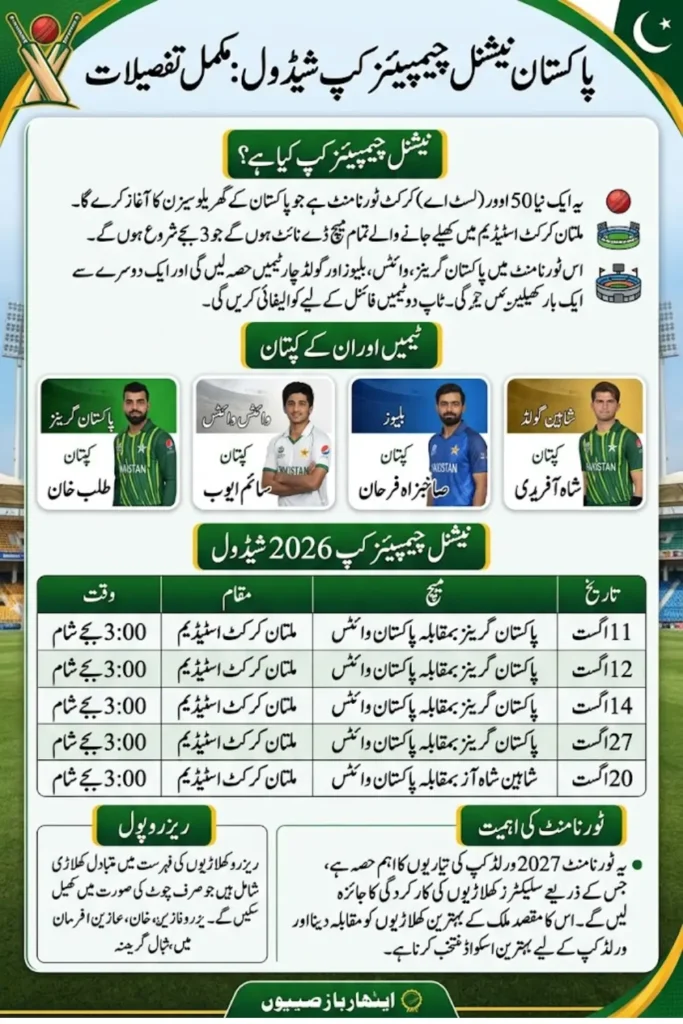
The National Champions Cup is a new List A tournament, meaning it follows the 50-over format used in one-day cricket. It marks the start of Pakistan’s 2026-27 domestic season and will run from August 11 to 18, with all matches hosted at the Multan Cricket Stadium.
What sets this competition apart from Pakistan’s usual domestic events is its scale and structure. Instead of spreading matches across multiple venues over several weeks, the PCB has condensed everything into a tight, seven-match window at a single ground. All the fixtures will be played as day-night matches, with the first ball scheduled for 3:00 PM each day. This setup allows the board to concentrate its scouting efforts, put players under sustained pressure in a short span, and get clear performance data heading into World Cup planning.
Tecno Pova 8 Review Features, Camera, Performance and Full Specifications
Format and Tournament Structure
Four teams will take part in the National Champions Cup: Pakistan Greens, Pakistan Whites, Pakistan Blues, and Pakistan Gold. They’ll play a single round-robin format, meaning each team faces every other team once during the league stage.
Once the round-robin matches wrap up, the top two teams on the points table will advance directly to the final, which is set for August 18 at the same venue. This straightforward format means there’s no room for hiding, a bad start in the league phase could realistically knock a team out of contention for the final. One of the more interesting structural choices here is that the PCB has locked in a fixed playing XI for each side. Squads must field their named eleven throughout the tournament, and the 13-player reserve pool can only be used if a player gets injured or suffers a concussion. This is a shift from the usual domestic setup where team combinations often change from match to match, and it puts more weight on team chemistry and workload management for the coaching staff.
National Champions Cup Squads and Captains
Each of the four teams is being led by a well-known name from Pakistan’s national setup. Shadab Khan captains Pakistan Greens, Saim Ayub leads Pakistan Whites, Sahibzada Farhan takes charge of Pakistan Blues, and Shaheen Shah Afridi captains Pakistan Gold.
Beyond the captains, all four squads carry a strong blend of experienced internationals and rising domestic talent, giving the tournament genuine competitive depth. Here’s how the four playing XIs line up:
| Pakistan Greens | Pakistan Whites | Pakistan Blues | Pakistan Gold |
|---|---|---|---|
| Shadab Khan (c) | Saim Ayub (c) | Sahibzada Farhan (c) | Shaheen Shah Afridi (c) |
| Faheem Ashraf | Akif Javed | Ahmed Daniyal | Abdul Samad |
| Fakhar Zaman | Ali Raza | Arafat Minhas | Abdul Subhan |
| Farhan Yousaf | Haris Rauf | Hasan Ali | Faisal Akram |
| Mehran Mumtaz | Hasan Nawaz | Hussain Talat | Haider Ali |
| Mohammad Hasnain | Khushdil Shah | Jahandad Khan | Kamran Ghulam |
| Mohammad Salman Mirza | Mohsin Riaz | Rohail Nazir (wk) | Maaz Sadaqat |
| Naseem Shah | Mohammad Wasim Jnr | Shamyl Hussain | Mohammad Nawaz |
| Omair Bin Yousuf | Saad Masood | Sufyan Moqim | Muhammad Akhlaq (wk) |
| Saad Baig (wk) | Shahzaib Khan | Taimur Khan (wk) | Muhammad Imran |
| Sameer Minhas | Usman Khan (wk) | Tayyab Tahir | Saad Khan |
Looking at the four squads, there’s a noticeable spread of pace-bowling talent, with names like Naseem Shah, Haris Rauf, Hasan Ali, and Shaheen Shah Afridi himself all leading different attacks. This should make for some sharp, high-intensity contests, especially with the tournament’s condensed scheduling putting bowlers under repeated workload in a short window.
Coaching Staff Behind Each Team
Coaching support plays a big role in how these squads are managed, especially given the fixed-XI rule and the short turnaround between matches. Each of the four teams has its own dedicated coaching setup covering head coaching, bowling, batting, and fielding.
Here’s the full breakdown of support staff for each side:
| Team | Head Coach | Bowling Coach | Batting Coach | Fielding Coach |
|---|---|---|---|---|
| Pakistan Greens | Ijaz Ahmed Jnr | Rehan Riaz | Khurram Shahzad | Fahad Iqbal |
| Pakistan Whites | Iqbal Imam | Samiullah Niazi | Faisal Athar | Saqib Faqir |
| Pakistan Blues | Aizaz Cheema | Fahad Masood | Naveed Latif | Hussain Khosa |
| Pakistan Gold | Misbah-ul-Haq | Waqas Ahmed | Riffatullah Mohmand | Atiq-ur-Rehman |
Notably, Pakistan Gold’s coaching staff is led by Misbah-ul-Haq, a former Pakistan captain with extensive experience both as a player and as a national team head coach. His presence adds a layer of credibility to Shaheen Shah Afridi’s side heading into the tournament.
Metro Step-Thru Electric Bike in Pakistan: Price, Battery, Features & Availability
The Reserve Pool Explained
Since teams are locked into fixed playing XIs for the entire tournament, the reserve pool exists purely as a safety net rather than a rotation option. It covers 13 players across different roles, ready to step in only if the situation genuinely calls for it.
Here’s how the reserve pool breaks down by category:
- Batters: Mohammad Suleman, Mohammad Faiq, Muhammad Irfan Khan
- All-rounders: Mubasir Khan, Danish Aziz
- Pacers: Arshad Iqbal, Muhammad Salman, Razaullah, Saqib Khan, Mohammad Amir Khan, Shahnawaz Dahani
- Wicketkeeper: Haseebullah
This pool is heavily weighted toward fast bowlers, which makes sense given how demanding a condensed, day-night 50-over schedule can be on pace attacks. If any of the four captains lose a bowler to injury or a concussion substitution, there’s a reasonably deep bench of pace options to call upon.
National Champions Cup 2026 Schedule
With the tournament squeezed into just eight days, the schedule is tightly packed, and every match carries weight in the race for the final two spots. All matches will be played at the Multan Cricket Stadium with a 3:00 PM start time.
| Date | Match | Venue | Time |
|---|---|---|---|
| 11 August | Pakistan Greens vs Pakistan Whites | Multan Cricket Stadium | 3:00 PM |
| 12 August | Pakistan Blues vs Pakistan Gold | Multan Cricket Stadium | 3:00 PM |
| 13 August | Pakistan Blues vs Pakistan Whites | Multan Cricket Stadium | 3:00 PM |
| 14 August | Pakistan Gold vs Pakistan Greens | Multan Cricket Stadium | 3:00 PM |
| 15 August | Pakistan Blues vs Pakistan Greens | Multan Cricket Stadium | 3:00 PM |
| 16 August | Pakistan Gold vs Pakistan Whites | Multan Cricket Stadium | 3:00 PM |
| 18 August | Final (Top Two Teams) | Multan Cricket Stadium | 3:00 PM |
One thing that stands out from the schedule is how quickly some teams turn around between matches. Pakistan Blues, for example, play on August 12, 13, and 15, giving them very little rest across that stretch. It’s a demanding pace, particularly for fast bowlers, and it will be worth watching how each team’s coaching staff manages workload given that injured players can only be replaced through the reserve pool.
Why This Tournament Matters for the 2027 World Cup
The timing and structure of the National Champions Cup aren’t accidental. With the ICC Men’s Cricket World Cup 2027 approaching, the PCB has explicitly framed this event as an evaluation tool for identifying players who can perform under pressure in the 50-over format.
By fixing the playing XIs and concentrating matches into a short, high-intensity window, national selectors get a clearer picture of how specific player combinations function together, rather than judging individuals in isolation across a scattered domestic season. It also puts several fringe international players and rising domestic performers directly alongside established stars like Shaheen Shah Afridi, Shadab Khan, and Haris Rauf, giving selectors a direct comparison point. For a board that’s openly building toward a global tournament, this kind of structured, closely-monitored competition could end up shaping several squad decisions over the coming months.
Conclusion
The National Champions Cup gives Pakistan cricket fans a compact, high-stakes start to the 2026-27 domestic season, and a genuine early look at how the squad might shape up for the 2027 World Cup. With four strong sides, fixed playing elevens, and a tight eight-day window in Multan, every match carries real weight for both the players and the selectors watching closely. Whether it’s Shaheen Shah Afridi’s Pakistan Gold, Shadab Khan’s Pakistan Greens, or either of the other two sides, the tournament promises tightly-fought, meaningful cricket from the very first ball on August 11.
Frequently Asked Questions
1. When does the National Champions Cup 2026 start? The tournament runs from August 11 to 18, with all matches played at the Multan Cricket Stadium as day-night fixtures starting at 3:00 PM.
2. How many teams are playing in the National Champions Cup? Four teams are competing: Pakistan Greens, Pakistan Whites, Pakistan Blues, and Pakistan Gold, in a single round-robin format.
3. Who are the captains of the four teams? Shadab Khan leads Pakistan Greens, Saim Ayub captains Pakistan Whites, Sahibzada Farhan leads Pakistan Blues, and Shaheen Shah Afridi captains Pakistan Gold.
4. Can teams change their playing XI during the tournament? No, teams must field their announced playing XI throughout, and reserve players can only be used to replace an injured or concussed player.
5. Why is the National Champions Cup important for Pakistan cricket? The PCB has designed the tournament as a key evaluation event for Pakistan’s preparations ahead of the ICC Men’s Cricket World Cup 2027.