Sehat Sahulat Program Revival in Islamabad
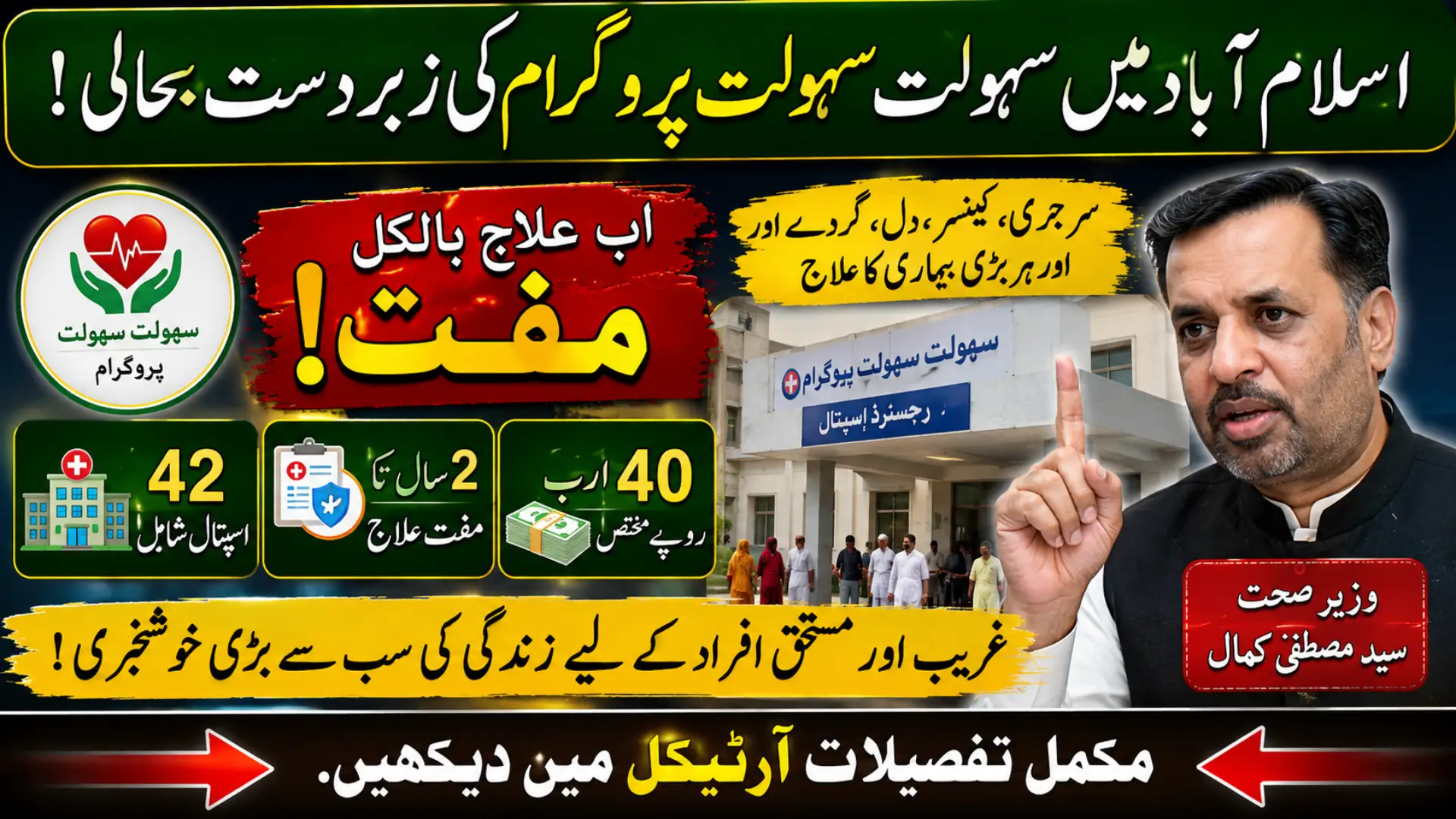
The Sehat Sahulat Program revival in Islamabad marks a significant turning point for public healthcare in Pakistan. After remaining suspended for several years in the federal capital, the program has been formally relaunched by Federal Minister for National Health Services, Syed Mustafa Kamal, with the aim of providing free medical treatment to deserving patients across 42 hospitals in the twin cities of Islamabad and Rawalpindi.
This revival comes at a time when Pakistan’s healthcare system is under serious strain. With a growing urban population, rising poverty levels, and hospitals receiving patients from multiple regions, the need for a structured free healthcare program has never been more urgent. The relaunch of the Sehat Sahulat Program is seen as a direct and practical response to this growing public need.
Official Government Helpline Numbers 2026 for Complaints, Education, Health, and Transport
What Is the Sehat Sahulat Program and Why Was It Revived?
The Sehat Sahulat Program, also known as the Health Facilitation Program, was originally launched in 2015 as part of Pakistan’s first federal-level social health insurance initiative. It was designed to provide cashless inpatient treatment to low-income families across Pakistan, covering services like surgery, maternity care, emergency treatment, and care for chronic illnesses such as cancer and heart disease. Over the years, it was expanded to Islamabad Capital Territory, Azad Jammu and Kashmir, and Gilgit-Baltistan, but the program was later suspended due to administrative and financial challenges.
The revival of the Sehat Sahulat Program in Islamabad was made possible after Prime Minister Muhammad Shehbaz Sharif approved the government’s proposal in the public interest. Federal Minister Syed Mustafa Kamal credited the prime minister’s support as a key reason behind the program’s reactivation and stated that the government is fully committed to bringing healthcare reform to Pakistan’s most vulnerable citizens. A revised plan with an estimated cost of Rs. 40 billion was approved by the National Steering Committee to support the restoration of services.
| Program Feature | Details |
| Program Name | Sehat Sahulat Health Facilitation Program |
| Launched By | Federal Minister Syed Mustafa Kamal |
| Number of Hospitals | 42 hospitals in Islamabad and Rawalpindi |
| Phase 1 Duration | Free treatment for two years |
| Phase 3 Goal | Free OPD services to be added in the third year |
| Total Budget Approved | Rs. 40 billion |
| Regions Covered | Islamabad Capital Territory, AJK, Gilgit-Baltistan |
| Amount Spent (Last 5 Months) | Rs. 2 billion on patient treatment |
Key Benefits of the Sehat Sahulat Program for Patients
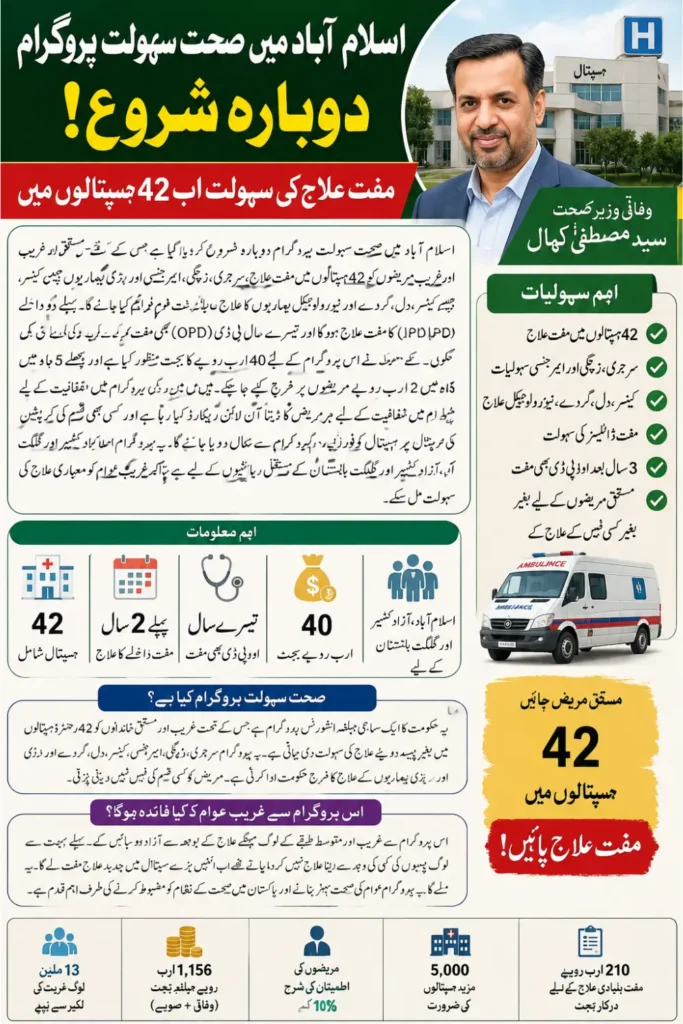
The Sehat Sahulat Program offers a wide range of free healthcare services to eligible patients. These services go beyond basic consultations and include advanced medical treatments that many low-income families could never afford on their own. Below are the key services and patient benefits covered under the program:
- Free cashless inpatient treatment at 42 registered hospitals
- Coverage for surgeries, emergency care, and maternity services
- Treatment for serious illnesses including cancer, heart disease, kidney problems, and neurological conditions
- Free dialysis sessions for patients with kidney failure
- Plans to add free OPD consultations in the third year of the program
- Real-time data collection to ensure fair and transparent distribution of services
The Sehat Sahulat Program has officially been revived in Islamabad, restoring free cashless inpatient treatment for eligible patients at 42 hospitals across Islamabad and Rawalpindi. The government has approved a Rs. 40 billion budget and plans to expand the program with free OPD services in its third year.
Xiaomi Watch S5 46mm Price in Pakistan 2026 Full Specs, Features, Battery & Review
How the Sehat Sahulat Program Works in Islamabad
The program operates on a social health insurance model where the government pays for the treatment of eligible patients directly to the registered hospitals. Patients do not need to pay anything at the point of service. Instead, hospitals are reimbursed by the government through a structured system managed with third-party administrators. The program is applicable within the territorial jurisdiction of Islamabad Capital Territory and is available to permanent residents as well as patients coming from nearby regions.
Federal Minister Syed Mustafa Kamal visited Dr. Akbar Niazi Teaching Hospital to personally review the implementation of the program and meet patients receiving treatment. He confirmed that real-time data on patients’ treatment and medical expenses is being actively collected to maintain transparency. This data-driven approach is intended to prevent misuse and ensure that the program reaches those who genuinely need it, rather than being misused for financial gain.
Transparency, Anti-Corruption Measures, and Government Accountability
One of the most important aspects of this program’s revival is the government’s strong focus on transparency and accountability. The minister made it very clear that any hospital found violating the rules of the Sehat Sahulat Program or helping in any form of corruption would be immediately removed from the program’s list of registered hospitals. This strict stance is meant to send a clear message that the program exists to serve patients, not to be misused by institutions.
To support this goal, the government is building a system of real-time monitoring that tracks every patient’s treatment journey and associated expenses. This ensures that payments made to hospitals are accurate, justified, and transparent. The use of technology and data in program management represents a modern shift in how Pakistan’s public health programs are being administered, and it reflects a broader effort to build trust between the government and ordinary citizens.
Challenges Facing Islamabad’s Healthcare System
Islamabad’s healthcare system faces serious pressure due to its rapidly growing population and its role as a treatment hub for patients from multiple regions. Below are the major challenges that make the Sehat Sahulat Program revival so important for the capital:
- Islamabad’s population has crossed 3.5 million and is continuing to grow rapidly
- Hospitals in the capital serve patients from Azad Kashmir, Gilgit-Baltistan, Rawalpindi, and other nearby areas
- Both public and private hospitals are experiencing overcrowding due to high patient volume
- Pakistan’s combined federal and provincial health budget is Rs. 1,156 billion, yet patient satisfaction is below 10 percent
- According to WHO data cited by the minister, 13 million people in Pakistan currently live below the poverty line
- Without a free healthcare program, low-income patients are forced to delay or avoid treatment entirely
Pakistan’s Path Toward Universal Health Coverage
Federal Minister Syed Mustafa Kamal described universal health coverage as the future direction for Pakistan’s healthcare system, noting that most countries around the world are already moving toward this model. A comprehensive government study found that providing basic healthcare facilities to all citizens would require a budget of approximately Rs. 210 billion. However, to make this possible, Pakistan would need to build at least 5,000 more hospitals across the country, which represents a massive but necessary long-term investment.
The government’s current approach reflects an understanding that universal health coverage cannot happen overnight. It requires phased planning, financial commitment, and a willingness to reform existing systems. The Sehat Sahulat Program revival in Islamabad is being treated as a model that, if successful, can be expanded to cover more regions and eventually lead to nationwide universal health coverage. The government’s acknowledgment that patient satisfaction currently stands below 10 percent despite a budget of over Rs. 1,156 billion is a sign that reforms are being approached with honesty rather than political pretense.
| Healthcare Indicator | Current Status in Pakistan |
| Population of Islamabad | Over 3.5 million |
| People Below Poverty Line (WHO) | 13 million |
| Combined Health Budget (Federal + Provincial) | Rs. 1,156 billion |
| Patient Satisfaction Rate | Below 10 percent |
| Amount Spent on Patients (Last 5 Months) | Rs. 2 billion |
| Budget Needed for Basic Healthcare Coverage | Rs. 210 billion |
| Additional Hospitals Required Nationwide | 5,000 more hospitals |
Who Is Eligible and How to Access the Sehat Sahulat Program?
The Sehat Sahulat Program is designed for deserving and low-income patients who cannot afford private healthcare. Eligible patients include permanent residents of Islamabad Capital Territory, as well as individuals from Azad Jammu and Kashmir and Gilgit-Baltistan who are registered under the program. Patients simply need to visit one of the 42 registered hospitals in Islamabad and Rawalpindi to access free inpatient treatment under the program without any upfront payment.
The government has not yet published a detailed eligibility criteria document for the 2026 revival at the time of this writing, but the program is expected to rely on existing NADRA records and poverty-based data to verify patient eligibility. Families that meet the poverty threshold and are registered as permanent residents of the covered areas should be able to access services. Those who are unsure about eligibility are encouraged to visit their nearest registered hospital and ask program staff for assistance.
Frequently Asked Questions About the Sehat Sahulat Program Revival
Q1. What is the Sehat Sahulat Program in Islamabad?
The Sehat Sahulat Program is a government-run free healthcare initiative relaunched in Islamabad by Federal Minister Syed Mustafa Kamal. It provides cashless inpatient medical treatment to deserving patients at 42 registered hospitals across Islamabad and Rawalpindi.
Q2. How many hospitals are included in the Sehat Sahulat Program in Islamabad?
The program has been launched in 42 hospitals across the twin cities of Islamabad and Rawalpindi. Both public and private hospitals are part of the network to ensure broad access for eligible patients.
Q3. Who can benefit from the Sehat Sahulat Program?
Permanent residents of Islamabad Capital Territory, Azad Jammu and Kashmir, and Gilgit-Baltistan who meet the poverty-based eligibility criteria can benefit from the program. Patients from nearby areas such as Rawalpindi who visit Islamabad hospitals are also being served.
Q4. Will OPD services also be free under this program?
In the first two years, the program covers free inpatient treatment only. The government has announced plans to include free OPD, or outpatient department, services in the third year of the program’s implementation.
Q5. How is the government preventing corruption in the Sehat Sahulat Program?
The government is collecting real-time data on patient treatment and expenses to monitor the program closely. Any hospital found violating program rules or facilitating corruption will be immediately removed from the list of registered hospitals.
Q6. How much has the government spent on the Sehat Sahulat Program so far?
The government has already spent Rs. 2 billion on patient treatment during the last five months following the program’s revival. A total budget of Rs. 40 billion has been approved for the overall restoration and expansion of the program.
NAVTTC Free Livestock Vocational Training Program 2026 Apply Now for Youth Employment Opportunities