BYD Pakistan New Shipment
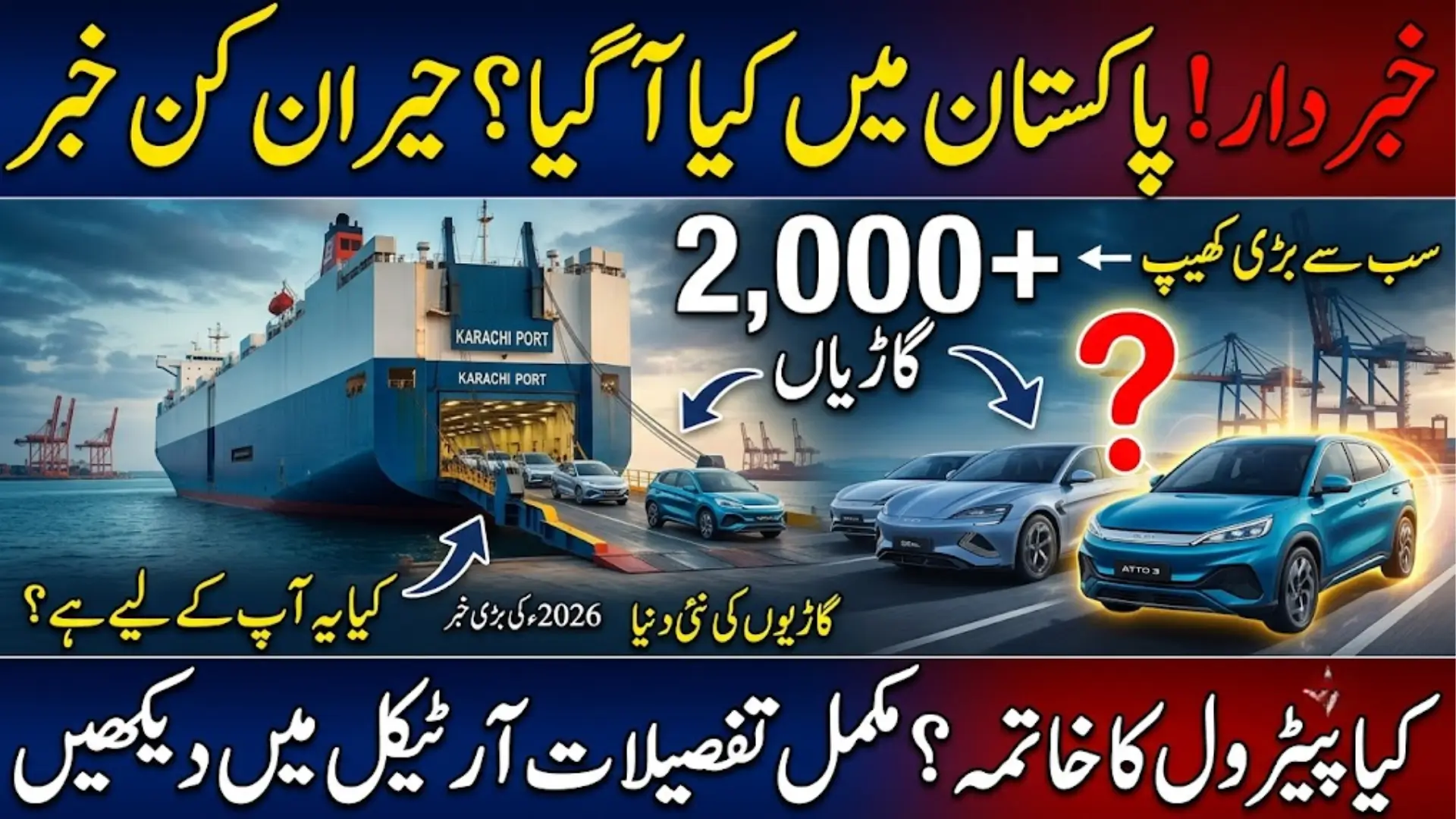
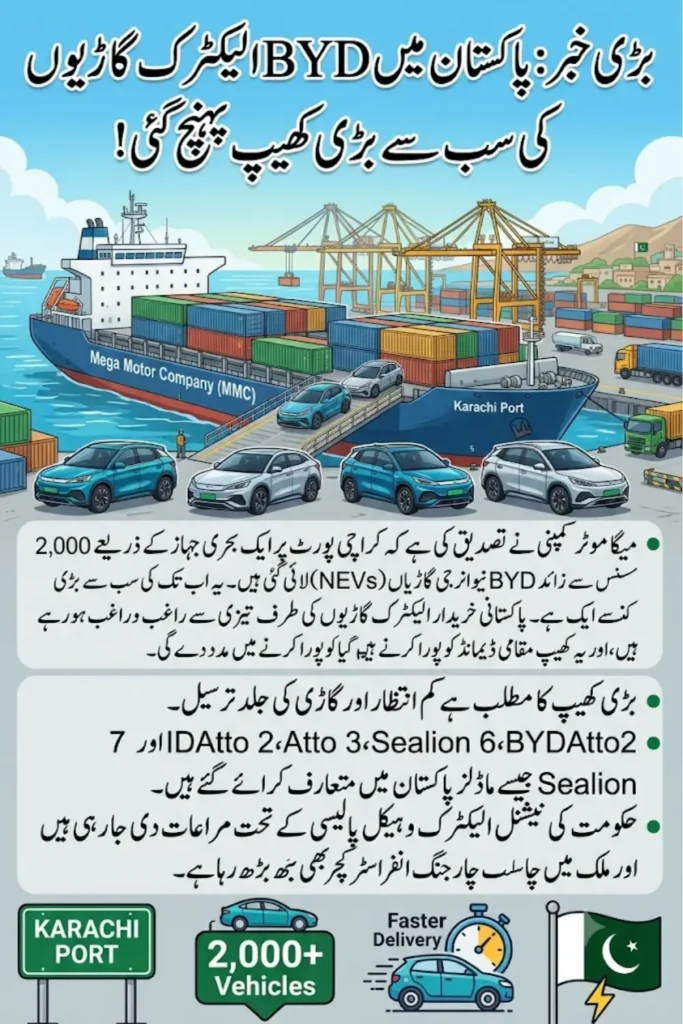
BYD Pakistan just brought in one of its biggest deliveries yet. Mega Motor Company (MMC), the brand’s official partner in the country, confirmed that a Roll on/Roll off (RoRo) vessel carrying more than 2,000 BYD New Energy Vehicles (NEVs) has docked at Karachi Port among the largest single consignments of BYD cars to reach Pakistan so far.
Honestly, the timing says a lot. Pakistani buyers are warming up to electric mobility faster than most people expected a couple of years ago, and shipments like this one show that MMC is scrambling in a good way to keep pace with orders. Below, we break down what actually arrived, why it matters, and what it means if you’re thinking about buying a BYD yourself.
Pakistan Daily Petrol Price System: OGRA to Update Fuel Rates Every Day
What Arrived at Karachi Port, and Why It’s a Big Deal
The vessel that docked at Karachi Port wasn’t carrying a token batch of test units. More than 2,000 vehicles came in on a single RoRo ship a scale that MMC itself has flagged as one of the largest BYD consignments the country has received to date. That’s a meaningful jump from earlier shipments, which typically numbered in the low hundreds.
Danish Khaliq, Vice President of Sales & Strategy at BYD Pakistan–MMC, framed the shipment as a direct response to demand pressure. He pointed to evolving global supply chain challenges and unprecedented demand for BYD vehicles worldwide as reasons the two companies had to tighten up their supply planning and logistics. Lei Jian, BYD Pakistan’s Country Head, added that the shipment supports the brand’s broader push as it works to strengthen its footprint in the country.
Why does a shipping story matter to someone who just wants to buy a car? Because backlog and waiting times have been a real pain point for NEV buyers in Pakistan. A larger, steadier flow of stock generally means shorter delivery windows and fewer surprises at the dealership — assuming demand doesn’t outrun supply again, which is always the risk with a fast-growing market.
RoRo Shipping: The Logistics Behind the Headlines
RoRo vessels are basically floating parking garages vehicles are driven directly onto the ship and off again at the destination port, no crating or lifting required. That makes them the standard method for moving large volumes of finished cars internationally, and it’s a big part of why an automaker can move thousands of units in one trip without damaging them.
For Pakistan specifically, RoRo shipping through Karachi Port has become the backbone of BYD’s import operation. Faster turnaround at port, lower handling costs, and fewer damaged-in-transit claims all add up to a more predictable supply chain — something that matters a lot when a brand is trying to scale from a handful of dealerships to a nationwide network in just a couple of years.
Why Automakers Prefer RoRo for Large NEV Shipments
- Speed: Vehicles drive on and off the ship, cutting loading and unloading time compared to container shipping.
- Lower damage risk: No crane lifting or repeated repositioning means fewer scratches, dents, or mechanical issues on arrival.
- Cost efficiency at scale: Per-unit shipping costs drop significantly when thousands of vehicles move together.
- Predictable scheduling: Dedicated RoRo routes and berths at ports like Karachi allow importers to plan deliveries around fixed sailing schedules.
BYD’s Global Position: Why Pakistan Matters to the Bigger Picture
Lei Jian’s comment about BYD becoming the world’s No. 1 NEV brand isn’t just marketing talk. In 2025, BYD’s worldwide electric car sales climbed 27% to roughly 2.26 million all-electric passenger vehicles, making it the world’s largest battery-electric car brand that year. Add plug-in hybrids into the mix, and the company’s total new-energy vehicle sales hit a record for the year, with growth continuing into 2026 even as China’s home market cooled off.
Overseas expansion is doing a lot of the heavy lifting for BYD right now. In the first half of 2026, BYD’s overseas sales grew nearly 71% even as total NEV sales dipped compared to the same period in 2025, with China’s domestic sales under pressure from an intense price war. Markets like Pakistan, which sit outside that saturated home turf, are increasingly important to BYD’s growth story which helps explain why MMC keeps pushing shipment volumes higher instead of holding steady.
That global scale also shapes what happens locally. BYD’s NEVs are now sold in 112 countries and regions, and the company has been opening assembly plants in Thailand, Uzbekistan, Hungary, and Brazil as part of its localization push. Pakistan is being lined up for the same treatment — more on that below.
BYD Models and Prices in Pakistan (2026)
If you’re weighing which BYD suits your budget, here’s a snapshot of what MMC currently offers, based on published ex-showroom prices as of mid-2026. Prices and specs can shift with tariff changes, so treat these as a starting reference rather than the final word always confirm with a dealership before booking.
| Model | Type | Approx. Ex-Showroom Price (PKR) | Best For |
|---|---|---|---|
| BYD Atto 2 | Battery Electric (BEV) | 7,290,000 | Entry-level buyers wanting BYD’s brand and tech at the lowest price point |
| BYD Atto 3 | Battery Electric (BEV) | 8,990,000 (Advance variant) | Families needing a full C-segment SUV with a rotating touchscreen and solid range |
| BYD Sealion 6 | Plug-in Hybrid (PHEV) | Roughly 6–8 million (varies by trim) | Buyers worried about charging access who still want electrified running costs |
| BYD Seal | Battery Electric Sedan | ~14.79–16.99 million (Dynamic/Premium trims) | Drivers who want sedan performance and long range over SUV practicality |
| BYD Sealion 7 | Battery Electric (BEV) | 15,490,000 | Premium SUV buyers who want more power and range than the Atto 3 |
| BYD Shark 6 | Plug-in Hybrid Pickup | ~19,950,000 | Buyers wanting BYD’s most expensive, feature-loaded model in a pickup body |
Note: Trim-level pricing can vary between dealerships and cities, and some figures (like the Sealion 6) are approximate ranges reported by local auto outlets rather than official BYD price sheets. Always verify current pricing directly with MMC before making a purchase decision.
Pakistan’s NEV Policy: What’s Actually Changing
None of this growth happens in a vacuum. Pakistan’s government has been steadily building a policy framework meant to pull EV adoption forward, and BYD’s expansion is riding that wave. The National Electric Vehicle Policy 2025-30 was officially launched in June 2025 and targets 30% of new vehicle sales being electric by 2030, with further goals of 50% by 2040.
On the incentive side, the government has kept existing NEV benefits in place while it works out longer-term tariff reform. Existing incentives for NEVs under the earlier Auto Industry Development and Export Policy will stay in effect until June 30, 2026, after which applicable customs duty, additional customs duty, and regulatory duty will be phased down gradually. That transition period is exactly why import timing — like this Karachi shipment carries some urgency for companies like MMC.
Infrastructure is the other half of the equation. The NEV policy includes plans for thousands of new charging stations across highways, urban centers, and petrol stations, alongside reduced electricity tariffs for commercial EV charging points. In practice, though, most BYD owners in Pakistan still charge at home rather than relying on public infrastructure, since that network is still fairly young.
What Pakistani NEV Buyers Should Know Before Booking
- Home charging is still the norm. Most BYD owners plug in overnight using a standard outlet or an installed fast charger rather than depending on public stations.
- Public charging is expanding, but slowly. Karachi, Lahore, and Islamabad have a growing number of DC fast chargers, but coverage on highways between cities remains limited.
- Tariff changes are coming. Incentives tied to the current policy phase run through mid-2026, so prices could shift once new tariff structures take effect.
- Local assembly is on the way. BYD’s partner has confirmed a local manufacturing plant is under construction, which should eventually reduce import costs.
- Booking amounts vary by model. Advance payments have ranged from roughly PKR 1.4 million for the Atto 2 to PKR 3 million for the Sealion 7, based on prior launch announcements.
Local Manufacturing: BYD’s Next Step in Pakistan
Shipping thousands of built-up units is one thing, but BYD’s long game in Pakistan runs deeper than imports. Mega Motor Company has signed a financing agreement with British International Investment, the UK’s development finance institution, to help fund Pakistan’s first purpose-built NEV manufacturing plant, with that financing reportedly covering a quarter of a project estimated at around $150 million.
Progress on that front appears to be on schedule. During a meeting with Pakistan’s finance minister in mid-2026, BYD and MMC representatives confirmed that construction of the local assembly facility is moving forward as planned, alongside discussions about expanding the charging network and training local technicians. Once local assembly comes online, expect some pressure on prices — assembling domestically usually cuts the duties that get baked into imported sticker prices.
BYD’s footprint is also stretching beyond private car sales. The company delivered BYD Atto 2 and Sealion 7 units to Islamabad Police in a ceremony marking the first operational adoption of an NEV fleet by a federal department in Pakistan. That kind of institutional buy-in tends to build public confidence in a brand faster than showroom marketing alone.
Conclusion
The Karachi Port shipment is a snapshot of where BYD Pakistan is headed, not just a one-off headline. Between growing import volumes, a supportive national NEV policy, and a local assembly plant under construction, MMC looks like it’s building the kind of supply chain that can actually keep up with Pakistani demand instead of chasing it. If you’ve been sitting on the fence about buying a BYD, the practical takeaway is simple: stock is improving, but pricing and incentives are both due to shift as the current policy phase winds down in mid-2026 — so it pays to check current terms before you book.
FAQs
How many BYD vehicles arrived in the recent Karachi Port shipment?
More than 2,000 BYD New Energy Vehicles arrived on a single RoRo vessel at Karachi Port, according to Mega Motor Company. The company described it as one of the largest BYD consignments to reach Pakistan to date.
Who is BYD’s official partner in Pakistan?
Mega Motor Company (MMC) is BYD’s official partner and distributor in Pakistan. MMC handles vehicle imports, dealership operations, and customer service across the country’s major cities.
Is BYD really the world’s top-selling NEV brand?
Yes BYD sold roughly 2.26 million all-electric passenger vehicles worldwide in 2025, making it the top-selling battery-electric car brand that year, and its combined NEV sales also set a company record. It has held the global NEV sales lead for multiple consecutive years running into 2026.
Will BYD cars get cheaper once local assembly starts in Pakistan?
It’s likely, though not guaranteed. Local assembly typically reduces the import duties baked into a vehicle’s price, and BYD’s Pakistani plant — backed partly by UK development financing is reported to be under construction on schedule.
Is public EV charging infrastructure ready for BYD owners in Pakistan?
Not fully yet. Most BYD owners currently charge at home overnight, while public fast-charging networks in cities like Karachi, Lahore, and Islamabad are still expanding under the government’s National Electric Vehicle Policy 2025-30.