Pakistan Hajj Policy 2027-2030
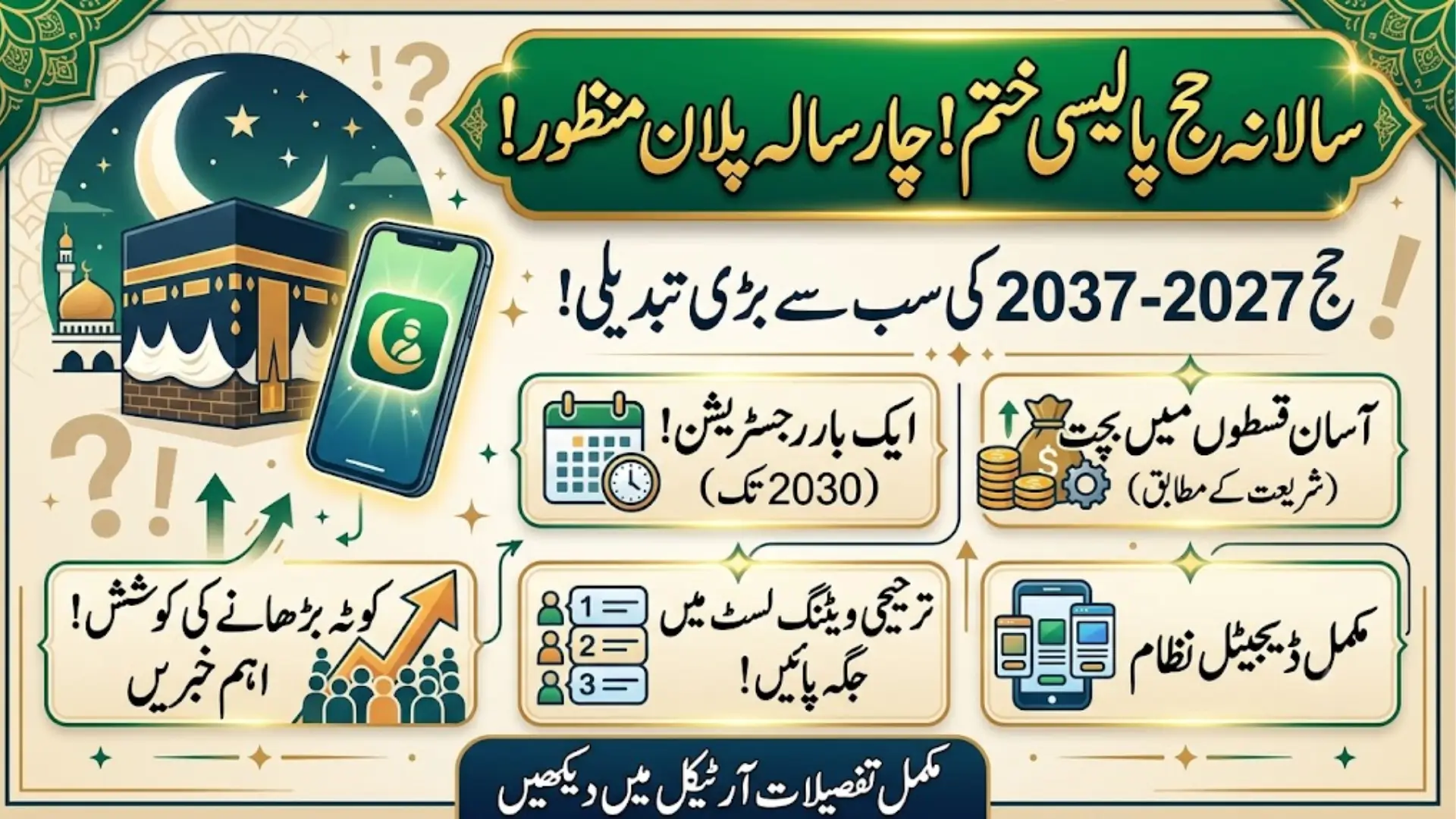
Pakistan’s federal cabinet approved the Pakistan Hajj Policy 2027-2030 on Tuesday, July 7, 2026, marking the country’s first-ever four-year Hajj framework. Chaired by Prime Minister Shehbaz Sharif, the cabinet meeting replaced decades of annual policymaking with a single long-term plan that runs through 2030.
If you’ve ever gone through Pakistan’s old Hajj registration cycle, you know the drill: new forms, new deadlines, new anxiety, every single year. That’s over now. This article breaks down exactly what the new policy changes, what stays the same, and what it means if you’re planning to perform Hajj sometime before 2030.
What Is Pakistan’s New Four-Year Hajj Policy?
For as long as most Pakistanis can remember, the Ministry of Religious Affairs rolled out a fresh Hajj policy every single year. Each version covered eligibility rules, quota splits, and package prices for that one Hajj season only, then the whole process started over from scratch twelve months later.
The 2027-2030 plan breaks that pattern. According to the Prime Minister’s Office, cabinet members received a detailed briefing confirming this is Pakistan’s first comprehensive, multi-year Hajj policy and plan. It’s designed to give the government room to plan operations years ahead instead of scrambling annually, while still leaving space for tweaks when Saudi rules shift.
Why the Government Moved Away from Annual Policies
Annual policies sound flexible on paper, but in practice they created a lot of duplicated work. Officials had to renegotiate logistics, retrain staff, and re-explain the same procedures to millions of applicants year after year honestly, it wasn’t an efficient use of anyone’s time.
The cabinet was told the new framework will support long-term planning, improve operational efficiency, and help deliver better facilities to pilgrims. Standard operating procedures and supporting regulations are still being drafted to put the plan into action. That said, the government has kept an amendment clause in place, so the policy can be adjusted whenever Saudi Arabia updates its own Hajj laws and regulations.
Changan Oshan X7 FutureSense Price Cut 2026: Up to Rs. 850,000 Discount Announced in Pakistan
How One-Time Registration Works Under the 2027-2030 Plan
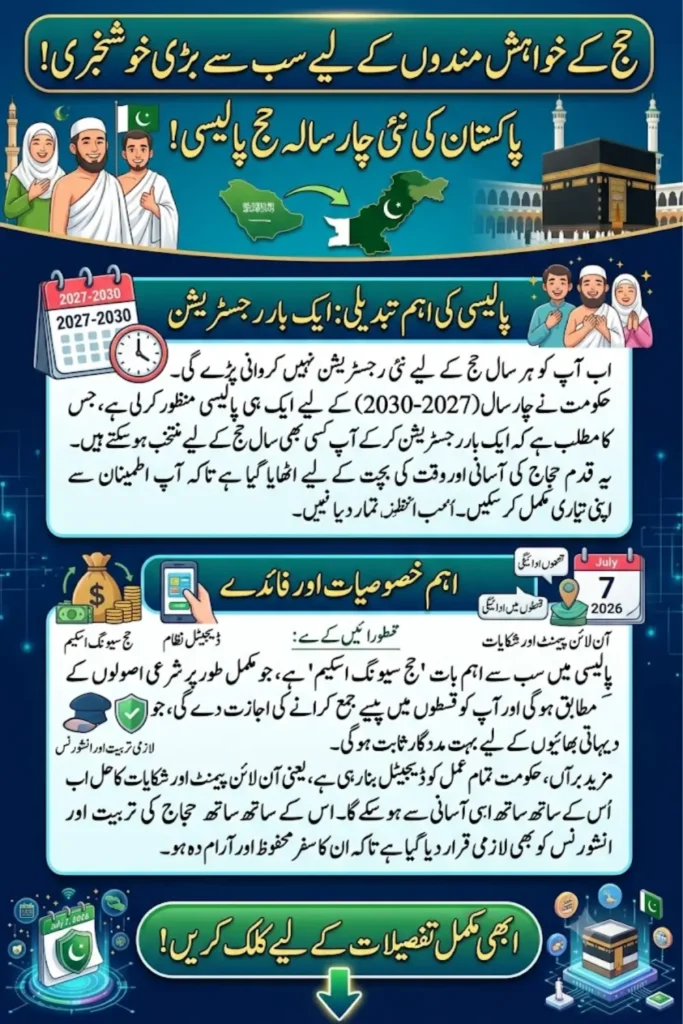
Here’s the headline change most people care about: you won’t need to register for Hajj every single year anymore. Under the new system, intending pilgrims complete registration once and then pick any Hajj year they prefer, up to and including 2030.
This single change removes a genuine source of frustration for families who’d been trying to time their pilgrimage around finances, health, or work schedules. Instead of missing one year’s window and waiting for the next annual announcement, applicants stay in the system continuously.
Priority Waiting List Explained
So what happens to everyone who registers? The government will maintain a priority-based waiting list built from registration data. Officials haven’t published the exact ranking formula yet, since SOPs for the policy are still being written, but the basic idea is that your registration date and preferences determine roughly where you land in the queue.
Worth noting this waiting list runs alongside the existing quota split between government and private schemes, so your position also depends on which scheme you choose. Applicants who registered early for Hajj 2027, more than 232,000 people within the first two weeks of the campaign according to state broadcaster Radio Pakistan, are essentially the first cohort to test this new system.
Shariah-Compliant Hajj Savings Scheme
Money is usually the biggest barrier standing between a family and Hajj. Package costs run into the hundreds of thousands of rupees, and saving that amount in one go is tough for a lot of households. The new policy tries to address that directly.
The cabinet approved a Shariah-compliant Hajj savings scheme that lets prospective pilgrims put money aside gradually and arrange financing ahead of their trip, all structured to comply with Islamic financial principles. Full details contribution amounts, participating banks, timelines haven’t been released publicly yet, so treat any specific figures you see elsewhere with caution until MoRA issues formal guidance.
How the Savings Scheme Could Work
Similar Shariah-compliant savings products in Pakistan’s banking sector typically work through monthly or periodic deposits into a dedicated account, with profits distributed according to Islamic finance rules rather than fixed interest. If the Hajj savings scheme follows that model, participants would likely build up their pilgrimage fund over months or years rather than facing one lump-sum payment close to departure.
That’s a reasonable assumption based on how other government-backed Shariah savings products operate in Pakistan, but it isn’t officially confirmed for this specific scheme. Anyone budgeting for Hajj 2028, 2029, or 2030 should wait for the Ministry of Religious Affairs to publish the scheme’s actual terms before making financial commitments.
Digitization of Pakistan’s Hajj System
Paper-based Hajj processing has been a headache for both pilgrims and administrators for years lost forms, long bank queues, and complaints that seemed to vanish into a void. The new policy pushes hard toward fixing that.
Officials told the cabinet that Pakistan is digitizing the entire Hajj management system, covering online payment mechanisms, a digital complaints platform, and electronic monitoring throughout the pilgrimage. This isn’t entirely new the National IT Board already supported a paperless registration drive for Hajj 2027 but the four-year policy formalizes digitization as a permanent feature rather than a one-off pilot.
What Pilgrims Can Expect Online
Registration for Hajj 2027 already runs through the online Hajj Portal and the Pak Hajj mobile app, letting applicants sign up from home without visiting a bank branch. Do you remember standing in line just to submit a form? That era is fading fast for Pakistani pilgrims.
Going forward, expect online payments, digital tracking of complaints, and app-based monitoring to extend across the full Hajj journey, not just the registration stage. Overseas Pakistanis benefit here too, since the digital system lets them register from abroad, though NADRA biometric verification still requires a visit to a facilitation center in select diaspora cities or a trip back home.
Social Media Tax in Pakistan 2026: 5% Withholding Tax on Digital Income Approved in Finance Bill
Government vs Private Hajj Quotas
Pakistan’s Hajj allocation is split between two channels: the government scheme, run directly by the Ministry of Religious Affairs, and licensed private tour operators. The new policy keeps this dual structure but adds long-duration and short-duration package options within it.
For context, here’s how the quota and policy structure compares between the outgoing annual system and the new four-year plan.
| Feature | Old Annual Hajj Policy | New Hajj Policy 2027-2030 |
|---|---|---|
| Policy duration | Renewed every year | Fixed for four years (2027-2030) |
| Registration | Required annually | One-time, valid through 2030 |
| Waiting list | Not standardized | Priority-based, continuously maintained |
| Savings option | None | Shariah-compliant savings scheme |
| Processing | Largely paper-based, partial digitization | Fully digitized payments, complaints, monitoring |
| Package types | Varied by year | Long-duration and short-duration options confirmed |
Pakistan’s total Hajj quota for 2026 stood at 179,210 pilgrims, split between government and private schemes. Saudi Arabia hasn’t announced country-specific quotas for 2027 yet, and Religious Affairs Minister Sardar Muhammad Yousaf has publicly asked Riyadh to raise Pakistan’s allocation to around 230,000, citing the country’s growing Muslim population.
Pilgrim Training, Takaful and Emergency Response
Beyond registration and payments, the policy also tightens up what happens once pilgrims are actually on their way to Saudi Arabia. Mandatory training sessions, insurance coverage, and emergency protocols are all written into the framework.
Here’s what the cabinet confirmed as part of these pilgrim-focused reforms:
- Mandatory training for all intending pilgrims before departure
- Takaful (Islamic insurance) arrangements built into both government and private packages
- Emergency response measures for medical or logistical issues during Hajj
- Third-party validation of both government and private Hajj operations, ordered directly by the prime minister
- Merit-based, transparent appointment of Hajj assistants (Hajj Moavineen) who accompany pilgrim groups
That third-party validation point matters more than it might seem at first glance. Pakistan’s private Hajj sector has faced serious accountability problems in recent years reports of operator failures have left thousands of pilgrims stranded or unable to travel despite paying in full. Requiring outside verification of operator performance is a direct response to that track record, and it’s arguably one of the more consequential parts of the new policy.
Pakistan Hajj Policy 2027–2030
First-ever four-year Hajj framework approved by the federal cabinet on July 7, 2026 — replacing annual registration with a single continuous system.
Key Reforms
Six changes at the center of the new framework.
One-Time Registration
Register once, choose any Hajj year through 2030 — no annual re-application.
Shariah Savings Scheme
Save gradually and arrange Islamic-compliant financing for future Hajj costs.
Full Digitization
Online payments, digital complaints and electronic monitoring end-to-end.
Priority Waiting List
Registrations feed a continuously maintained, priority-based queue.
Takaful & Training
Mandatory pilgrim training, Islamic insurance and emergency response built in.
Third-Party Validation
Independent checks on government and private Hajj operators, ordered by the PM.
Old vs. New System
Toggle to compare the previous annual policy against the 2027–2030 framework.
| Feature | Approach |
|---|---|
| Policy duration | BeforeRenewed every single year NowFixed for four years (2027–2030) |
| Registration | BeforeRequired annually NowOne-time, valid through 2030 |
| Savings option | BeforeNone NowShariah-compliant savings scheme |
| Processing | BeforeLargely paper-based NowFully digitized end-to-end |
| Detail | Status |
|---|---|
| Pakistan’s 2026 quota | 179,210 pilgrims |
| Pakistan’s 2027 quota | Not yet announced by Saudi Arabia; ~230,000 requested |
| Hajj 2027 registration cost | Free of charge |
| Hajj 2027 sign-ups so far | 232,000+ in first 14 days |
Quick Answers
Common questions about the new policy.
Hajj 2027 Preparations and Quota Talks
Hajj 2026 wrapped up in Saudi Arabia in May, with roughly 1.6 million pilgrims from around the world taking part. Pakistan's government didn't wait long to start preparing for the next cycle mandatory registration for Hajj 2027 opened in June, a full year before the pilgrimage itself.
That early start reflects the same long-term thinking behind the four-year policy. Rather than waiting for a new annual policy to trigger registration, MoRA launched the Hajj 2027 sign-up process independently, using the digital infrastructure the ministry has been building out.
Registration Numbers So Far
The response has been strong. More than 51,000 people registered within the first two days of the campaign, and that number climbed past 232,000 within 14 days, according to Radio Pakistan and Ministry of Religious Affairs figures. Of the early applicants, roughly 41,000 chose the government scheme and around 10,000 opted for private operators, based on the ministry's initial breakdown.
Below is a quick snapshot comparing what's known about Hajj 2026 and the still-developing Hajj 2027 cycle.
| Detail | Hajj 2026 | Hajj 2027 (as of July 2026) |
|---|---|---|
| Pakistan's quota | 179,210 pilgrims | Not yet announced by Saudi Arabia; Pakistan seeking ~230,000 |
| Registration model | Annual, one-time for that year | First year under the 2027-2030 continuous system |
| Registration cost | N/A (concluded) | Free of charge |
| Passport validity requirement | N/A (concluded) | Must remain valid well into November 2027 |
| Total pilgrims worldwide | Approximately 1.6 million | Not yet confirmed |
Package costs, exact quota splits, and application deadlines for Hajj 2027 haven't been finalized publicly. The Ministry of Religious Affairs has said those details will come in a later phase, so anyone budgeting right now should treat current estimates as provisional rather than final.
FAQs
What is Pakistan's new four-year Hajj policy?
It's the Hajj Policy and Plan 2027-2030, approved by the federal cabinet on July 7, 2026. It's Pakistan's first multi-year Hajj framework, replacing the previous system of issuing a fresh policy every single year.
Do I need to register for Hajj every year in Pakistan now?
No. Under the new policy, pilgrims register once and can select any Hajj year through 2030, rather than completing the registration process annually. Authorities then place registered applicants on a priority waiting list.
What is the Shariah-compliant Hajj savings scheme?
It's a planned savings program that will let prospective pilgrims set aside money gradually and arrange financing for future Hajj expenses in line with Islamic financial principles. Specific terms, such as contribution amounts and participating banks, haven't been officially released yet.
How many people have registered for Hajj 2027 so far?
More than 232,000 people registered within the first 14 days of the Hajj 2027 registration drive, according to Radio Pakistan and the Ministry of Religious Affairs. Registration remains open and continues under the mandatory drive launched in June 2026.
What is Pakistan's Hajj quota for 2027?
Saudi Arabia has not yet announced country-specific Hajj quotas for 2027. Pakistan's 2026 quota was 179,210 pilgrims, and the government has requested an increase to around 230,000 for 2027 to better match its population.
BlackBerry QNX Expansion: Growth in Automotive, Robotics, Industrial Automation and Medical AI