Germany IT Immigration Law 2026: New Visa Rules, EU Blue Card Salary Requirements and Skilled Worker Pathways

Germany IT Immigration Law 2026: New Visa Rules, EU Blue Card Salary Requirements and Skilled Worker Pathways

Germany IT Immigration Law 2026

Germany has updated its immigration system in 2026 to attract skilled IT professionals from different countries. The new framework focuses on simplifying visa procedures, improving clarity in rules, and making residency options more accessible for qualified tech workers.

These reforms are designed to meet Germany’s growing demand for IT talent. The updated law supports faster hiring, better mobility for professionals, and stronger alignment between job offers and residency approvals.

Huawei Nova 16 Series : Nova 16 Ultra, Pro, Nova 16 & Nova 16z Specifications, Features and Prices

Germany IT Immigration Law 2026: New Visa Rules, EU Blue Card Salary Requirements and Skilled Worker Pathways

Why Germany Is Changing IT Immigration Rules in 2026

Germany is facing a shortage of skilled workers in the technology sector, especially in software development, cybersecurity, and data-related fields. To address this gap, the government has introduced more flexible immigration routes for international professionals.

The new system also ensures that companies can hire foreign talent more efficiently. By reducing administrative delays, Germany aims to remain competitive in the global tech labor market and attract highly skilled individuals.

  • Faster visa approval process for IT professionals
  • Easier access to long-term residency through employment

Germany has introduced updated IT immigration rules for 2026 to make it easier for qualified foreign tech professionals to work and settle in the country. The revised framework streamlines visa processing, expands pathways for experienced IT workers without degrees, and supports faster access to long-term residency.

Residence Permit for Skilled Workers (Sections 18a and 18b)

The Skilled Worker Residence Permit is one of the main pathways for IT professionals under Germany’s immigration system. It is designed for individuals who have recognized academic or vocational qualifications and a valid job offer from a German employer.

Applicants must ensure their qualifications are officially recognized in Germany. In addition, approval from the Federal Employment Agency may be required depending on the job role and contract conditions.

EU Blue Card Germany (Section 18g)

The EU Blue Card is a fast-track immigration option for highly qualified professionals in the IT sector. It is mainly designed for individuals with a university degree and a relevant job offer from a German company.

The minimum annual salary requirement for the EU Blue Card is €45,934.20. In some cases, if the salary exceeds €50,700, the approval requirement from the Federal Employment Agency may be removed, making the process faster.

GWM Cannon Alpha Price in Pakistan 2026 Expected Launch Date, Specs and Features

IT Immigration Visa Options in Germany 2026

Germany offers multiple visa pathways depending on education, experience, and salary level. These options allow both degree holders and experienced professionals to apply for work opportunities in the country.

The system is designed to be flexible so that companies can hire skilled workers based on both academic qualifications and practical IT experience.

Visa TypeRequirementKey Condition
Skilled Worker Permit (18a/18b)Degree or vocational qualificationJob offer required
EU Blue Card (18g)University degreeMinimum salary €45,934.20
Fast Track Blue CardHigh salary job€50,700+ removes approval requirement
Experience-Based RouteIT experienceJob offer required

IT Professionals Without University Degree Pathways

Germany also provides immigration options for IT professionals who do not hold a university degree but have strong practical experience. These routes help companies fill technical positions even when formal education is missing.

Applicants must demonstrate relevant IT experience and secure a valid job offer from a German employer. Salary requirements and federal approval conditions still apply depending on the chosen route.

Experience-Based IT Route Requirements

This route is designed for professionals with substantial work experience in the IT field. It allows skilled individuals to apply based on their practical knowledge instead of academic qualifications.

Applicants must show at least three years of IT experience within the last seven years. A valid job offer is mandatory, and salary conditions must meet German immigration standards.

Simplified Tech Route Requirements

The simplified route is aimed at mid-level IT professionals with shorter but relevant experience. It offers a more accessible pathway for workers with strong technical skills.

Applicants must have at least two years of IT experience within the last five years. A job offer is required, along with a minimum salary threshold of €45,630 annually.

Salary Requirements for Germany IT Immigration 2026

Salary thresholds play an important role in determining eligibility for different visa categories. These thresholds ensure that foreign workers meet Germany’s labor market standards.

Higher salaries often lead to faster approval and fewer administrative requirements. This system also helps differentiate between skilled worker levels and senior professionals.

CategoryMinimum Salary Requirement
EU Blue Card€45,934.20 per year
Fast Track Blue Card€50,700+ per year
Experience-Based RouteBased on job offer
Simplified Tech Route€45,630 per year

Collective Bargaining and Salary Flexibility

Germany allows flexibility in salary requirements for companies that are part of collective bargaining agreements. These agreements ensure fair wages and working conditions for employees.

In such cases, employers can hire international IT professionals even if standard salary thresholds differ, as long as workers receive equal rights and protections under German labor laws.

Conclusion

Germany’s IT immigration law in 2026 creates a structured and flexible system for attracting global tech talent. It balances skilled worker protection with industry demand, making it easier for professionals to find job opportunities.

With multiple visa pathways, including the EU Blue Card and experience-based routes, Germany continues to position itself as a leading destination for IT professionals worldwide.

Upcoming 23 EVs and Hybrid Cars in Pakistan 2026 Launch Dates and Model List

FAQs

What is Germany IT Immigration Law 2026?
It is a revised immigration system designed to attract skilled IT professionals with simplified visa and residency options.

What is the EU Blue Card salary requirement in Germany 2026?
The minimum salary requirement is €45,934.20 per year for eligible applicants.

Can IT professionals apply without a university degree?
Yes, Germany offers experience-based visa routes for skilled IT workers without formal degrees.

What is the fastest visa option for IT workers?
The EU Blue Card is the fastest option, especially for applicants with higher salaries and qualifications.

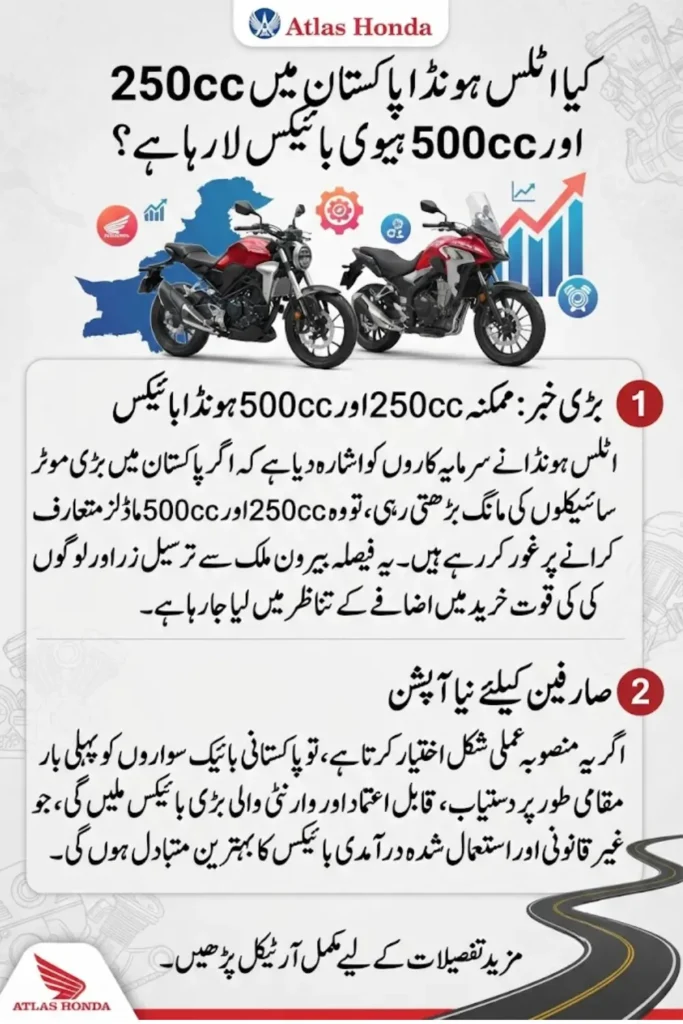
Atlas Honda Hints at 250cc and 500cc Bikes for Pakistan as Premium Demand Grows

Atlas Honda Hints at 250cc and 500cc Bikes for Pakistan as Premium Demand Grows

Atlas Honda Hints at 250cc and 500cc Bikes

Atlas Honda 250cc and 500cc motorcycles might not be far-fetched anymore. Pakistan’s largest two-wheeler maker has told investors it’s watching the premium bike segment closely, and could roll out bigger-engine models if current demand trends hold up.

The signal came from the company’s MY26 Corporate Briefing Session, not a formal product announcement. That distinction matters, and it’s worth unpacking exactly what Atlas Honda said, why now, and what it could mean for buyers who’ve been waiting for a locally backed heavy bike option.

What Did Atlas Honda Say at Its MY26 Briefing?

Atlas Honda told investors during its MY26 Corporate Briefing Session that it may introduce 250cc and 500cc motorcycles in Pakistan if demand for larger-engine bikes keeps rising. Management linked this growth to higher overseas remittances and stronger consumer buying power, alongside plans to raise annual production capacity from 1.65 million to 2 million units by December 2026.

The briefing was attended by Topline Securities, a brokerage house that regularly publishes notes on listed companies after such sessions. Chief Executive Officer Saquib Shiraz and other senior executives walked analysts through the company’s financial performance, growth outlook, and expansion strategy. Nothing here was framed as a confirmed launch it’s a possibility management is keeping on the table, contingent on how the market behaves over the coming months.

That said, honestly, this kind of language from a company as conservative as Atlas Honda is notable. It doesn’t typically float new segments unless internal data already points that way.

GIKI MS & PhD Assistantship 2026: New Stipends, Eligibility, Benefits and Deadline

Atlas Honda Hints at 250cc and 500cc Bikes for Pakistan as Premium Demand Grows

Why Is Atlas Honda Eyeing 250cc and 500cc Motorcycles?

Rising Remittances and Premium Bike Demand

Higher remittance inflows from overseas Pakistanis have been feeding into household spending power, and motorcycle buyers are part of that pattern. Atlas Honda’s management pointed to this trend directly, noting that sales of premium, higher-displacement motorcycles have picked up as a result.

This isn’t unique to Honda. Across Pakistan’s bike market, buyers with access to remittance income or improved savings have gradually moved toward bikes above the traditional 70cc-125cc commuter range. If that shift continues, a locally available 250cc or 500cc Honda would give buyers an alternative to grey-market imports and used heavy bikes, which currently dominate that space.

A Broader Shift Toward Above-100cc Motorcycles

Atlas Honda also flagged that motorcycles above 100cc are steadily gaining market share as consumer demand improves. Small commuter bikes still dominate by volume, but the mix is changing gradually, year over year.

Think about what this means for a company that built its name on the 70cc CD 70 and the 125cc CG 125. Moving upmarket into 250cc and 500cc territory would be a genuine strategic shift, not just a new SKU tacked onto the existing lineup.

PWDP Internship Batch II Punjab Psychology Internship Check Complete Detail

Atlas Honda’s Production Capacity Expansion Plans

Capacity is the other big theme from the briefing, and it directly supports any move into bigger bikes. Atlas Honda’s current rated capacity sits at 1.65 million motorcycles a year. Once an ongoing expansion project wraps up by December 2026, that figure is expected to rise to 2 million units annually.

The company pegged the capital expenditure for this expansion at roughly Rs. 5–6 billion. That’s a meaningful investment, and it signals the company expects demand to keep climbing rather than plateau a reasonable bet given Pakistan’s bike-buying population and its heavy reliance on two-wheelers for daily transport.

Current vs. Planned Capacity

MetricCurrent StatusAfter Expansion
Rated annual capacity1.65 million units2 million units
Expected completionOngoingDecember 2026
Capital expenditureRs. 5–6 billion
Current utilizationAbove rated capacity (via overtime & vendors)To be confirmed post-expansion

Meeting Demand Through Overtime and Vendor Support

Interestingly, Atlas Honda is already producing above its rated capacity. Management said it’s leaning on overtime shifts and support from its vendor ecosystem to keep pace with strong market demand right now.

That’s not a sustainable long-term setup, though it works as a stopgap, not a strategy. The expansion to 2 million units is meant to close that gap and give the company enough headroom for both existing models and any future 250cc or 500cc additions.

Does Atlas Honda Already Sell Bigger Bikes in Pakistan?

Here’s a detail casual readers might miss: Atlas Honda isn’t entirely new to bigger machines. Models like the CB500X, CBR600RR, CBR1000RR Fireblade, and the Gold Wing have appeared in Pakistan through limited import channels rather than local assembly, often in small numbers for showcases, dealership displays, or specialized use.

  • The CB500X has previously been used by police units in Punjab for patrol duties, showing the platform already has some local track record.
  • Larger Honda models such as the CBR600RR and Gold Wing exist mainly as completely built-up (CBU) imports, sold in far smaller volumes than mainstream commuter bikes.

So a 250cc or 500cc launch wouldn’t be Atlas Honda’s first brush with bigger displacement — it would be the first attempt to bring that segment into a more mainstream, locally supported sales and service network.

Market Trends: Recovery and Competition From Chinese Brands

Two-Wheeler Market Recovery to 2.3 Million Units

Pakistan’s overall two-wheeler market has recovered to around 2.3 million units, according to figures shared at the briefing. That’s a meaningful rebound after a stretch of economic pressure that hit motorcycle sales industry-wide over the past couple of years.

Recovery isn’t uniform across brands, though. Some manufacturers have gained ground faster than others, and the shift in buyer preference toward higher-cc bikes is part of what’s reshaping that competitive picture.

Chinese Motorcycle Brands Lose Ground

Sales from Chinese motorcycle brands have dropped significantly compared to their historical peak, Atlas Honda noted. Meanwhile, bikes above 100cc continue to claim a bigger slice of the overall market.

Market SegmentTrend DirectionKey Driver
Overall two-wheeler marketRecovered to ~2.3 million unitsGeneral economic stabilization
Chinese motorcycle brandsDeclined sharply from peakReduced price competitiveness, buyer preference shift
Above-100cc motorcyclesGaining market shareRising incomes, remittances, buyer upgrades

If you’ve followed Pakistan’s bike market over the last decade, you’ll remember when Chinese-brand bikes flooded the entry-level segment on price alone. That advantage seems to be narrowing now, with buyers who can afford it trading up rather than staying loyal to the cheapest option.

Pricing, EV Plans, and the Farm Income Outlook

No Major Price Hikes in Three Years

Atlas Honda said it hasn’t raised motorcycle prices over the past three years, apart from adjustments tied to government levies. That’s a fairly notable claim given how much input costs and currency pressure have squeezed manufacturers across Pakistan’s auto sector during that same period.

Whether this holds for any future 250cc or 500cc models remains to be seen larger-displacement bikes typically carry higher import duties and different tax treatment than commuter bikes, so pricing them competitively would be a separate challenge altogether.

Electric Vehicle Plans Remain Limited for Now

On electric motorcycles, Atlas Honda said no additional investment is currently planned. The company believes its existing facilities are sufficient to meet expected EV demand, at least for the near term.

This suggests EVs aren’t the company’s immediate growth focus, even as several competitors and new entrants push electric two-wheelers more aggressively. Atlas Honda appears to be betting more heavily on the premium petrol segment for now.

  • Rising farm incomes remain a core growth driver, since Atlas Honda’s management noted that close to 60% of its customer base has ties to farming activity.
  • Discussions around a new auto policy are still speculative, with no official government announcement made, and recent FY2026-27 budget tariff adjustments haven’t materially affected the motorcycle industry so far.

What This Could Mean for Pakistani Bike Buyers

If Atlas Honda does move ahead, buyers could get access to a locally backed 250cc or 500cc motorcycle with proper dealership support, spare parts availability, and warranty coverage something the used and grey-import heavy bike market often lacks.

That’s a real gap in the current market. Anyone who’s shopped for a bigger bike in Pakistan knows the trade-off: imported machines often mean uncertain parts supply and shaky resale value, while local commuter bikes simply don’t scale up to that displacement.

None of this is guaranteed yet, and Atlas Honda has been careful to frame it as conditional. Demand needs to keep growing, and the capacity expansion needs to land on schedule, before any 250cc or 500cc model moves from possibility to product.

PWDP Volunteer Program Punjab 2026: Apply for This One-Year Opportunity

Conclusion

Atlas Honda’s 250cc and 500cc motorcycle plans are still at the exploration stage, not a confirmed launch. But the pieces lining up rising remittance-driven demand, a capacity expansion to 2 million units by December 2026, and a market that’s already tilting toward above-100cc bikes suggest the company is preparing itself for that possibility rather than ruling it out. For now, buyers interested in Atlas Honda’s move into bigger bikes will need to watch for an official product announcement, since everything shared so far has come through investor briefings rather than a formal launch event.

FAQs

Has Atlas Honda officially confirmed a 250cc or 500cc motorcycle launch?

No. Atlas Honda has only said it may introduce these models if demand for higher-displacement bikes keeps growing. This came from an investor briefing, not a formal product launch announcement.

When will Atlas Honda’s production capacity increase to 2 million units?

The company expects its ongoing expansion project to be completed by December 2026, raising rated annual capacity from 1.65 million to 2 million motorcycles. The expansion carries an estimated capital expenditure of Rs. 5–6 billion.

Does Atlas Honda already sell any 250cc or 500cc bikes in Pakistan?

Yes, in limited numbers. Models like the CB500X, CBR600RR, and Gold Wing have been available through import channels rather than local mass production, often in small volumes for select buyers or institutional use.

Why has Atlas Honda not increased motorcycle prices in three years?

Management stated it has held prices steady over the past three years, aside from adjustments linked to government levies. The company hasn’t detailed the exact factors behind this stability beyond that statement.

Is Atlas Honda planning to invest more in electric motorcycles?

Not at the moment. The company said no additional investment is currently planned for EV production, as it considers its existing facilities sufficient to meet expected electric motorcycle demand.

GIKI MS & PhD Assistantship 2026: New Stipends, Eligibility, Benefits and Deadline

GIKI MS & PhD Assistantship 2026: New Stipends, Eligibility, Benefits and Deadline

GIKI MS & PhD Assistantship

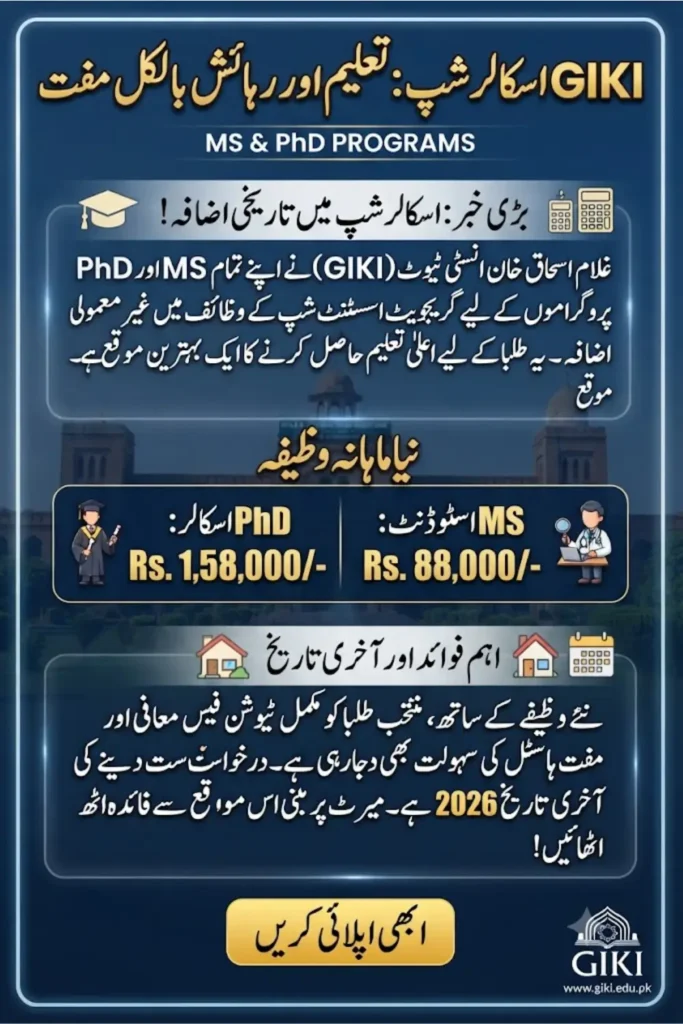
GIKI Graduate Assistantship funding just got a serious upgrade, and if you’re considering an MS or PhD at the Ghulam Ishaq Khan Institute, this changes the math on affording it. The institute has rolled out new assistantship rates for students in its graduate programs, with PhD scholars now eligible for a considerably higher monthly stipend than before.

Located in Topi, Khyber Pakhtunkhwa, GIKI has long offered assistantship support to graduate students. But this latest scheme introduced ahead of Fall 2026 admissions pushes stipend amounts well past what the institute has historically paid out, at least based on what’s shown on its own admissions page.

What Is the New GIKI Graduate Assistantship Scheme?

GIKI has introduced updated graduate assistantships aimed at supporting researchers across its MS and PhD programs. Reporting from ProPakistani puts the new stipend figures at Rs. 158,000 per month for PhD scholars and Rs. 88,000 per month for MS students — numbers that mark a substantial jump from the institute’s longstanding assistantship rates.

Free tuition and free hostel accommodation come bundled in for selected students too, so the total value of the package goes well beyond the monthly cash figure. Worth noting: GIKI’s own graduate admissions page confirms that a “newly introduced graduate assistantship scheme” now applies to all Fall 2026 applicants, though at the time of writing, the published stipend tables on that same page still reflect older figures — Rs. 20,000 to Rs. 75,000 depending on the scheme tier. That’s a gap prospective students should clarify directly with the admissions office before assuming which numbers apply to their specific application.

Toyota Corolla Cross HEV Price Increase in Pakistan: What Changed and Why Complete Details

GIKI MS & PhD Assistantship 2026: New Stipends, Eligibility, Benefits and Deadline

Why the Increase Matters

Anyone who’s tracked GIKI’s assistantship rates over the past few years will notice this isn’t a small bump — it’s a genuine overhaul. The previous top-tier PhD assistantship (GA-3) topped out at Rs. 75,000 a month, while MS-level assistantships sat as low as Rs. 20,000. Going from Rs. 75,000 to a reported Rs. 158,000 for PhD scholars is more than double.

For a country where research funding at the graduate level has often lagged behind cost-of-living increases, a stipend increase at this scale is the kind of thing that changes whether talented students actually pursue a research degree instead of heading straight into industry. If you’ve applied for graduate funding in Pakistan before, you’ll know how rare it is to see an increase this large announced all at once.

Eligible Programs and Application Details

The assistantship scheme covers every MS and PhD program at GIKI, spanning both engineering and applied sciences. This isn’t limited to one department chasing funding it’s an institute-wide rollout.

Programs covered under the scheme include Artificial Intelligence, Computer Engineering, Computer Science, Chemical Engineering, Civil Engineering, Electrical Engineering, Electronic Engineering, Engineering Management, Engineering Sciences, Materials Engineering, Mechanical Engineering, and Nanotechnology and Materials Engineering. That’s a genuinely broad spread, covering nearly every technical discipline GIKI teaches at the graduate level.

Who Gets Automatically Considered

Here’s something that’ll matter to anyone who already applied before this announcement went public:

  • All submitted applications for GIKI’s graduate programs are automatically considered for the new assistantship scheme
  • Applications already in progress at the time of the announcement don’t need to be resubmitted
  • No separate assistantship-specific form is required beyond the standard graduate admission application
  • Selection still runs on merit, based on the admission test, interview performance, and prior academic record

That last point is consistent with how GIKI has always run its assistantship schemes — funding follows merit, not a separate application track.

Old vs. New GIKI Assistantship Stipends

To put the new numbers in perspective, here’s how the previously published rates compare with the figures now being reported for the new scheme.

LevelPrevious Top Stipend (GIKI official page)Newly Announced Stipend
MS studentsRs. 20,000/monthRs. 88,000/month
PhD scholarsRs. 75,000/monthRs. 158,000/month
TuitionFull waiver (select schemes)Free tuition
AccommodationFree bachelor accommodationFree hostel accommodation

GIKI Graduate Programs at a Glance

Discipline areaSample programs
Computing & AIArtificial Intelligence, Computer Science, Computer Engineering
Core EngineeringElectrical Engineering, Electronic Engineering, Mechanical Engineering, Civil Engineering
Materials & ChemicalChemical Engineering, Materials Engineering, Nanotechnology and Materials Engineering
Management & SciencesEngineering Management, Engineering Sciences

How to Apply for the GIKI Assistantship

Since existing applicants are automatically rolled into consideration, the practical step for new applicants is simply applying to a GIKI graduate program before the deadline. GIKI’s application deadline for this cycle is July 31, 2026, based on current reporting — a date well worth double-checking against the institute’s official admissions portal since deadlines for graduate cycles have shifted in past years.

Selection still comes down to the same fundamentals GIKI has always used: performance in the admission test or interview, your academic credentials, and your CGPA or grades from prior degrees. Given that assistantships are described as limited in number even under the new scheme, it’s smart to have transcripts and test prep sorted well ahead of the deadline rather than scrambling in the final week.

Documents and Prep Worth Having Ready

Based on GIKI’s standard graduate admission process, applicants typically need the following in order:

  • Complete academic transcripts from your BS or MS program, depending on which degree you’re applying for
  • Admission test or interview scheduling confirmation, since assistantship merit ranking depends heavily on this
  • CNIC and standard identity documentation required for Pakistani university admissions
  • A clear sense of which specific MS or PhD program and discipline you’re targeting, since assistantship allocation happens per discipline

Getting these ready early gives you breathing room if the admissions office asks for clarifications or additional documents closer to the deadline.

Final Word

The GIKI Graduate Assistantship overhaul is a meaningful jump for anyone weighing a research-based MS or PhD in Pakistan, especially with PhD stipends reportedly moving to Rs. 158,000 and MS stipends to Rs. 88,000 a month. Given that GIKI’s own published stipend tables haven’t fully caught up with these new figures yet, prospective applicants should confirm exact terms directly with the graduate admissions office before finalizing their decision but the direction of this change is clearly a strong one for Pakistan’s engineering research pipeline.

FAQs

What is the new GIKI graduate assistantship stipend?

GIKI’s newly introduced scheme offers PhD scholars a reported monthly stipend of Rs. 158,000 and MS students Rs. 88,000, along with free tuition and hostel accommodation. These figures are notably higher than the institute’s previously published assistantship rates.

What is the deadline to apply for GIKI’s MS/PhD assistantship?

The application deadline for this assistantship cycle is July 31, 2026. Applicants should confirm this date directly with GIKI’s admissions office, since deadlines for graduate intakes have varied across previous cycles.

Do I need a separate application for the GIKI assistantship?

No. GIKI automatically considers all submitted and in-progress graduate program applications for the newly introduced assistantship scheme, so a standard MS or PhD application is sufficient.

Which programs are covered under the GIKI assistantship scheme?

The scheme covers all MS and PhD programs at GIKI, including Artificial Intelligence, Computer Science, Computer Engineering, Chemical Engineering, Civil Engineering, Electrical Engineering, Electronic Engineering, Engineering Management, Engineering Sciences, Materials Engineering, Mechanical Engineering, and Nanotechnology and Materials Engineering.

How is the GIKI assistantship awarded?

Assistantships are awarded on merit, based on the applicant’s performance in the admission test or interview, along with academic credentials and CGPA from prior degrees. The number of assistantships available in each discipline is limited.

Toyota Corolla Cross HEV Price Increase in Pakistan: What Changed and Why Complete Details

PWDP Internship Batch II Punjab Psychology Internship Check Complete Detail

PWDP Internship Batch II Punjab Psychology Internship Check Complete Detail

PWDP Internship Batch II

The PWDP Internship Program Batch II has opened applications for Psychology students across Punjab, giving them a real shot at working inside government schools instead of just reading about child development in a textbook. It’s run by the School Education Department, Government of Punjab, under the Psychological Well-being and Development Program (PWDP).

If you’re a BS or MS Psychology student, or you’ve graduated recently and are looking for hands-on field experience, this one’s worth a look. No stipend is attached, but the practical exposure and an official government certificate at the end aren’t nothing either.

Quick answer: The PWDP Internship Program Batch II is a three-month, unpaid internship from Punjab’s School Education Department for BS/MS Psychology students and recent graduates. Interns work inside government schools, running mental health awareness sessions, well-being activities, and student assessments, and receive an official completion certificate.

PWDP Volunteer Program Punjab 2026: Apply for This One-Year Opportunity

What Is the PWDP Internship Program Batch II?

PWDP stands for Psychological Well-being and Development Program, an initiative run by Punjab’s School Education Department to bring trained psychology talent directly into government classrooms. Batch II is, as the name suggests, the second round of this internship intake meaning the department has already run at least one earlier cycle before opening this one up.

Basically, the goal here is student mental health. Punjab’s public schools have been leaning harder into this space lately the District Education Authority Lahore, for instance, approved a related Psychology Development Program back in April 2026 aimed at grades nine and ten, covering resilience, personal safety, and career guidance under experts like Samavia Butt and Dayan Zafar. PWDP appears to build on that same push, though it’s worth noting that the exact institutional link between that earlier Lahore-specific rollout and this province-wide Batch II internship hasn’t been officially spelled out in public documentation.

Who Can Apply

Eligibility here is fairly specific, and it’s worth checking carefully before you fill anything out. The program targets:

  • BS Psychology students currently enrolled at HEC-recognized universities in Punjab
  • MS Psychology students at recognized institutions
  • Recent Psychology graduates who’ve completed their degree
  • Candidates genuinely interested in youth development and mental well-being work
  • Applicants who are willing and able to physically conduct sessions inside government schools

That last point matters more than people expect this isn’t a remote or desk-based internship. You’ll be present in schools, working directly with students and staff.

PWDP Internship Batch II Punjab Psychology Internship Check Complete Detail

What the Internship Actually Involves

Interns spend three months embedded in field-level work rather than sitting through lectures. Expect a mix of structured psychological well-being sessions, student assessments, and awareness activities built around real classroom settings.

There’s also a training component built into the process orientation sessions, reporting requirements, and ongoing field implementation support run alongside the core internship work. If you’ve done any kind of practicum placement before, you’ll recognize the format: guided fieldwork with check-ins, not just being dropped into a school and left to figure things out alone.

What You Actually Gain From It

Since this is unpaid, it’s fair to ask what you’re getting out of three months of volunteer work. Here’s the honest rundown:

  • Structured professional training in school-based mental health delivery
  • Real leadership, communication, and facilitation practice not simulated, actual sessions with actual students
  • Direct networking exposure to education professionals and government officials, which can matter a lot for future opportunities
  • An official internship certificate issued by the School Education Department, Government of Punjab, upon successful completion

That certificate carries some weight for anyone building a CV aimed at government-sector psychology roles or NGO-based child development work later on.

Upcoming 23 EVs and Hybrid Cars in Pakistan 2026 Launch Dates and Model List

How PWDP Compares to Other Punjab Education Department Internships

It helps to see where PWDP sits next to other Punjab School Education Department programs people often confuse it with, like the School Teacher Interns (STI) scheme.

FeaturePWDP Internship (Batch II)STI (School Teacher Interns)
FieldPsychology / mental healthTeaching
EligibilityBS/MS Psychology students, recent graduatesBA/BSc/MA/MSc/BS graduates
Duration3 monthsTypically 6–9 months
PaymentUnpaid, volunteer-basedPaid monthly stipend
PlacementGovernment schools (well-being sessions)Government schools (teaching duties)

Application Snapshot

DetailInformation
Program namePsychological Well-being and Development Program (PWDP)
BatchBatch II
DepartmentSchool Education Department, Government of Punjab
Duration3 months
CompensationUnpaid / volunteer-based
Application modeOnline form
CertificateYes, issued on successful completion

How to Apply

Applications go through an online form shared directly by PWDP. Before submitting, double check your university’s recognition status and make sure your academic details, especially your enrollment year and specialization, are entered accurately incomplete or mismatched information is one of the easiest ways to get an application rejected outright.

One thing worth flagging: exact application deadlines and total intern intake numbers for Batch II hadn’t been officially published in a way that could be independently verified at the time of writing. If you’re applying, it’s worth confirming current deadlines directly through the School Education Department’s official channels or the application form itself, rather than relying on secondhand dates floating around social media.

Final Word

The PWDP Internship Program Batch II gives Psychology students in Punjab a genuine, if unpaid, way to get inside government schools and do real fieldwork on student mental health. For anyone eyeing a career in school psychology, counseling, or public-sector child development work, three months of structured experience plus a government-issued certificate is a decent trade-off, even without a salary attached.

FAQs

What is the PWDP Internship Program Batch II?

It’s a three-month, unpaid internship run by Punjab’s School Education Department under the Psychological Well-being and Development Program (PWDP). It places Psychology students and graduates in government schools to run mental health awareness and well-being sessions.

Who is eligible for the PWDP internship in Punjab?

BS and MS Psychology students enrolled in recognized Punjab universities can apply, along with recent Psychology graduates. Applicants also need to be willing to physically conduct sessions inside government school premises.

Is the PWDP internship paid?

No, the PWDP Internship Program Batch II is volunteer-based and unpaid. Interns instead receive structured training, field experience, and an official completion certificate from the School Education Department.

How long does the PWDP internship last?

The internship runs for three months, covering orientation, training, and hands-on fieldwork in government schools across Punjab. Interns take part in assessments, awareness sessions, and interactive student activities during this period.

How do I apply for the PWDP Internship Batch II?

Applications are submitted through an online form shared by PWDP. Candidates should confirm current deadlines and eligibility details directly through official School Education Department channels before submitting.

Honor 600e Smartphone Launch 2026 Full Specs, Price, Battery and Features Explained

PWDP Volunteer Program Punjab 2026: Apply for This One-Year Opportunity

PWDP Volunteer Program Punjab 2026: Apply for This One-Year Opportunity

PWDP Volunteer Program Punjab

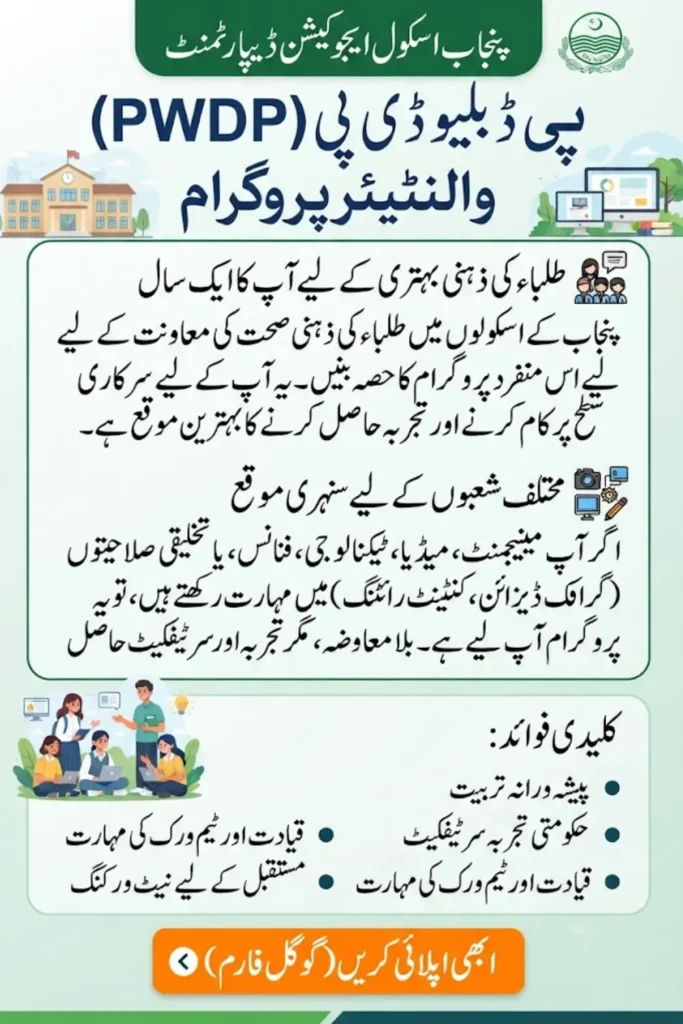
The Punjab School Education Department has just opened up something a bit different from the usual internship listings floating around right now. The PWDP volunteer program invites skilled young people to spend a year supporting student mental well-being across the province, and it’s open across a surprisingly wide range of professional backgrounds.

If you’ve been scrolling through job boards feeling like everything requires three years of experience you don’t have, this one’s worth a second look. It’s not paid work, but it’s also not asking for a finished resume either just relevant skills and genuine interest.

What Is the PWDP Volunteer Program?

PWDP stands for the Psychological Well-being and Development Program, an initiative run through Punjab’s School Education Department that focuses on student mental health across the province’s schools. This isn’t a brand-new concept for the department Punjab has been rolling out mental health-focused programs at the district level over the past year, and this volunteer drive appears to be part of that broader push to build support systems for students.

What makes this particular announcement notable is the scope. Rather than looking only for psychologists or counselors, the department is recruiting across management, media, technology, finance, content, and digital communication. Basically, if you have a skill that could support a public-sector team running a large program, there’s probably a slot that fits you.

It’s worth being upfront here too: this is a volunteer role, not a salaried government position. The department has stated this clearly in its own announcement, so anyone applying should go in with realistic expectations about compensation there isn’t any mentioned, beyond training, experience, and a certificate.

Xiaomi Sky Nomad New EREV Brand Debuts With N90 SUV

PWDP Volunteer Program Punjab 2026: Apply for This One-Year Opportunity

Available PWDP Volunteer Positions

Ten distinct roles are listed in the announcement, and they span both creative and operational work. That variety is actually one of the more useful things about this program it doesn’t box volunteers into a single career track.

Volunteer RoleBest Suited For
Program ManagementStudents or grads with organizational and coordination experience
Media and CommunicationJournalism, PR, or communications backgrounds
Human ResourcesThose with HR, recruitment, or people-management interest
TechnologyDevelopers, IT support, or systems-minded applicants
FinanceAccounting, budgeting, or financial analysis skills
Web DevelopmentFront-end or back-end developers
Videography and PhotographyVisual storytellers and content shooters
Social Media ManagementPlatform-savvy creators and community managers
Graphic DesignDesigners comfortable with branding and visual content
Content MarketingWriters and content strategists

Notice how technical and creative roles sit right alongside more traditional program-management positions? That’s intentional. A program this size genuinely needs people handling logistics as much as it needs people producing content or building tools.

How Roles Get Assigned

Applicants are expected to apply for the specific role matching their background, not a general “volunteer” category. That means your form submission should reflect real, demonstrable skills in whichever area you’re targeting.

If you’re a photography student, apply under videography and photography rather than trying to squeeze into program management just because it sounds more official. The department is clearly trying to match people to roles where they’ll actually contribute, not just fill seats.

What Volunteers Get From the Program

So what’s actually in it for volunteers, given there’s no salary attached? Quite a bit, honestly, if you’re early in your career or looking to build a public-sector track record.

  • Professional training and hands-on project experience throughout the program.
  • Direct exposure to working alongside government officials and subject-matter experts involved in student well-being initiatives.
  • Development of leadership, teamwork, communication, and project management skills through real project work rather than classroom simulations.
  • An official experience certificate issued after successful completion of the volunteer term.

None of this replaces a paycheck, and that’s a fair thing to weigh before applying. But for students, fresh graduates, or freelancers looking to add a credible government-affiliated project to their portfolio, the training and networking angle here does carry real value.

Who Should Apply for This Program?

The program casts a fairly wide net in terms of who’s eligible. Students, graduates, freelancers, content creators, designers, social media handlers, web developers, and photographers are all explicitly mentioned as suitable applicants.

That’s a broader pool than most government internship listings target. You don’t need to be enrolled in a specific degree program or have a background in psychology or education to qualify what matters more is whether your skill set lines up with one of the ten roles listed above.

  • Anyone genuinely interested in youth development, student support, or mental health awareness work.
  • Freelancers or students who want project experience tied to a public-sector initiative for their CV or portfolio.
  • Content creators, designers, or developers looking to apply their existing skills to a meaningful cause rather than starting from scratch in an unrelated field.

If you’ve worked on smaller community or university-level mental health awareness projects before, you’ll probably recognize the general shape of what PWDP is asking for here practical support work rather than clinical counseling itself.

How to Apply for the PWDP Volunteer Program

Applying is fairly straightforward. Interested candidates need to fill out the official Google Form shared as part of the department’s announcement, providing accurate details about their education, skills, experience, and the specific position they’re targeting.

Take your time on this form rather than rushing it. Since applicants are expected to match themselves to a role, vague or generic answers about “any position” likely won’t stand out against candidates who clearly explain why they fit a specific slot, like web development or content marketing.

Application Requirements to Keep Ready

Before you sit down to fill out the form, it helps to have a few things ready so you’re not scrambling halfway through.

  • Basic educational background and qualifications relevant to your chosen role.
  • A short summary of relevant skills or past project experience, even informal or freelance work counts.
  • Clarity on which single position you’re applying for, since the form appears to ask for a specific choice rather than multiple preferences.

One thing worth flagging: the official announcement doesn’t specify an application deadline, minimum age requirement, or exact number of open slots. If any of these details matter to your decision to apply, it’s worth reaching out to the School Education Department directly or watching for a follow-up notification, since this information hasn’t been officially confirmed yet.

PWDP Compared to Other Punjab Youth Programs

It helps to see where PWDP sits next to other youth-focused programs the Punjab government has recently rolled out, since a few of them get compared online and confusion is easy.

ProgramTypeDurationCompensation
PWDP Volunteer ProgramUnpaid volunteer role1 yearTraining, experience certificate
CM IT Internship ProgramPaid internship5 monthsRs. 50,000/month stipend
Climate Leadership Development InternshipPaid internship3 monthsRs. 60,000/month stipend
Punjab Young Professionals Program (P4A)Paid fellowship1 yearRs. 150,000/month stipend

The contrast is pretty clear. PWDP is the only one on this list without a stipend attached, but it’s also the only one explicitly built around student mental health work rather than infrastructure, IT, or climate policy. If a monthly income matters to you right now, one of the paid options above might be a better fit. If you’re after mission-driven experience in a niche that’s still growing in Pakistan’s public sector, PWDP has less competition and a genuinely different kind of resume value.

Toyota Corolla Cross HEV Price Increase in Pakistan: What Changed and Why Complete Details

Final Word on the PWDP Volunteer Program

The PWDP volunteer program gives skilled young Pakistanis a real shot at contributing to student mental health work without needing a psychology degree to get in the door. It won’t pay the bills, and the announcement still leaves some practical details, like deadlines and exact seat counts, unconfirmed. Still, for anyone wanting genuine public-sector project experience alongside a certificate to show for it, applying through the official Google Form is a low-risk way to find out if you’re a fit.

FAQs

What is the PWDP volunteer program in Punjab? It’s a one-year volunteer opportunity run by Punjab’s School Education Department under the Psychological Well-being and Development Program. Volunteers support student mental health initiatives across roles like media, technology, finance, and content creation.

Is the PWDP volunteer program a paid job? No, the department has clarified this is a volunteer-based opportunity, not a regular government job with a salary. Volunteers receive training, hands-on project experience, and an official experience certificate instead of pay.

Who can apply for the PWDP volunteer program? Students, graduates, freelancers, content creators, designers, web developers, and photographers are all eligible to apply. Applicants should choose the specific role that matches their existing skills and experience.

How do I apply for the PWDP volunteer program 2026? You can apply by filling out the official Google Form shared in the department’s announcement. Make sure to accurately list your education, skills, and the specific position you’re targeting.

What do PWDP volunteers receive after completing the program? Volunteers get professional training, hands-on experience working alongside government officials, and skill development in leadership and project management. They also receive an official experience certificate at the end of the program.

Matric and Inter Punjab Board Result Dates 2026 and Supplementary Exams Explained

Xiaomi Sky Nomad New EREV Brand Debuts With N90 SUV

Xiaomi Sky Nomad New EREV Brand Debuts With N90 SUV

Xiaomi Sky Nomad

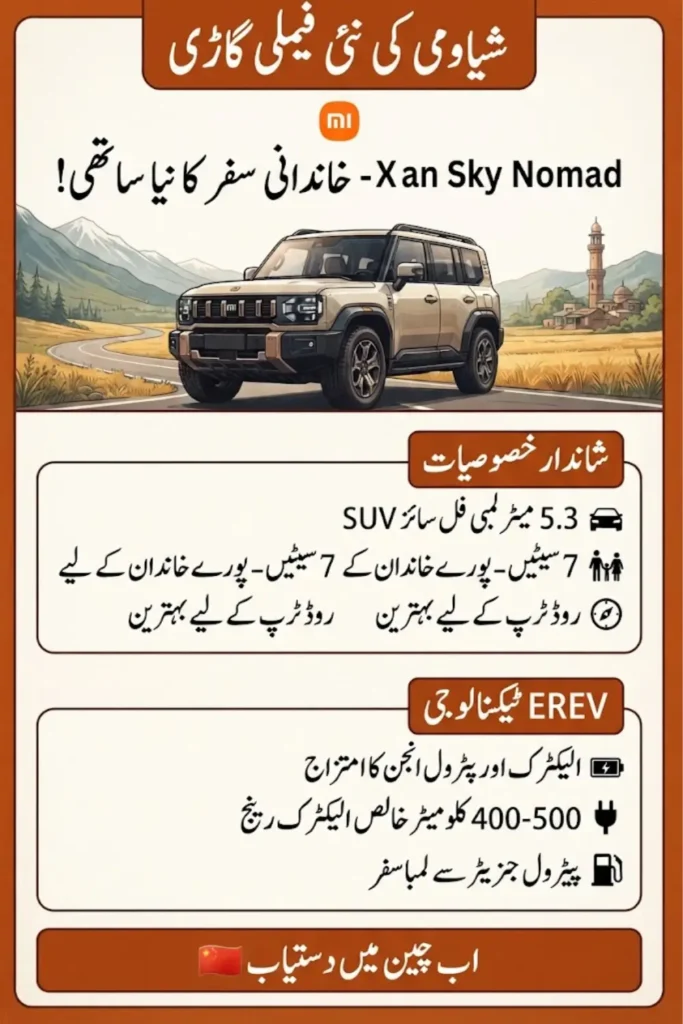
Xiaomi Sky Nomad is the name of the company’s newest automotive venture, officially confirmed on July 8, 2026, and it’s aimed squarely at families rather than speed junkies. Where the SU7 and YU7 lineup chases performance numbers, this one is built around space, comfort, and road-trip range.

In China, the venture goes by Xiaomi Pengcheng and the company has already plastered city billboards and a fresh WeChat account with the new branding. Honestly, the rollout has moved fast trademark filings, regulatory approval, and now a public name, all within about a year.

What Is Xiaomi Sky Nomad?

Sky Nomad is Xiaomi’s answer to a question a lot of EV buyers keep asking: what happens when the battery runs low on a long drive? Rather than building another pure battery-electric model, Xiaomi picked an EREV setup, pairing an electric drivetrain with a small gasoline engine that only generates power it never spins the wheels directly.

There’s actually some genuine ambiguity around what Sky Nomad even is, structurally. Early reports claimed it would be a fully separate sub-brand, dropping the Xiaomi logo entirely. But Xiaomi EV’s own official Weibo account has since described it as a new series from Xiaomi EV rather than a standalone brand. Founder and CEO Lei Jun added his own framing too, distinguishing the SU7/YU7 lineup as a driver-focused car line while positioning Sky Nomad as a large, flexible family SUV concept. So treat “brand vs. series” as still settling Xiaomi hasn’t nailed down the terminology publicly, and coverage has shifted on this point even within the past 24 hours.

What isn’t in dispute is the target buyer. This is a family-first, road-trip-first vehicle, built to compete with cars like the Li Auto L9 and the AITO M9 both established players in China’s EREV family SUV space.

Toyota Corolla Cross HEV Price Increase in Pakistan: What Changed and Why Complete Details

Xiaomi Sky Nomad New EREV Brand Debuts With N90 SUV

Why Xiaomi Chose the EREV Route

China’s EREV market has been quietly lucrative for a while now. Li Auto built its entire profitable business on the format years before most pure-EV startups managed to stop burning cash. For Xiaomi, adding a gas generator to an otherwise electric platform is less a retreat from EVs and more a calculated move into a segment where the money already is.

It also solves a real, practical problem: charging infrastructure isn’t evenly spread across China, especially outside major cities. An EREV lets drivers get near-EV smoothness around town, then switch to the generator for a cross-country trip without hunting for a charger. If you’ve ever planned a long drive around charging stops, you’ll get why that matters to a family buyer more than 0-60 numbers do.

The N90: Sky Nomad’s First Model

The first vehicle to wear the Sky Nomad name is the N90, internally codenamed Kunlun N3. It’s a genuinely large SUV over 5.3 meters long with a 3.1-meter wheelbase and it’s expected in both five-seat and seven-seat layouts, so buyers can pick extra cargo room or extra passenger seats depending on what their family actually needs.

Under the hood (or rather, under the floor), the N90 runs on a 1.5-liter turbocharged engine that works purely as a generator. It doesn’t touch the wheels. Instead, electric motors handle all the driving while the engine tops up the battery when needed. Xiaomi has reportedly picked Sunwoda and CALB as battery suppliers, split roughly 60/40 between the two companies.

Battery capacity is expected to sit above 70 kWh, giving somewhere between 400 and 500 km of electric-only range a figure that’s moved around slightly across early reports, so treat it as a solid estimate rather than a locked spec until Xiaomi confirms final numbers closer to launch. Total combined range, once you factor in the fuel tank, hasn’t been officially published yet, so any specific total-range figure floating around should be read as unconfirmed for now.

Design and Tech Highlights

Design-wise, the N90 breaks from the SU7 and YU7’s curvier look. Xiaomi’s own teaser posters show a boxier, more rugged silhouette — block-style headlights, a trapezoidal front intake, extra air vents, and a notably tall hood. Small details like electrically powered side steps are aimed squarely at comfort and ease of entry, not lap times.

A roof-mounted LiDAR sensor also makes an appearance, which points to more advanced driver-assistance features than what you’d find on a budget SUV. Lei Jun has talked about the interior being reconfigurable designed to change shape depending on what the people inside actually need it for, rather than sticking to one fixed layout. That’s a notably different pitch than “0-100 km/h in X seconds,” and it tells you exactly who Xiaomi is chasing with this one.

How Sky Nomad Compares to Xiaomi’s Existing Lineup

FeatureSU7 / SU7 UltraYU7 / YU7 GTSky Nomad (N90)
Body styleSedanCrossover SUVFull-size SUV
PowertrainBattery-electricBattery-electricEREV (electric + gas generator)
FocusPerformance drivingSporty crossoverFamily space and long-distance comfort
Seating555 or 7
Launch statusOn saleOn saleExpected H2 2026

Sky Nomad vs. Rival EREV Family SUVs

ModelMakerBody lengthPowertrainMarket position
Xiaomi N90Xiaomi (Sky Nomad)5.3 mEREVNew entrant, family-focused
Li L9Li Auto~5.2 mEREVEstablished family SUV leader
AITO M9Seres/Huawei~5.2 mEREVPremium family SUV

Xiaomi’s Bigger Automotive Push

None of this is happening in a vacuum. Xiaomi entered the car business in 2024 with the SU7 sedan and, somewhat improbably for a phone maker, grabbed real market share fast. It followed that with the performance-tuned SU7 Ultra and then the YU7 crossover, including a sportier YU7 GT trim.

The numbers back up the momentum. Xiaomi delivered 32,759 vehicles in China in May 2026 alone, and cumulative deliveries for the first half of 2026 reached 185,055 units. That puts the company at roughly 34% of its full-year target of 550,000 vehicles — a goal that’s about 34% higher than the roughly 410,000 units it delivered across all of 2025. Reaching that target will mean pushing monthly deliveries well past current levels in the second half of the year, and Sky Nomad is clearly meant to help carry that load.

Here’s a quick rundown of what’s driving Xiaomi’s EV expansion right now:

  • Regulatory clearance from China’s Ministry of Industry and Information Technology (MIIT) for EREV production, granted in June 2026
  • A dedicated WeChat account and city-wide billboard campaign for the Sky Nomad/Pengcheng branding
  • Trademark filings for “SkyNomad” and related Chinese names that predate the public announcement by many months
  • A stated 2026 delivery target of 550,000 vehicles across the whole lineup

What’s Still Unconfirmed

Not everything about Sky Nomad is locked down yet, and it’s worth being upfront about that instead of guessing:

  • Official pricing for the N90 hasn’t been announced; some industry chatter points to a range roughly between 200,000 and 450,000 yuan, but Xiaomi hasn’t confirmed this
  • The exact combined driving range (electric plus generator) isn’t officially published
  • Whether Sky Nomad ends up branded as a fully separate marque or stays badged as a Xiaomi EV series is still unresolved, even in Xiaomi’s own recent statements
  • A precise launch date beyond “second half of 2026” hasn’t been set.

Upcoming 23 EVs and Hybrid Cars in Pakistan 2026 Launch Dates and Model List

Conclusion

Xiaomi Sky Nomad marks a real shift in strategy for a company that built its car business on speed and battery-electric power alone. Betting on an EREV SUV, the N90, shows Xiaomi reading the room on where Chinese family buyers are actually spending money. Whether it launches as a distinct brand or simply a new series under Xiaomi EV, the N90 is shaping up as one of the more important vehicle launches of Xiaomi’s second half of 2026 and one worth watching if you’re cross-shopping family SUVs against Li Auto or AITO.

FAQs

What is Xiaomi Sky Nomad?

Xiaomi Sky Nomad is a new extended-range electric vehicle lineup from Xiaomi, officially confirmed on July 8, 2026. It’s known as Xiaomi Pengcheng in China and focuses on spacious, family-oriented SUVs rather than the performance-focused SU7 and YU7 models.

What is the first Sky Nomad model?

The first model is the N90, a full-size SUV codenamed Kunlun N3 internally. It measures over 5.3 meters long, comes in five- or seven-seat configurations, and uses a 1.5-liter engine purely as a generator for its electric motors.

Is the Xiaomi N90 fully electric?

No. The N90 is an extended-range electric vehicle (EREV), meaning it runs on electric motors but carries a small gasoline engine that generates electricity once the battery runs low. It’s expected to offer 400–500 km of pure electric range before the generator engages.

When will the Xiaomi N90 launch?

Xiaomi hasn’t set an exact launch date, but reports point to the second half of 2026. Full pricing and specifications are expected to be announced closer to that release window.

How much will the Xiaomi Sky Nomad N90 cost?

Xiaomi has not officially released pricing for the N90. Some industry sources suggest a range around 200,000 to 450,000 yuan (roughly $28,000–$63,000), but this figure remains unconfirmed until Xiaomi makes an official statement

Matric and Inter Punjab Board Result Dates 2026 and Supplementary Exams Explained

Toyota Corolla Cross HEV Price Increase in Pakistan: What Changed and Why Complete Details

Toyota Corolla Cross HEV Price Increase in Pakistan: What Changed and Why Complete Details

Toyota Corolla Cross HEV Price Increase

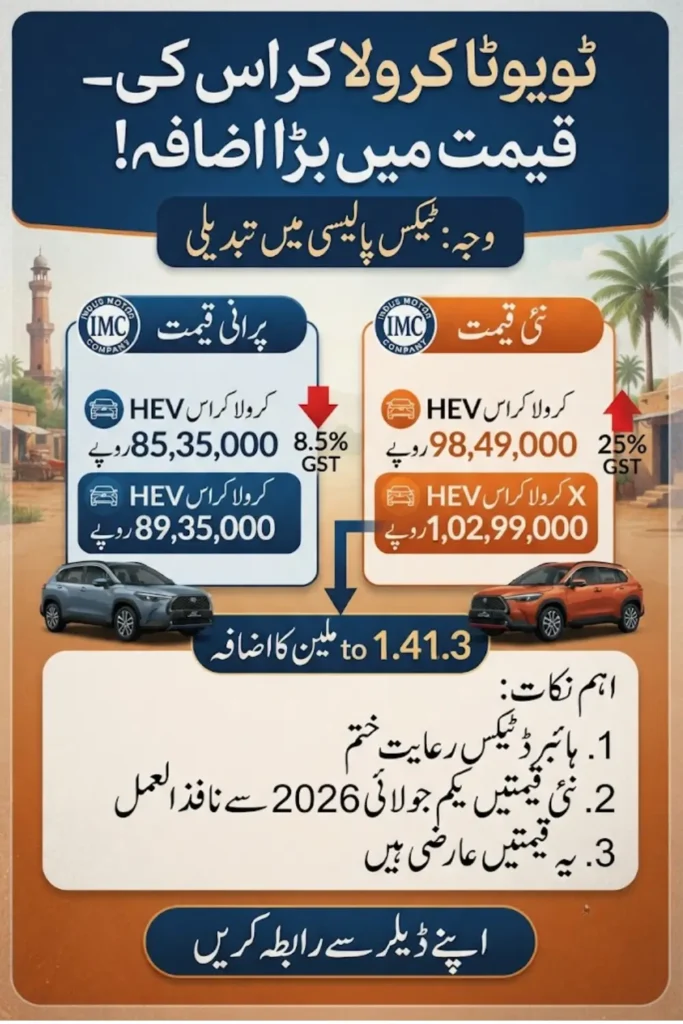
The Toyota Corolla Cross HEV price in Pakistan just went up by more than a million rupees, and hybrid car buyers are feeling the pinch. Indus Motor Company (IMC), the local maker of Toyota vehicles, revised its Retail Selling Prices (RSPs) for the Corolla Cross HEV lineup starting July 1, 2026.

The reason isn’t a redesign or new features. It comes down to tax policy. A sales tax concession that hybrid vehicles enjoyed for years has expired, and buyers are now footing a much bigger bill.

Why Did Toyota Corolla Cross HEV Prices Increase?

For the past few years, hybrid electric vehicles assembled in Pakistan got a break on General Sales Tax. This was meant to nudge buyers toward greener, more fuel-efficient cars at a time when fuel prices kept climbing. It worked too hybrids became one of the fastest-growing segments in the local auto market.

That concession expired on June 30, 2026, and no extension was announced before the deadline. Under the Federal Budget 2026–27, locally assembled Hybrid Electric Vehicles (HEVs) and Plug-in Hybrid Electric Vehicles (PHEVs) automatically reverted to the standard GST regime. Since Toyota didn’t get a fresh notification granting continued relief, the higher tax got passed straight on to the customer.

Changan UNI-S Price in Pakistan 2026 Expected Launch Date, Features, Engine & Specifications

Toyota Corolla Cross HEV Price Increase in Pakistan: What Changed and Why Complete Details

New Toyota Corolla Cross HEV Prices (Effective July 2026)

Only the hybrid variants of the Corolla Cross are affected by this revision. Petrol-only models are untouched, so if you were eyeing a standard Corolla Cross rather than the HEV, this price hike doesn’t apply to you.

Here’s how the numbers break down for both hybrid variants currently on sale in Pakistan.

VariantOld Price (PKR)New Price (PKR)Increase (PKR)
Corolla Cross HEV8,535,0009,849,0001,314,000
Corolla Cross HEV X8,935,00010,299,0001,364,000

That’s a jump of roughly 15% on both variants. For a buyer who had budgeted around Rs. 8.5 to 9 million, this kind of increase can genuinely change the affordability math and push some people back toward the petrol-only Corolla Cross or a smaller hybrid model instead.

What’s Included in the Quoted Price

IMC’s listed prices aren’t the full picture of what you’ll actually pay at delivery. It helps to know exactly what’s baked into the RSP and what gets added on top.

  • The quoted price is Ex-Factory Karachi and already includes Sales Tax, Federal Excise Duty (FED), Capital Value Tax (CVT), and the NEV Levy.
  • Transportation charges and transit insurance are billed separately, and these vary depending on where you’re taking delivery.
  • Advance Income Tax or Withholding Tax (WHT) is also charged separately, and the amount depends on whether you’re a tax filer or non-filer.
  • Non-filers typically pay a noticeably higher WHT rate, so it’s worth checking your filer status before finalizing a booking.

What Changed in the GST Rate for Hybrid Vehicles

The tax change itself is worth understanding, since it explains why the increase is roughly the same percentage across both variants. Before July 2026, hybrid vehicles benefited from a tiered, reduced GST structure based on engine size.

Once the concession lapsed, hybrids got folded into the same 25% GST bracket that applies to combustion-engine vehicles priced above Rs. 4 million or with an engine capacity of 1400cc and above. That’s a steep jump from what hybrid buyers were used to paying.

Engine CapacityPrevious GST RateCurrent GST Rate
Up to 1,800cc8.5%25%
1,801cc to 2,500cc12.75%25%

This isn’t a Toyota-specific change. Every locally assembled hybrid, regardless of brand, is now taxed under this same standard rate unless the government issues a fresh policy carving out an exception.

Booking and Delivery Conditions for Buyers

If you’re considering a Corolla Cross HEV right now, the terms around booking matter as much as the sticker price. IMC has been clear that the new pricing isn’t a one-time adjustment locked in for the rest of the year.

The revised prices apply to all new bookings made on or after July 1, 2026, and are subject to vehicle availability at the time of booking. Buyers who booked before that date under the old pricing structure should confirm directly with their dealership on how their existing order is being treated.

IMC has also flagged that these prices are provisional. The final price you pay at delivery could still shift if there are further changes to government taxes, duties, import rules, exchange rates, or other fiscal policies between now and when your unit is actually delivered. That’s a meaningful caveat, especially given how often Pakistan’s auto sector has seen mid-year tax revisions recently.

How This Affects the Wider Hybrid Car Market in Pakistan

Toyota isn’t alone here. The same GST reversal applies across the industry, and several other brands selling hybrid models in Pakistan are expected to follow with similar price hikes if they haven’t already.

Models from Honda, Hyundai, Kia, Haval, MG, Jaecoo, and GWM all fall under the same tax treatment, since the concession applied to hybrid vehicle categories generally rather than to any single manufacturer. Industry estimates suggest some hybrid models across these brands could see increases anywhere from roughly Rs. 1 million to over Rs. 2.5 million, depending on the model and its original price bracket.

That’s a lot of uncertainty hitting the market at once. Buyers comparing hybrid options right now should check each brand’s updated price list individually rather than assuming older comparisons still hold.

GWM Cannon Alpha Price in Pakistan 2026 Expected Launch Date, Specs and Features

What Happens Next for Hybrid Buyers

The bigger question is whether this tax change is permanent or just a gap before something new gets announced. The auto industry is currently watching the upcoming Automotive Industry Development and Export Policy (AIDEP) 2026–31 closely, since it’s expected to set the framework for how hybrids and EVs get taxed going forward.

Until that policy is finalized, there’s no official signal that hybrid tax relief is coming back anytime soon. If you’re planning a purchase, it makes sense to get written confirmation of the final on-road price from your dealer before committing, given how provisional the current numbers are.

Final Thoughts

The Toyota Corolla Cross HEV price in Pakistan has climbed by over a million rupees almost overnight, and it’s purely a tax story rather than anything to do with the car itself. With the GST concession gone and no clear replacement policy in sight, hybrid buyers are paying meaningfully more than they were just weeks ago. Anyone shopping for a Corolla Cross HEV should treat the current price as provisional and confirm final costs with their dealer before booking.

FAQs

Why did the Toyota Corolla Cross HEV price increase in Pakistan? The price went up because the government’s reduced GST rate for locally assembled hybrid vehicles expired on June 30, 2026. Hybrids now fall under the standard 25% GST bracket instead of the earlier 8.5% or 12.75% rates.

What is the new price of the Toyota Corolla Cross HEV in Pakistan? The Corolla Cross HEV now costs Rs. 9,849,000, and the HEV X variant costs Rs. 10,299,000. Both prices apply to bookings made on or after July 1, 2026.

Are petrol Corolla Cross models also more expensive now? No, this price revision applies only to the hybrid electric variants. Petrol-only Corolla Cross models remain at their previous prices.

Does the Corolla Cross HEV price include all taxes? The quoted Ex-Factory Karachi price includes Sales Tax, FED, CVT, and the NEV Levy. Transportation, transit insurance, and Withholding Tax are charged separately based on the buyer’s filer status.

Will Corolla Cross HEV prices change again? Yes, IMC has stated that current prices are provisional. Further changes to taxes, duties, import policies, or exchange rates could still affect the final delivery price.

Matric and Inter Punjab Board Result Dates 2026 and Supplementary Exams Explained

Honor 600e Smartphone Launch 2026 Full Specs, Price, Battery and Features Explained

Honor 600e Smartphone Launch 2026 Full Specs, Price, Battery and Features Explained

Honor 600e Smartphone Launch 2026

The Honor 600e Smartphone is the latest addition to the Honor 600 series, introduced as the most affordable variant in the lineup. It has been quietly listed on Honor’s official website in Peru, revealing its complete specifications, design details, and pricing information. The device focuses on delivering a balanced experience with a powerful battery, high-refresh display, and strong camera setup.

This smartphone is aimed at users who want premium features at a relatively lower price compared to the Honor 600 and Honor 600 Pro. With a Dimensity 7100 chipset, 108MP camera, and large 6,520mAh battery, the Honor 600e positions itself as a value-for-money mid-range smartphone in the global market.

Upcoming 23 EVs and Hybrid Cars in Pakistan 2026 Launch Dates and Model List

Honor 600e Smartphone Design and Display Overview

The Honor 600e Smartphone features a 6.6-inch AMOLED display with a 120Hz refresh rate. It supports a resolution of 2600 x 1200 pixels, offering sharp visuals and smooth scrolling for daily use, gaming, and multimedia consumption. The display is designed to provide a flagship-like viewing experience at a lower cost.

One of the standout features is its extremely high brightness level, reaching up to 6,500 nits peak brightness. It also supports 3840Hz PWM dimming, which helps reduce eye strain during long usage. The design remains similar to its higher-end siblings, making it look modern and premium.

Honor 600e Smartphone Launch 2026 Full Specs, Price, Battery and Features Explained

Key Display Highlights of Honor 600e Smartphone

  • 6.6-inch AMOLED display with Full HD+ resolution
  • 120Hz refresh rate for smooth performance
  • 6500 nits peak brightness with high visibility
  • 3840Hz PWM dimming for eye protection

Performance and Software of Honor 600e Smartphone

The Honor 600e Smartphone is powered by the MediaTek Dimensity 7100 chipset built on a 6nm process. It ensures efficient performance for multitasking, gaming, and everyday applications. The device comes with 8GB RAM and 512GB internal storage, which is a generous configuration for a mid-range smartphone.

On the software side, the device runs Android 16 with MagicOS 10. This combination provides a modern user interface, improved system optimization, and enhanced security features. However, official long-term software update support has not yet been confirmed by the company.

Table: Honor 600e Performance Specifications

ComponentSpecification
ChipsetMediaTek Dimensity 7100
CPUOcta-core architecture
GPUMali-G610 MC2
RAM8GB
Storage512GB
OSAndroid 16 with MagicOS 10

Camera Setup of Honor 600e Smartphone

The Honor 600e Smartphone features a dual rear camera setup designed for versatile photography. It includes a 108MP primary sensor with a wide aperture, allowing users to capture detailed and sharp images in different lighting conditions.

Along with the main camera, there is a 5MP ultrawide lens for wider shots. On the front, the device has a 16MP selfie camera, which is suitable for video calls and social media photography. The camera system focuses more on clarity and everyday usability rather than advanced professional features.

GWM Cannon Alpha Price in Pakistan 2026 Expected Launch Date, Specs and Features

Battery Life and Charging of Honor 600e Smartphone

One of the strongest features of the Honor 600e Smartphone is its massive 6,520mAh battery. This large battery capacity ensures extended usage for gaming, streaming, and daily tasks without frequent charging interruptions.

The device supports 45W fast wired charging along with 6W reverse wired charging. This means users can quickly recharge the phone and also use it to charge other devices in emergency situations.

Table: Honor 600e Battery and Charging Features

FeatureDetail
Battery Capacity6520mAh
Wired Charging45W Fast Charging
Reverse Charging6W Support
Battery TypeLi-Po

Connectivity and Extra Features of Honor 600e Smartphone

The Honor 600e Smartphone supports modern connectivity options, including 5G network compatibility. It also comes with an under-display optical fingerprint sensor, which improves security and provides a clean design experience.

Another important feature is its IP66 rating, which offers protection against dust and water splashes. The device also includes a customizable hardware button, adding extra convenience for users.

Changan UNI-S Price in Pakistan 2026 Expected Launch Date, Features, Engine & Specifications

Important Features of Honor 600e Smartphone

  • 5G network support for faster connectivity
  • IP66 dust and water resistance rating
  • Under-display fingerprint sensor
  • Customizable hardware shortcut button

The smartphone features a 120Hz AMOLED display, MediaTek Dimensity 7100 chipset, 108MP rear camera, and a 6,520mAh battery, making it one of the most feature-packed mid-range devices in the Honor 600 series.

Pricing and Availability of Honor 600e Smartphone

The Honor 600e Smartphone has been listed in Peru with a price of approximately $588 for the 8GB + 512GB variant. Currently, only one configuration is officially available, but additional variants may be launched in other markets.

The device comes in three color options including Velvet Gray, Desert Gold, and Vital Green. Global availability is expected to expand as Honor rolls out the 600e in more regions.

Final Words

The Honor 600e Smartphone offers a strong combination of performance, display quality, and battery life at a mid-range price point. It stands out with its high-resolution AMOLED display, large battery, and powerful chipset, making it suitable for users seeking balanced performance.

Overall, the Honor 600e strengthens the Honor 600 series by providing a more affordable option without compromising essential features. It is a practical choice for users who want premium-like specifications at a reasonable price.

FAQs

What is the display size of Honor 600e Smartphone?
It has a 6.6-inch AMOLED display.
It supports a 120Hz refresh rate.

Which processor is used in Honor 600e?
It is powered by the MediaTek Dimensity 7100 chipset.
It offers efficient mid-range performance.

What is the battery capacity of Honor 600e Smartphone?
It comes with a 6,520mAh battery.
It supports fast and reverse charging.

How many cameras does Honor 600e have?
It has a dual rear camera setup.
It includes a 108MP main sensor.

What is the price of Honor 600e Smartphone?
It is priced around $588 for the base variant.
Price may vary by region.

Which operating system does Honor 600e run?
It runs Android 16 with MagicOS 10.
It provides a modern user experience.

Official Government Helpline Numbers 2026 for Complaints, Education, Health, and Transport

Matric and Inter Punjab Board Result Dates 2026 and Supplementary Exams Explained

Matric and Inter Punjab Board Result Dates 2026 and Supplementary Exams Explained

Matric and Inter Punjab Board Result Dates

If you’re a student in Punjab waiting on your annual exam marks, the Punjab Board Result 2026 schedule has finally started taking shape. The nine boards under the Punjab Boards Committee of Chairmen, or PBCC, have circulated tentative dates for both Matric and Intermediate classes, and honestly, the wait has felt long for a lot of families this year.

None of this is locked in yet, though. What follows is a full breakdown of the proposed dates, how they compare with the Federal Board’s timeline, and what students should actually do while they wait.

Punjab Matric Result 2026

Nine boards fall under the PBCC umbrella Lahore, Gujranwala, Faisalabad, Multan, Rawalpindi, Sargodha, Sahiwal, Bahawalpur, and DG Khan. All of them typically announce Matric results on the same day and at the same time, which keeps things fair across the province rather than giving one district an early look.

For 2026, the Class 10 (Matric Part II, also called SSC-II) result is tentatively scheduled for August 6. Class 9 (Matric Part I, SSC-I) is expected roughly a month later, on September 2. Why the gap? Boards traditionally clear Class 10 first since those marks feed directly into intermediate admissions, and colleges need that data early to start their own enrollment cycles.

Pakistan Hajj Policy 2027-2030 Approved: One-Time Registration & Major Changes Explained

Matric and Inter Punjab Board Result Dates 2026 and Supplementary Exams Explained

Why Class 10 Results Come Before Class 9

Think about it from a logistics angle. Thousands of students need their Matric Part II result before they can even apply to FSc, ICS, or other intermediate programs. Delaying that would create a bottleneck across the whole admission calendar. Class 9 marks, by contrast, mostly matter for the student’s own record and don’t gate anything else so boards can afford to take a bit more time compiling them.

That said, don’t assume the sequence never changes. Some years have seen minor shifts depending on how quickly the marking and compilation process wraps up.

Punjab Matric Supplementary Exams 2026

Not every student clears their papers on the first attempt, and that’s exactly what supplementary exams exist for. Based on the current tentative plan, Punjab’s second annual (supplementary) Matric exams are set to begin on October 6, 2026.

Students who fail one or more subjects in the annual exams can register for these supplementary papers instead of losing an entire academic year. Here’s what generally applies to the process:

  • Admission forms for supplementary exams usually open within a couple of weeks of the annual result, with a standard fee window followed by a late-fee window.
  • Only the subjects a student failed need to be reattempted passed subjects aren’t repeated.
  • Supplementary result gazettes are typically released a few weeks to a couple of months after the exam, though Punjab boards haven’t issued an official date for the 2026 supplementary result yet.
  • Private candidates and repeaters generally follow the same registration process as regular students, just through a separate form category.

Since the fee schedules and exact supplementary result date haven’t been officially notified for 2026, students should check their specific board’s website rather than relying on last year’s timeline.

FBISE Matric Result 2026: What’s Different for Federal Board Students

Students under the Federal Board of Intermediate and Secondary Education, or FBISE, follow a completely separate calendar from Punjab. FBISE covers Islamabad, cantonment and garrison areas, Gilgit-Baltistan, Azad Kashmir, and overseas Pakistani schools — so if you’re enrolled through one of these, Punjab’s dates don’t apply to you at all.

FBISE’s SSC-I and SSC-II results were initially expected around mid-July 2026. That target has since slipped, and the board is now tentatively looking at the last week of July for announcing both Class 9 and Class 10 results together. FBISE has a habit of releasing both classes on the same day, unlike Punjab’s staggered approach.

Nothing here is official yet either. FBISE hasn’t issued a formal notification confirming the exact date or time, so students should keep an eye on the board’s own portal rather than trusting screenshots circulating on social media and yes, those fake “leaked result” posts do the rounds every single year.

Punjab Inter Result 2026: Class 11 and Class 12 Dates

Intermediate students face a longer wait than Matric students, partly because HSSc papers cover more subjects and partly because the marking process for practical-heavy groups like Pre-Medical and Pre-Engineering takes extra time.

Under the current tentative schedule, Class 12 (2nd Year, HSSC Part II) results are expected on September 23, 2026. Class 11 (1st Year, HSSC Part I) follows about a month later, on October 22, 2026. As with Matric, second-year results come out first since those marks matter most for university admissions.

How This Affects University Admission Timelines

Universities across Punjab, including big names students apply to for engineering, medical, and business programs, generally wait for HSSC Part II results before opening merit-based admissions. A late result can compress the admission window uncomfortably, so any further delay beyond September 23 would put real pressure on both students and universities.

If you’re planning to apply somewhere competitive, it’s worth tracking your board’s announcements closely rather than waiting for word of mouth. Universities won’t extend deadlines just because a board result got pushed back.

Punjab Intermediate Supplementary Exams 2026

Students who don’t clear their Intermediate papers on the first try get another shot through supplementary exams. These are currently set to begin on November 3, 2026, roughly two weeks after the Class 11 annual result.

The general process mirrors Matric supplementary exams students reattempt only failed subjects, submit fresh forms with a prescribed fee, and receive a separate result gazette later on. Punjab boards haven’t confirmed an exact supplementary result date for 2026 at this point, so don’t lock in any plans around an assumed date.

DAAD Helmut-Schmidt-Program 2026 Scholarships in Germany Fully Funded Guide

FBISE Inter Result 2026: HSSC-I and HSSC-II Timeline

FBISE’s Intermediate result timeline runs on its own track too. The board conducted HSSC first annual exams during May and June 2026, and marking is currently underway. According to the latest tentative update, both HSSC-I (Class 11) and HSSC-II (Class 12) results are expected during the last week of August 2026.

Unlike Punjab, FBISE hasn’t split its Class 11 and Class 12 dates apart both are tracked toward the same rough window for now. That could still change once the board finalizes its notification, so this is one to watch closely if you’re an FBISE student.

Punjab Board Result 2026: Complete Date Comparison

Here’s a side-by-side look at every tentative date mentioned so far, pulled together in one place for quick reference.

Exam / BoardClassTentative Result DateStatus
Punjab Boards (PBCC)Matric Part II (Class 10)August 6, 2026Unconfirmed
Punjab Boards (PBCC)Matric Part I (Class 9)September 2, 2026Unconfirmed
FBISESSC-I & SSC-II (Class 9 & 10)Last week of July 2026Unconfirmed
Punjab Boards (PBCC)Inter Part II (Class 12)September 23, 2026Unconfirmed
Punjab Boards (PBCC)Inter Part I (Class 11)October 22, 2026Unconfirmed
FBISEHSSC-I & HSSC-II (Class 11 & 12)Last week of August 2026Unconfirmed
Punjab Boards (PBCC)Matric Supplementary Exams BeginOctober 6, 2026Unconfirmed
Punjab Boards (PBCC)Inter Supplementary Exams BeginNovember 3, 2026Unconfirmed

All figures above come from media reports quoting board sources; none carry an official notification stamp as of this writing. Dates can shift by days or weeks, so recheck closer to the announcement window.

How to Check Your Punjab Board Result 2026 Once It’s Announced

Once a board actually confirms and releases the result, checking it is fairly straightforward. Most Punjab boards and FBISE offer more than one method, which helps when official sites slow down under heavy traffic on result day.

  • Official board website: search by roll number or by full name if you’ve misplaced your slip.
  • SMS service: send your roll number to your board’s designated short code (this varies by board, so confirm the code on the board’s site beforehand).
  • Result gazette PDF: usually uploaded an hour or so after the announcement, listing every student’s marks.
  • Board mobile app, where available, for a quicker mobile-friendly check.

Have your roll number ready ahead of time. It’s the fastest and most reliable way to pull up your result the moment it goes live, and honestly, scrambling to find your admit slip on result day is a stress nobody needs.

Punjab Board Result 2026: Final Word

The 2026 result season for Punjab boards is shaping up around a fairly predictable pattern Matric Part II in early August, Matric Part I in early September, and Intermediate results trailing through late September and October. FBISE students should expect their Matric marks toward the end of July and Inter marks by late August, though again, nothing here is locked in.

Given how often tentative dates shift by a week or two, your safest bet is bookmarking your specific board’s official website and checking it directly rather than relying on secondhand posts. That’s really the only way to know your Punjab Board Result 2026 date for certain once it’s confirmed.

Punjab Board Result 2026

Matric & Intermediate tentative result schedule

Tentative — Unconfirmed
Dates below are based on media reports quoting board sources. No board has issued a final, official notification yet. Always confirm on the official site before making plans.
Punjab Boards Aug 6, 2026

Matric Part II (Class 10)

Punjab Boards Sep 2, 2026

Matric Part I (Class 9)

FBISE Last week of Jul 2026

SSC-I & SSC-II (Class 9 & 10)

Punjab Boards Sep 23, 2026

Inter Part II (Class 12)

Punjab Boards Oct 22, 2026

Inter Part I (Class 11)

FBISE Last week of Aug 2026

HSSC-I & HSSC-II (Class 11 & 12)

Supplementary Oct 6, 2026

Matric supplementary exams begin

Supplementary Nov 3, 2026

Inter supplementary exams begin

FAQs

When will the Punjab Board Matric Result 2026 be announced? The Class 10 (Matric Part II) result is tentatively scheduled for August 6, 2026, with Class 9 (Matric Part I) expected on September 2, 2026. Neither date has received final confirmation from the Punjab boards yet.

What is the FBISE result date for 2026? FBISE’s Matric (SSC-I and SSC-II) results are tentatively expected in the last week of July 2026, while Intermediate (HSSC-I and HSSC-II) results are tentatively set for the last week of August 2026. Both timelines remain unofficial for now.

When will Punjab Intermediate Result 2026 for Class 12 be declared? Class 12 (2nd Year, HSSC Part II) results are tentatively scheduled for September 23, 2026. This is expected to be announced before the Class 11 result, since second-year marks matter most for university admissions.

How can I check my Punjab Board Result 2026 online? You can check it on your specific board’s official website using your roll number or name, through SMS to your board’s designated code, or via the downloadable result gazette PDF released shortly after the announcement.

When do Punjab Matric and Inter supplementary exams start in 2026? Matric supplementary exams are tentatively set to begin on October 6, 2026, while Intermediate supplementary exams are expected to start on November 3, 2026. Exact supplementary result dates haven’t been officially announced yet.

Changan UNI-S Price in Pakistan 2026 Expected Launch Date, Features, Engine & Specifications

OpenAI’s $50000 AI Bug Bounty Is Live Pakistanis Can Now Apply for This High-Paying Opportunity

OpenAI’s $50000 AI Bug Bounty

If you’ve ever dreamed of getting paid to “break” an AI model, OpenAI just made that dream a lot more valuable. The company behind ChatGPT has expanded its bug bounty efforts into a program that pays up to $50,000 to researchers who can find serious safety gaps in its newest models and yes, applicants from Pakistan are welcome to apply.

This isn’t your typical bug bounty where you poke around for coding errors. It’s focused on something far more sensitive: biological safety. OpenAI wants to know if its AI can be tricked into giving out dangerous biology-related information, and it’s paying serious money to find out before someone with bad intentions does.

What Is OpenAI’s Bug Bounty Program, Exactly?

OpenAI’s Bio Bounty Program is a private, invitation-only initiative built to stress-test the safety guardrails on its frontier AI models. Instead of hunting for software bugs like broken links or server errors, researchers are asked to find ways around the model’s biosafety protections the systems designed to stop the AI from sharing dangerous biological knowledge.

The program didn’t appear out of nowhere. It grew out of an earlier effort tied specifically to GPT-5.5, which launched in April 2026 with a top reward of $25,000. OpenAI has now turned that short-term project into a permanent, ongoing program that will keep expanding to cover future frontier models as they’re released. The goal is simple: catch dangerous weaknesses through controlled, expert testing rather than letting the public stumble onto them first.

Punjab Education Initiatives Management Authority Jobs with Salaries Up to Rs. 750,000

Why Biological Safety Specifically?

You might wonder why OpenAI is laser-focused on biology rather than general hacking or misinformation. The answer comes down to risk level. AI models that can explain complex science well enough to help with legitimate research could, in the wrong hands, also help someone cause real-world harm. That’s a risk OpenAI takes seriously enough to pay top dollar for finding it first.

Internal testing before GPT-5.5’s launch reportedly uncovered some model-level biosafety failures during expert red-teaming, even though the final safety systems caught and blocked the most serious attempts. That’s part of why OpenAI decided to keep this kind of testing going permanently instead of treating it as a one-time check before launch.

AI Safety · Bio Bounty Program

OpenAI Bio Bounty — Up to $50,000

Private, invitation-only research program testing biosafety protections on GPT‑5.6.

Applications Open
$50,000 Top reward
GPT-5.6 Current focus model
Rolling Application review
NDA Required if selected
Eligibility

Researchers based in Pakistan and other listed countries can apply.

Pakistan: Eligible
How to apply
  • Have an active ChatGPT accountRequired before submitting any application
  • Submit the online applicationName, country, affiliation, and relevant experience
  • Wait for a rolling reviewNo fixed deadline — OpenAI reviews on an ongoing basis
  • Sign the NDA if selectedRequired before receiving platform access
  • Start testing eligible modelsFollow the program’s defined testing rules
Model scope timeline
GPT-5.5
Scope closes July 27, 2026
GPT-5.6
Ongoing focus
Future models
Added over time
Apply on OpenAI’s official page → Previous GPT-5.5 applicants do not need to reapply.

How Much Can You Actually Earn?

The headline number is $50,000, and that’s exactly what OpenAI pays for what it calls a “universal jailbreak” a single, repeatable method that consistently defeats the model’s biosafety protections across a set of predefined test questions. This reward has doubled from the original $25,000 offered under the GPT-5.5 program.

Not every submission will hit that jackpot, though. OpenAI also offers smaller, discretionary payouts for partial findings submissions that reveal useful weaknesses but don’t fully qualify as a complete universal bypass. This tiered approach means researchers still have an incentive to report meaningful issues even if they haven’t cracked the full challenge.

Reward TypeAmountRequirement
Universal JailbreakUp to $50,000A single method that consistently bypasses biosafety protections across test scenarios
Partial FindingSmaller, discretionary amountUseful but incomplete bypass or insight
Previous GPT-5.5 Reward$25,000 (now doubled)Same jailbreak criteria, older model

Is Pakistan an Eligible Country?

Yes and this is the detail most people searching for this topic actually want confirmed. Pakistan appears on OpenAI’s official list of eligible countries for the program, meaning researchers based there can submit an application just like applicants from anywhere else on the list.

That said, eligibility to apply is not the same as guaranteed acceptance. OpenAI reviews every application and only invites a select group of researchers to move forward. So being from an eligible country like Pakistan gets your foot in the door, but the actual technical background and experience you bring will determine whether you’re accepted into the testing group.

Step-by-Step: How to Apply

Applying itself is a short process, but getting accepted depends heavily on your background and how well you present your experience. Here’s how the process generally works.

  • Have an active ChatGPT account this is required before you can even submit an application.
  • Fill out the online form with your full name, country, employer or affiliation, and a summary of relevant experience.
  • Wait for review OpenAI processes applications on a rolling basis, so there’s no fixed deadline to worry about.
  • Sign an NDA if selected, since testing details and findings are kept confidential.
  • Begin testing eligible models once you’re onboarded to the private testing platform.

What Happens After You Apply

Once you submit your application, there’s no fixed timeline for a response OpenAI reviews submissions continuously rather than in batches. If your background matches what they’re looking for, you’ll be contacted with next steps, which includes signing the NDA before you get any access to actual testing tools or models.

If you already applied under the older GPT-5.5 Bio Bug Bounty, good news: you don’t need to reapply. OpenAI has carried those applications forward into the new, expanded program automatically.

Social Media Tax in Pakistan 2026: 5% Withholding Tax on Digital Income Approved in Finance Bill

Who Should Consider Applying?

This program isn’t meant for casual hobbyists poking around ChatGPT for fun. OpenAI is specifically looking for people with real, demonstrable experience in relevant technical fields.

  • AI safety and red-teaming experience
  • Cybersecurity or general security research background
  • Machine learning or natural language processing (NLP) knowledge
  • Biosecurity or biological sciences expertise

Students and academics aren’t excluded either. If you’re studying a relevant field and can show genuine technical understanding, you’re encouraged to apply acceptance simply depends on how your profile matches what OpenAI needs for a given testing round.

GPT-5.5 vs GPT-5.6: What’s Changing

Timing matters here, especially if you’re planning to apply soon. The original GPT-5.5 testing window closes on July 27, 2026, after which the program shifts its full focus to GPT-5.6, OpenAI’s newer frontier model. Future models will be folded into the program as OpenAI releases them.

DetailGPT-5.5 ProgramGPT-5.6 Program
Launch DateApril 23, 2026July 2026
Max Reward$25,000 (later raised to $50,000)$50,000
Scope EndsJuly 27, 2026Ongoing
Reapplication NeededN/ANo, for existing applicants

A Word of Caution

It’s worth being realistic about what this program is and isn’t. It’s not a general-purpose bug bounty where you can report any AI mistake or awkward response and expect a payout. OpenAI has been clear that ordinary jailbreaks, content complaints, or routine model quirks fall outside the scope of this reward. The bar is specifically a universal, repeatable bypass of biosafety protections a high technical threshold that only serious, experienced researchers are likely to meet.

Also, because participants sign an NDA, you won’t be able to publicly share your findings, methods, or even much detail about your participation. If you’re someone who enjoys publishing security research openly, that’s an important trade-off to weigh before applying.

Conclusion

OpenAI’s expanded Bio Bounty Program is a serious opportunity for skilled researchers, including those based in Pakistan, to get paid well for helping make advanced AI models safer. With rewards now reaching $50,000 and the application process open on a rolling basis, there’s no urgent deadline pressure but the technical bar for actually earning the top reward is high. If you have real experience in AI safety, security research, or biosecurity, it’s worth putting together a strong application and seeing where it leads.

Frequently Asked Questions

Can Pakistanis apply for OpenAI’s Bug Bounty Program?
Yes, Pakistan is listed as an eligible country on OpenAI’s official application page. However, selection still depends on OpenAI’s internal review process.

How much money can I actually earn?
The top reward is $50,000 for a full universal jailbreak, with smaller discretionary payouts available for partial findings.

Do I need a ChatGPT account to apply?
Yes, an active ChatGPT account is a basic requirement before submitting your application.

Is this program open to students?
Yes, students with relevant technical or research experience can apply, though acceptance still depends on OpenAI’s evaluation of their background.

What exactly is a “universal jailbreak”?
It’s a single, repeatable method or prompt that consistently bypasses the model’s biosafety protections across OpenAI’s predefined test questions.

BlackBerry QNX Expansion: Growth in Automotive, Robotics, Industrial Automation and Medical AI