
Maryam Nawaz Ration Card Programme Expanded
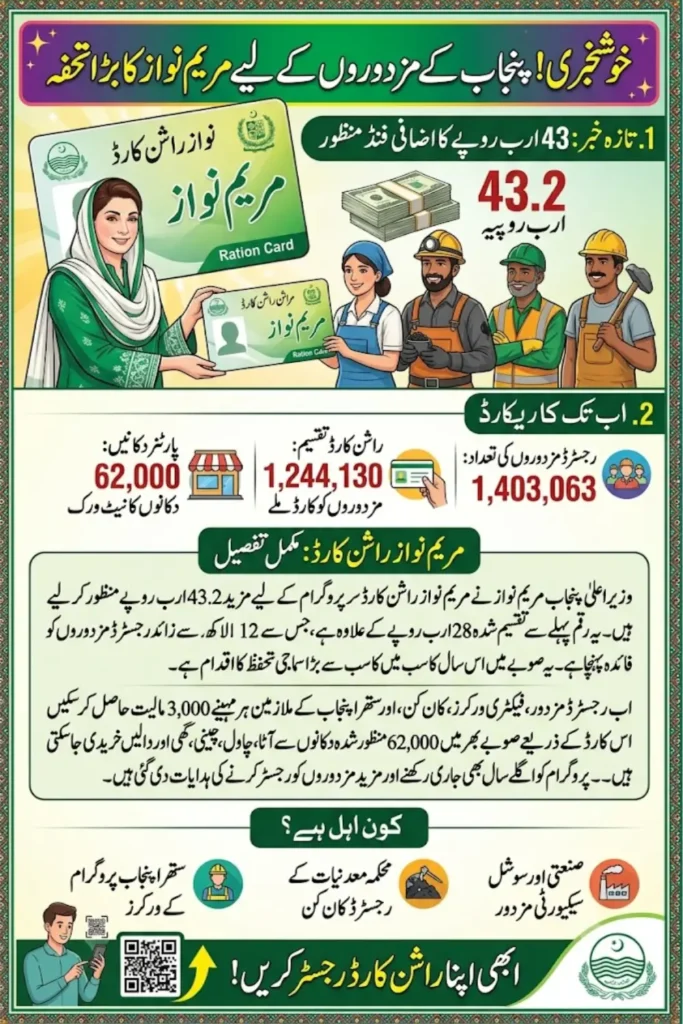
If you live in Punjab and work as a labourer, a factory hand, a miner, or in any registered low-income job, there’s fresh news that directly affects your monthly budget. Chief Minister Maryam Nawaz Sharif has approved an additional Rs43.2 billion for the Maryam Nawaz Ration Card programme, on top of the Rs28 billion already handed out to over 1.2 million registered workers. This isn’t a small top-up it’s one of the biggest social protection moves in the province this year.
For families who depend on this monthly support to buy flour, rice, sugar, ghee, and pulses, this announcement matters a lot. In this article, we’ll break down what the new funding means, how the scheme currently works, who’s eligible, and what changes are coming for the 2026-27 financial year.
Maryam Nawaz Ration Card
Programme dashboard — funding, reach & distribution
1,244,130 of 1,403,063 registered workers have received their card. Remaining cards are in print.
Source: Official Government Statement, July 2026
What Did the Punjab CM Actually Announce?
On Monday, an official government statement confirmed that CM Maryam Nawaz had approved an extra Rs43.2 billion for the ration card scheme during a review meeting on the programme. This comes after the province had already disbursed Rs28 billion to 1.2 million registered workers through the scheme. The new funding is meant to cover the growing number of registrations and keep monthly payments flowing without interruption.
This is not the first expansion the scheme has seen. It started small in 2025 and has been scaled up multiple times as more workers signed up and the government tested how well the disbursement system was working. The latest boost suggests Punjab's government sees this as a long-term commitment rather than a one-time relief package, especially since the CM has now also approved the programme for the next financial year.
Cross Subsidy Program Online Registration 2026: How to Apply, Eligibility & Official Portal
How Many Workers Are Currently Registered?
According to the official statement, the number of registered workers in Punjab has reached a record 1,403,063. Out of this total, 1,244,130 registered workers have already received their Maryam Nawaz Ration Cards, while printing of another 4,984 cards is under way.
That's a huge jump from where the programme started. Back in April 2025, the scheme launched with a target of covering around 1.25 million working families, and it has since crossed that mark comfortably. The gap between registered workers and those who've physically received their cards is fairly small in percentage terms, which shows the printing and distribution process is moving at a reasonable pace, even as new applications keep coming in.
How Does the Ration Card Scheme Work?
The mechanics of the programme are fairly simple, which is part of why it has managed to reach so many people quickly. Registered workers get a set amount of monthly support that they can use to buy essential kitchen items at approved shops.
Here's a quick breakdown of how the benefit is delivered:
- Workers get essential commodities worth Rs3,000 per month through the card
- This support is available at 62,000 shops across the province
- The card is linked to a bank partnership, so the amount loads digitally each month
- Items typically covered include flour, rice, sugar, ghee, and pulses
- No cash is withdrawn directly the card is used like a debit card at approved outlets
This shop-based model was chosen over straight cash transfers because it lets the government track usage and reduces the chances of the money being spent on anything other than food essentials. It also means workers don't need to travel far, since 62,000 outlets is a large network spread across cities and rural areas alike.
Who Is Eligible for the Ration Card?
Eligibility has broadened since the scheme first launched. Initially, it focused on industrial and social security registered workers, but it now covers a wider set of labour categories.
Groups currently benefiting from the programme include:
- Registered social security workers across various industries
- Mine workers registered under the Mines & Minerals Department
- Workers linked with the Suthra Punjab cleanliness programme, with more than 100,000 workers from this group now included
- Factory and industrial labourers who fall under Punjab's labour welfare umbrella
If you're not sure whether you qualify, the safest step is to check with your employer's labour registration status or visit the nearest Punjab Labour Department office, since registration is usually tied to formal employment records.
Programme Growth: A Quick Comparison
To understand how fast this scheme has expanded, it helps to look at the numbers side by side.
| Milestone | Approximate Date | Key Figures |
|---|---|---|
| Initial launch | April 2025 | Rs40 billion budget, target of 1.25 million families |
| Expanded package | April 2025 (later) | Rs84 billion total package including hospitals and welfare projects |
| Mid-year update | October 2025 | Over 1.37 million workers receiving monthly benefits |
| Latest update | July 2026 | Rs28 billion already disbursed, Rs43.2 billion newly approved |
The pattern here is clear: the government keeps adding funds as registration numbers climb, rather than setting a fixed budget and closing the scheme once it's used up. That approach has helped the programme stay open to new applicants instead of turning people away.
What's New for the 2026-27 Financial Year?
Beyond just adding money to the current budget, the CM also approved the ration card programme to continue into the 2026-27 financial year. This is an important detail because it confirms the scheme isn't ending soon it's being treated as an ongoing welfare commitment rather than a temporary relief effort tied to one budget cycle.
During the same meeting, Maryam Nawaz directed officials to keep increasing the number of registered workers, signaling that the government wants to bring in more eligible families rather than cap the programme at its current size. She also reiterated that protecting the financial well-being of labourers remains her personal responsibility, a message that has been repeated at almost every public event connected to this scheme since it launched.
Pakistan National Champions Cup Schedule 2026, Teams, and Match Fixtures Revealed
Benefits and Concerns Around the Scheme
Like most large welfare programmes, this one has clear strengths but also some practical challenges worth understanding.
| Aspect | Details |
|---|---|
| Reach | Over 1.4 million workers registered, spread across all districts |
| Monthly value | Rs3,000 per worker for essential groceries |
| Distribution network | 62,000 partner shops across Punjab |
| Main challenge | Keeping registration and card printing in sync as numbers grow |
| Sustainability question | Requires repeated budget top-ups as more workers join |
The biggest strength is scale few provincial welfare schemes in Pakistan have reached over a million beneficiaries this quickly. The main concern, which independent observers have pointed out about similar schemes, is long-term funding. Since the programme depends on repeated budget approvals rather than a fixed endowment, its future scale will depend on how much the provincial government can keep allocating each year.
Conclusion
The Rs43.2 billion top-up to the Maryam Nawaz Ration Card programme shows Punjab's government is treating worker welfare as a continuing priority, not a one-off announcement. With over 1.4 million workers now registered and the scheme extended into the next financial year, it's clear the province plans to keep expanding coverage rather than scaling back. For workers and their families, the practical takeaway is simple: if you're eligible and not yet registered, it's worth checking your status soon, since the government has signaled it wants more people added to the list.
Frequently Asked Questions
1. What is the Maryam Nawaz Ration Card programme? It's a Punjab government welfare scheme that gives registered workers Rs3,000 worth of monthly groceries through a bank-linked card, usable at thousands of partner shops.
2. How much has the government added recently? The CM approved an additional Rs43.2 billion on top of the Rs28 billion already disbursed to 1.2 million workers.
3. Who is eligible for the ration card? Registered social security workers, mine workers, Suthra Punjab staff, and other formally registered labourers across Punjab can qualify.
4. Where can cardholders use their ration card? Cardholders can use it at around 62,000 approved shops across the province to buy essential kitchen items.
5. Will the programme continue next year? Yes, the CM has already approved the scheme for the 2026-27 financial year, and officials have been told to register even more workers.
Hyundai Elantra Unveiled 2026 With New Design, Bigger Cabin and Advanced Technology